3I/ATLAS is an interstellar comet discovered on July 1, 2025. It has already passed the closest-to-the-Sun part of its journey and is receding from the inner Solar System. In 2026, the main news concerns the analysis of observations: researchers are examining its composition and the conditions in which its material formed. There is no confirmation that the object is an alien spacecraft.
- The closest approach to Earth occurred on December 19, 2025, at a distance of about 270 million kilometres.
- Its motion establishes its interstellar origin; its parent star is unknown.
- SETI radio observations found no evidence of an artificial transmitter in the frequency range studied.
- Research reported in September 2026 points to formation in a very cold environment.
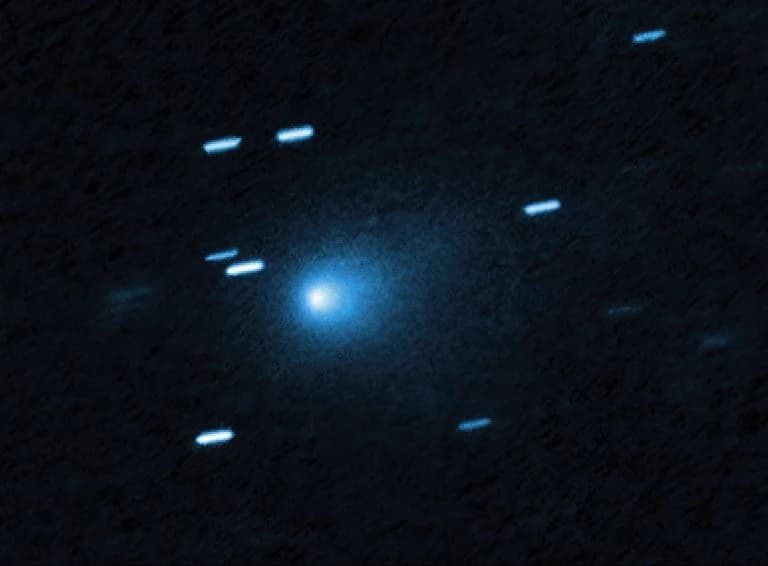
What is 3I/ATLAS, and how do you read its name?
In the designation 3I/ATLAS, I stands for interstellar and 3 identifies the third confirmed discovery in this class. ATLAS is the survey programme whose telescope in Chile found the comet. The spelling “31 ATLAS”, with two numerals, comes from the resemblance between a capital I and the number one. In the scientific name, the character following the three is a letter.
The comet also has another designation: C/2025 N1 (ATLAS). This is the same object named under the comet catalogue’s rules. Two designations do not mean that two different “Atlas comets” are approaching Earth at the same time. Moreover, ATLAS appears in the names of many objects discovered by this survey. To find a specific object, keep the full designation rather than only the last word.
Why scientists consider the comet interstellar
The main evidence is its trajectory. A familiar periodic comet follows a closed path around the Sun and returns after its long journey. The motion of 3I/ATLAS instead corresponds to a hyperbolic flyby. It arrived from outside with sufficient speed that solar gravity changes its direction without retaining it on a permanent orbit. After the encounter, the object continues moving away.
This conclusion does not come from one photograph of a tail. Astronomers compare positions measured at different times and calculate the motion. A February 2026 statement from the International Astronomical Union refers to more than four thousand observations submitted to the Minor Planet Center. These allow the orbit to be checked independently of how dramatic a particular image looks. An interstellar origin does not mean arrival from another galaxy: it describes material formed beyond our planetary system.
Where is 3I/ATLAS now, and will it return?
As of October 24, 2026, 3I/ATLAS is on the outgoing part of its trajectory. Its closest passage to the Sun took place in late October 2025, followed by its closest approach to Earth in December of that year. A report saying that the comet “will approach Earth on December 19” without specifying the year is therefore misleading: it describes an event that has already happened.
An exact distance “right now” requires a calculation for a specific instant. The distance changes continuously, as does its direction in the sky. Ephemerides such as JPL Horizons provide this information after selecting the object, time and observing location. A figure in an old article does not become current when it is republished. Nor is there one instant at which the comet “leaves the Solar System” without defining the boundary: planetary orbits, the heliosphere and the region of gravitational influence are different scales.
Is the comet dangerous to Earth?
Its minimum distance from our planet was approximately 1.8 astronomical units, or around 270 million kilometres, on December 19, 2025. An astronomical unit is close to the average Earth–Sun distance. Even at its closest approach, the comet remained so far away that suggestions of an Earth impact did not match its calculated trajectory.
“Passed inside Mars’s orbit” describes distance from the Sun rather than an encounter with Earth. The planets do not wait in a straight line for a passing object. A collision requires two bodies to occupy the same place at the same time. That is why an orbit determines the risk assessment, rather than emotional comparisons between a comet’s size and a city or its speed and an aircraft.
What does the comet look like, and why is its size hard to measure?
A photograph usually shows mainly the coma, a cloud of gas and dust surrounding the solid nucleus. It reflects and emits light, concealing the smaller body inside. Measuring the whole bright patch and calling it the nucleus diameter would give the wrong result. It is rather like estimating a lamp’s size from the width of its halo in fog: the glow depends on more than the source itself.
NASA’s overview gives an estimate based on Hubble observations from August 2025: a nucleus diameter between 440 metres and 5.6 kilometres. That is a broad range tied to a set of measurements, not an exact size established forever. New observations and models can refine it. Knowing what was measured and when is more useful than remembering one dramatic number without an uncertainty range. A detailed illustration of icy cliffs should not be mistaken for a surface photograph either.
Where do the tails, colours and changes in motion come from?
As cometary ice heats up, it turns into gas and carries dust particles with it. This material forms the coma and tails. Dust responds to sunlight’s pressure, while charged particles respond to the solar wind and magnetic field. A tail therefore need not follow the comet’s direction of travel like an aircraft contrail. Its appearance also depends on the observer’s position.
Photographic colour depends on the material’s composition, camera sensitivity, filters and processing. Comparing two images is meaningful only with that context. Small changes in motion do not require an artificial engine either: gas escaping from the surface can provide a reaction force. NASA describes the observed perturbations of 3I/ATLAS as consistent with ordinary cometary activity. An unusual colour, gas jet or complex tail shape alone does not establish that an object is a spacecraft.
What did the search for an alien spacecraft reveal?
On June 3, 2026, the SETI Institute reported results from a search for technological radio signals from 3I/ATLAS. Observations using the Allen Telescope Array covered frequencies from 1 to 9 GHz and totalled more than seven hours. After examining candidate detections, researchers found no evidence of extraterrestrial technology: the selected signals were explained by human-made interference.
That result has a specific scope. It applies to the equipment’s sensitivity, the chosen frequencies and the observation times. It does not test every imaginable device across all bands. Equally, an absent signal cannot become evidence that a spacecraft is hiding. A hypothesis needs testable predictions. For 3I/ATLAS, the observed cometary activity and radio-search results provide no grounds for declaring the object artificial.
What new clues about its origin emerged in 2026?
In September 2026, a team including Northumbria University presented research into charged particles in the tail of 3I/ATLAS. The observations used the WEAVE spectrograph on the William Herschel Telescope. Analysis of the nitrogen-to-carbon-monoxide ratio indicated very cold formation conditions, probably below −240 °C and far from the parent star.
This reconstructs the conditions in which the material formed; it does not give the comet’s temperature on publication day. Researchers read the chemistry as evidence of the past because different substances remain trapped in ice under different conditions. The result helps compare another planetary system with ours, but it does not identify a particular star or provide an exact birth date for the nucleus. Claims about the “oldest comet” should be read alongside the age-estimation method and its uncertainty range.
Why did spacecraft near other planets observe the comet?
Observing from space offers another perspective. Spacecraft near Mars and Juice, which is travelling to Jupiter, occupied different positions relative to the comet than telescopes on Earth. This made it possible to study the object from several directions and complement the ground-based campaign. Those spacecraft did not thereby become expeditions to the nucleus: they observed a passing object from a distance.
ESA explains that Juice observed the comet in November 2025, while the main body of those data arrived on Earth in February 2026. An image’s publication date can therefore differ substantially from its acquisition date. Delayed reception and processing explain why new results appear after the principal flyby. Scientific work continues with the observation archive and does not require the comet to remain nearby.
Can you observe 3I/ATLAS yourself?
Finding a faint comet requires more than the name of a constellation. You need its calculated position for the selected time, its brightness, sufficient altitude above the horizon and suitable equipment. Instructions for late 2025 or early 2026 refer to a specific observing window. They cannot simply be transferred to October 2026 without a new calculation: the object has moved away, and visibility has changed.
Start with a current ephemeris and compare the expected brightness with your instrument’s capabilities. If the target is inaccessible, scientific images and a trajectory model will offer more than a random binocular search. A sky map helps identify stellar reference points, but displaying constellations does not mean that a service calculates every comet’s current orbit. “Point your phone and see 3I/ATLAS” deserves the same scrutiny as any other observing advice.
Why interest in 3I/ATLAS continued after the flyby
Almost all the material we study in detail nearby is associated with the Solar System’s history. An interstellar comet brings material formed in a different environment. Comparing its chemistry, activity and dust helps reveal how typical conditions around the young Sun were. One such object cannot represent every planetary system, but it supplies a rare independent point of comparison.
This is where a sensation becomes a substantive scientific discovery. The date of closest approach soon becomes old news, while good-quality spectra can remain useful for testing models for a long time. The story of 3I/ATLAS concerns more than “where is it today?” It also concerns the evidence preserved about material that will not return to our telescopes along a closed solar orbit.
Sources
- NASA — 3I/ATLAS Facts and FAQs
- ESA — Comet 3I/ATLAS frequently asked questions
- NASA — Comet 3I/ATLAS observation timeline
- IAU — scientific evidence and countering misinformation about 3I/ATLAS, February 23, 2026
- SETI Institute — technosignature search results, June 3, 2026
- Northumbria University — ion-tail research, September 8, 2026
- NASA — Comet Facts
- NASA/JPL — Horizons ephemeris service
- NASA — Comets, research and overviews
Questions and answers
Is 3I/ATLAS an asteroid or a comet?
It is a comet: activity and a gas-and-dust coma have been observed. “Asteroid 3I/ATLAS” appears in searches but does not match the accepted classification.
When will 3I/ATLAS approach Earth?
The closest passage already occurred on December 19, 2025, at about 270 million kilometres from Earth. It is not an upcoming event in December 2026.
Did the comet come from another galaxy?
Its origin beyond the Solar System is established. This is not equivalent to an origin in another galaxy; a specific parent star has not been identified.
Is it true that a signal was received from it?
Radio emission from matter and a signal from an artificial transmitter are different phenomena. The SETI study published in June 2026 found no evidence of extraterrestrial technology.
Can a photograph show the surface of 3I/ATLAS?
Distinguish the nucleus, its surrounding cloud and an artist’s visualisation. A detailed picture of an icy landscape is not, by itself, a photograph of the surface.
Where should you check the latest 3I/ATLAS news?
Use NASA and ESA pages, scientific organisations’ announcements and the research papers themselves. Check two dates: when the observation was made and when its result was published.