The star that makes life possible
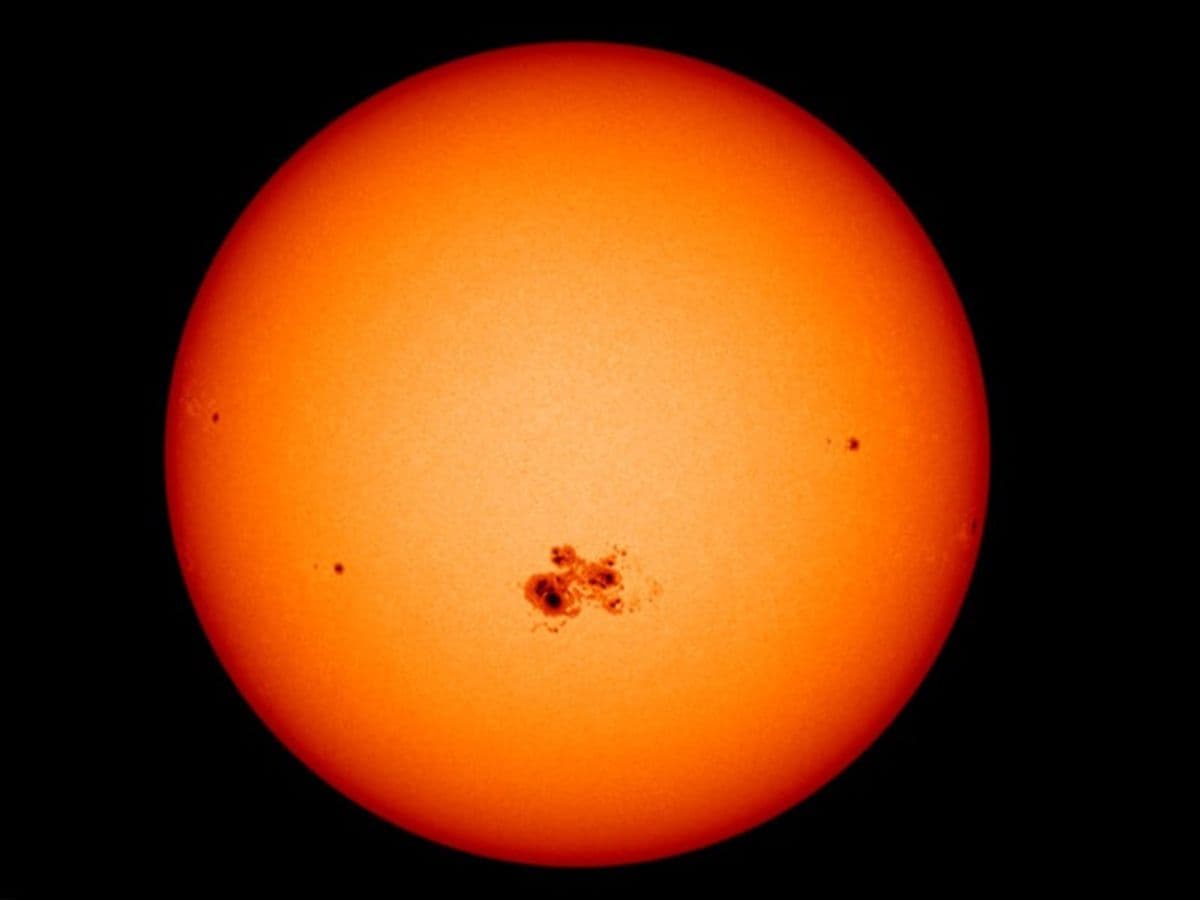
The Sun is a star, not a planet. Its gravity governs the motion of most bodies in our system, while its light powers Earth's climate and ecosystems. Sunspots and convection patterns change on its visible disk; the outer atmosphere extends far beyond it.
Sun: key facts
- Type
- Star
- Mean radius
- 695,700 km
- Mean distance from the Sun
- Center of the planetary system
- Orbital period
- Not applicable
- Rotation
- ≈ 25 days · equator
- Temperature
- ≈ 5,500 °C · photosphere
- Mass
- 1,9884 × 10³⁰ kg
- Mean density
- 1 408 kg/m³
Values are rounded. The distance describes the orbit, not the current distance from Earth. For giant planets, temperature refers to a reference atmospheric level: they have no solid ground. Mean radius differs from equatorial radius.
Atmosphere and appearance
Above the photosphere lie the chromosphere and corona. The corona's plasma reaches millions of degrees and produces the solar wind.
Sunspots
Cooler areas of the photosphere associated with strong magnetic fields.
Granulation
The bubbling pattern of convection: hot plasma rises and cools.
Prominences
Streams of plasma held above the surface by magnetic fields.
What is inside?
Scientific model. Layer colors are illustrative; the thin crust is enlarged for clarity.
Photosphere
The visible layer from which most sunlight escapes.
Convection zone
Hot plasma carries energy upward through convection.
Radiative zone
Energy travels through the repeated absorption and emission of photons.
Core
Around 15 million °C. Nuclear fusion reactions take place here.
The cutaway is based on physical models and indirect measurements. It is not a photograph of the interior; in 3D, you can select each layer separately.
The Sun's place in the system
There are no moons in the usual planetary sense. Planets orbit the Sun, while natural satellites orbit their planets or small bodies.
History of discovery and exploration
Observed since ancient times
Our star has no single discoverer. People followed eclipses for millennia; telescopes, spectroscopy and spacecraft gradually revealed its physics.
- 1611–1613
Sunspots and rotation
The movement of sunspots showed that the Sun rotates. Galileo explained them as features of the star itself.
- 1843
The rhythm of activity
Heinrich Schwabe discovered the sunspot cycle. Its average duration was later refined to about 11 years.
- 1908
A magnetic star
George Ellery Hale discovered magnetic fields in sunspots.
- 1995–2010
Observatories in space
SOHO, TRACE and SDO opened new ways to observe the solar atmosphere and its changes.
- 2021
Inside the corona
Parker Solar Probe passed through the solar corona for the first time, directly measuring its particles and magnetic field.
- December 24, 2024
A record close approach
Parker Solar Probe passed about 6.1 million km above the Sun's surface, a historic close encounter with our star.
SOHO and SDO observe the Sun; Parker Solar Probe explores its outer atmosphere.
How to read images of the Sun
Check the observed wavelength before comparing solar images. A visible-light photosphere image and an ultraviolet view of the hot atmosphere show different physical conditions. A dark area in one need not correspond to a sunspot in another. Assigned orange or red colours help distinguish features in measured radiation; they do not mean an observer would see precisely that disk through ordinary glass.
To examine changes, select a sequence with matching scale, filter and clearly recorded observing times. Identify a persistent group of features before assessing its displacement or development. A contrast adjustment can make a faint structure prominent without producing a new flare. Instrument labels and dates are therefore part of the observation itself, not secondary decorations beneath an attractive illustration.
Why solar plasma forms arches
Plasma contains charged particles and interacts with magnetic fields. This helps explain the complex arches above the solar limb, unlike freely rising flames over burning wood. Viewing direction also matters: a prominence at the limb and a dark filament against the disk can show similar phenomena from different angles. Relate appearance to geometry before assuming each shape represents a separate kind of object.
Solar flares and coronal mass ejections relate to activity but are not interchangeable terms. One describes a sudden release of energy and radiation; the other ejects a large cloud of magnetised material. Not every striking event is directed towards Earth, and its effects depend on its properties and direction. A single dramatic frame cannot reliably promise an aurora over a particular city that night.
Investigating the interior without reaching the core
A solar cutaway relies on physical models and observations, not a photograph of an exposed core. Helioseismology is one approach: oscillations in visible layers carry information about waves travelling inside the star. As in studies of Earth, researchers use a system’s response to test its internal structure. This is an indirect method with limitations, but offers far more than an unrestricted guess about an inaccessible region.
Different measurements test different aspects of a model: light probes emitting layers, oscillations constrain interior dynamics, and spacecraft study particles and fields. Agreement between independent constraints strengthens the overall description. In an interactive cutaway, region sizes and colours aid explanation; they are not photographic boundaries or claims that material properties change abruptly along every illustrated circle.
Observing the disk and using image archives
Looking at the Sun through binoculars or a telescope without a suitable, undamaged solar filter can injure eyesight; ordinary sunglasses are inadequate. Solar-observatory images offer a safer introduction. Choose one date, compare the full disk with an active region, then examine an adjacent date. This route helps separate persistent characteristics of the imaging method from genuine changes on the star.
Read image times together with the archive’s time convention: a current frame does not necessarily correspond to your local morning. To follow a sunspot group, mark its position relative to the limb and disk centre across several dates. Do not measure a speed directly from pixels in differently sized pictures. First align their scales and check that orientation and observing channel have not changed.
Questions and answers
What is the Sun's temperature?
The photosphere is about 5,500 °C and the core about 15 million degrees. The tenuous corona reaches millions of degrees. A temperature should therefore always be given with the name of its layer.
Why does the Sun not look orange in every observation?
Its appearance depends on the filter, processing and Earth's atmosphere. Many vivid orange space images show radiation in specific wavelength bands and use a false-color palette.
Can you land on the Sun?
There is no solid ground to land on. COSMO360's flight above the photosphere is a visual model, not somewhere a person could walk.
Continue exploring
The model offers a cutaway, rotation, images and a flight through a reconstructed environment. You can read the information on this page without loading 3D.
Open in the journeyAll planets and the Sun