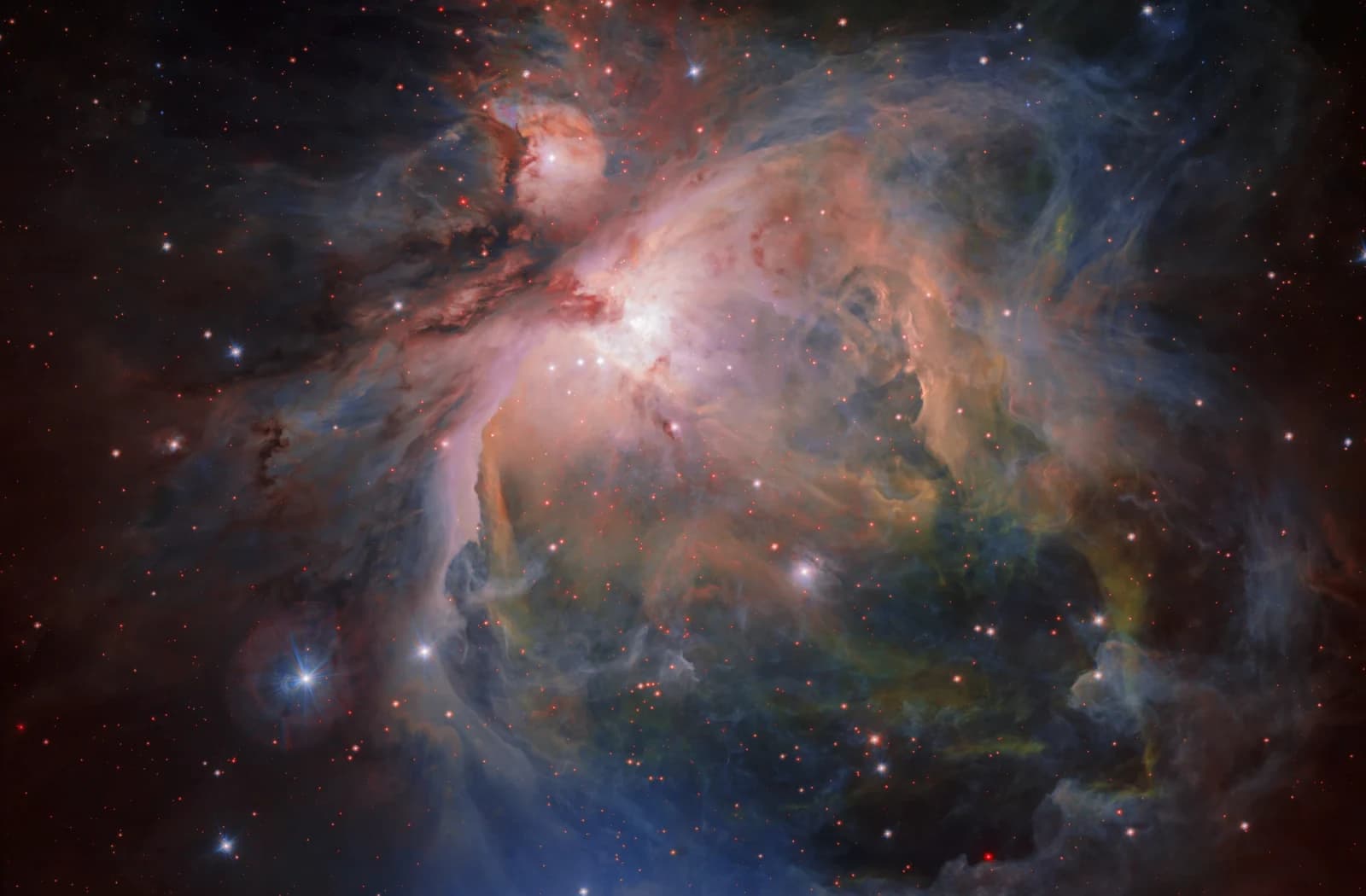
How a star is born
In a cold molecular cloud, gravity can gather gas and dust into a dense region. As it contracts, the center heats up and a protostar forms. When conditions allow sustained hydrogen-fusion reactions, the main, long stage of stellar life begins: the main sequence. Pressure inside the star opposes gravitational compression.
A larger mass does not guarantee a longer life. Massive stars consume their available fuel much faster, so their evolution takes less time. To understand a star, knowing its mass and developmental stage is more useful than knowing only its apparent brightness in the sky. Brightness also depends on distance, and observers must separate these factors.
Why stars end their lives differently
After hydrogen in the central region is depleted, a star changes its structure. In Sun-like stars, the outer layers expand during the red-giant stage and are later shed. The remaining compact, hot object, a white dwarf, gradually cools. The name “planetary nebula” for the ejected shell is historical: such a nebula is not made of planets.
More massive stars can pass through other stages and end in a supernova explosion, leaving a neutron star or black hole depending on the conditions. Not every star becomes a black hole. There is no single ending for all objects: mass, material loss, and interaction with a companion star influence the final evolution.
What Webb sees in stellar nurseries
Dust clouds hide many young stars in visible light. Webb's infrared observations let us study regions concealed from an ordinary photograph. They reveal forming objects, disks, and outflows of ejected gas. These processes show that a star's birth involves not only the accumulation of matter, but also its active return to the surroundings.
Observations of late stages complement the beginning of the story: ejected material and explosion remnants change the composition of the interstellar medium. Future generations of stars and planets can form from it. A striking nebula image is therefore also evidence of material exchange between generations. Read the caption carefully: the observing wavelength and color processing explain which physical processes the image highlights.
Early galaxies add another scale to observations of stellar nurseries. Their combined light allows stellar populations to be estimated using models that account for age, composition and dust. In some compact objects, gas around a growing black hole can contribute to the brightness. Estimating the number and mass of stars therefore requires separating possible sources of radiation rather than converting apparent brightness directly into a count of stars.
Why does mass determine a star's fate?
Mass affects the pressure and temperature in the core, fuel consumption, and the sequence of evolutionary stages. A massive star generally burns through its fuel faster; a greater mass does not guarantee a longer life.
Mass cannot be estimated from apparent brightness alone. A distant, powerful star may look fainter than a nearby, modest one: distance, spectrum, and other properties must be known.
White dwarfs, neutron stars, and black holes
Stars like the Sun leave white dwarfs, dense remnants that gradually cool. In sufficiently massive stars, core collapse may lead to a neutron star or black hole; the outcome depends on the star's properties and evolution.
These are different classes of objects. A white dwarf is not a small black hole, and a colorful nebula around a remnant shows ejected gas, rather than a new solid surface.
Especially strong magnetic fields occur in magnetars, a type of neutron star. They are associated with at least some fast radio bursts: brief radio pulses for which researchers study both the signal and its surroundings. Such observations help test the properties of a stellar remnant, but the origin of the entire diverse population of bursts cannot yet be reduced to one definitive scenario.
When compact remnants form a close pair, gravitational waves can trace their subsequent history. By carrying away orbital energy, they help the components spiral closer together; the final merger produces an especially strong signal. This continues the evolution of a binary system after the deaths of the original stars. Researchers infer the pair’s properties from the recorded waveform while accounting for instrumental noise and uncertainty in the models.
A pulsar left after core collapse lets researchers study the resulting stellar remnant. Observers measure the repeating signal over many rotations. Comparing its X-ray profile with a model of hot regions helps estimate the star’s size and test how its matter responds to pressure.
Why a red dwarf can outlive the Sun
Red dwarfs are low-mass main-sequence stars. Material can circulate through their interiors, carrying hydrogen toward the region where fusion occurs. Their low luminosity means they use fuel more slowly than massive, hot stars. A small size in this case is associated with very long evolution, not an imminent end. Red dwarfs should therefore not be confused with white dwarfs.
Models predict lifetimes for some red dwarfs that exceed the Universe’s present age. This is a calculation of physical evolution, not the result of watching one star from birth to death. Astronomy continually tests models against objects with different ages and properties. Those comparisons are particularly important for slow processes, whose complete cycles cannot be followed within human history.
Can one image show the birth of a star?
An image of a stellar nursery captures a brief moment in a lengthy process. The same field may contain bright young stars, dust-hidden protostars, and gas that is still collapsing. Radiation and outflows from young objects alter nearby cloud material. The picture is therefore not an orderly queue of identical stages, but a spatial scene in which different events happen together and influence one another.
Researchers compare observations at different wavelengths to interpret such a scene. Infrared light helps reveal objects behind dust, while the shape of jets traces ejected material. Colour processing distinguishes instrument signals that the human eye cannot directly detect. Filter names, scale, and the target’s designation make the image much more informative than the single label “nebula”.
Sources
- NASA: Stars
- NASA: Types of Stars
- NASA: Webb Star Lifecycle
- NASA — fast radio bursts and Webb studies of their host galaxies
- LIGO — what gravitational waves reveal about merging stars and black holes
- NASA — brightness and stellar-mass estimates of early galaxies
- NASA: measuring neutron-star squeezability
Image
Questions and answers
Does every star eventually become a black hole?
No. Stars like the Sun are expected to evolve through a red-giant stage to a white dwarf; the final outcome depends on mass and other conditions.
Why is an infrared telescope useful for studying star formation?
It can investigate many regions behind dust that hides young objects in visible light.