Gravitational waves are propagating changes in the geometry of spacetime. They let scientists investigate merging black holes and neutron stars through changes in the separation of mirrors on Earth. In 2025–2026, LIGO, Virgo and KAGRA presented exceptionally massive, clear and well-localised events. These are different kinds of records: a large mass does not necessarily yield the cleanest signal, and a precise position is not a photograph of the merger itself.
- The GWTC-5.0 catalogue released on 26 May 2026 contains 390 confirmed events. Its release date differs from the dates the signals arrived.
- GW250114 stands out for its signal-to-noise ratio of 76.9 and precise tests of strong gravity. This is not acoustic loudness.
- GW231123 left a black hole of approximately 225 solar masses. The record concerns mergers detected through gravitational waves, rather than all black holes.
- The famous “chirp” is an audio representation of data. A gravitational wave, rather than a sound wave, travelled through space to the detector.
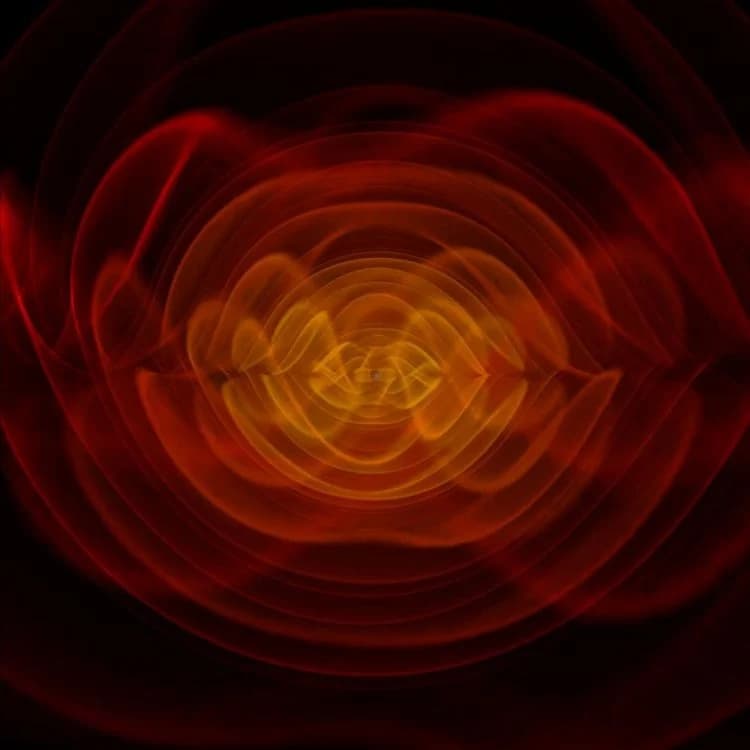
What oscillates in a gravitational wave?
In general relativity, gravity is associated with the geometry of space and time. When a system of massive objects changes rapidly enough and asymmetrically, some energy can leave as a propagating gravitational disturbance. Two black holes orbiting, drawing together and merging provide a vivid example. The wave carries information about that motion far from its source.
Ripples in a fabric are a helpful analogy, but there is no separate material fabric. As a wave passes, the distances between freely moving test masses change. For a suitable orientation, one direction transverse to the wave stretches while the perpendicular direction contracts, and the pattern then reverses. What must be measured is an extremely small fractional change, rather than the height of a visible crest.
What was detected in 2015, and why was it announced later?
The signal GW150914 reached the two LIGO detectors on 14 September 2015. Researchers associated it with a merger of two black holes. The discovery was announced on 11 February 2016 after analysis and validation. The dates are often confused: one marks the observation and the other the public announcement. Similarly, the digits in newer event names usually identify their observation date.
Earlier evidence was indirect: for example, changes in a binary pulsar’s orbit matched the energy loss expected from gravitational radiation. LIGO enabled a different level of observation by directly detecting a passing wave. The point is not that nobody suspected such waves existed before 2015, but that a new way to test the theory and investigate distant compact systems became available.
How do lasers and mirrors measure a distance?
A LIGO detector has two perpendicular arms, each 4 kilometres long. A laser beam is split, sent along the arms and recombined after reflections from mirrors. A change in the difference between the optical paths changes the light’s interference. This signal is used to reconstruct changes in the relative separation of the test masses: the mirrors.
Light reflects repeatedly inside the arms, increasing measurement sensitivity. The mirrors are suspended and isolated from vibration, and the beams travel through vacuum tubes. This is a complex measuring system rather than an ordinary ruler with a laser pointer. The change is so small that weak environmental disturbances and the instrument’s own noise must be addressed alongside the search for a cosmic signal.
How is a cosmic signal distinguished from terrestrial noise?
Ground motion, equipment, thermal fluctuations and other noise sources affect the measurements. Additional environmental sensors operate around the interferometer, and several independent methods check the data. A consistent signal in widely separated detectors, with a delay compatible with the wave travelling between them, is particularly valuable. Local interference generally does not reproduce that pattern.
LVK combines LIGO in the United States, Virgo in Italy and KAGRA in Japan through observations and joint analysis. This does not mean every instrument records every event simultaneously: availability and sensitivity differ. For example, the two LIGO detectors observed GW250114 while Virgo and KAGRA were not participating in that observation. Each result must be assessed using the actual detector network involved.
Why can a merger be “heard”?
As compact objects approach, the signal’s frequency rises, followed by merger and the fading disturbances of the newly formed black hole. This rising pattern is called a chirp, recalling a brief bird call. Its shape is used to infer system parameters and compare observations with calculated signals, rather than simply searching for any similar-sounding noise.
A recording can be turned into an audio track, with a speaker reproducing variations in the data as air vibrations. The official comparison of GW250114 and GW150914 first uses the original frequencies and then raises the pitch to make listening easier. Sound did not travel through the vacuum of space. Fast radio bursts, or FRBs, are a different kind of signal: they are electromagnetic radio emission, whereas LIGO measures a gravitational wave.
What changed with GWTC-5.0 in 2026?
On 26 May 2026, the collaboration presented GWTC-5.0, a catalogue containing 390 confirmed gravitational-wave events. The update added 161 events detected between 10 April 2024 and 28 January 2025 during the O4b observing period. This is neither 390 simultaneous outbursts nor a count of every preliminary alert ever posted online.
The catalogue makes it possible to investigate not just individual unusual pairs but the distributions of masses, spins and other properties across a large sample. How many objects formed when stars died, and how many through repeated mergers? In which environments do binaries form? Answering requires statistics and an accounting of detector sensitivity: systems are not equally easy to detect, and their signals must fall sufficiently well within an instrument’s operating range.
The GW240615 record: a smaller region of sky
The new catalogue highlights GW240615, a black-hole merger whose signal arrived on 15 June 2024. Combined data from both LIGO detectors and Virgo constrained its sky region to approximately 6 square degrees. This is the gravitational-wave localisation precision record described in the catalogue release, rather than a star’s position measured by ordinary photography.
Multiple detectors compare arrival times and other signal features to reduce uncertainty in direction. For astronomers, the resulting region becomes a search area for a possible electromagnetic counterpart. A small patch of sky does not by itself guarantee a visible flash, however: a binary black-hole merger may lack enough luminous material in its surroundings.
GW231123: how massive was the resulting black hole?
In July 2025, LVK reported GW231123, observed on 23 November 2023. Signal analysis indicated a remnant black hole of approximately 225 solar masses. The original black holes were estimated at roughly 100 and 140 solar masses; these values depend on modelling and have uncertainties. Gravitational waves carry away some of the system’s energy, so the remnant mass cannot simply be equated with the sum of the original masses.
The record concerns the most massive merger detected this way at the time of the announcement. Supermassive black holes at galaxy centres are far heavier and are studied in other bands and by other methods. GW231123 raises questions about the unusual pair’s formation: could it contain remnants of earlier mergers? This is an important scientific question, but the objects’ precise ancestry was not directly observed.
GW250114: what does a signal-to-noise ratio of 76.9 mean?
GW250114 arrived on 14 January 2025 from a merger of two black holes with similar masses. GWTC-5.0 gives it a signal-to-noise ratio of 76.9, exceptionally clear compared with previous observations. This quantity describes how distinctly the signal emerges from noise within the analysis. It is not a decibel value and does not describe how deafening the merger would sound to a nearby person.
A clean recording lets scientists study the short post-merger stage, called ringdown, when disturbances of the remnant fade. Like a bell, it has characteristic modes with different frequencies and decay rates. Measuring them provides additional ways to infer mass and spin and test whether different parts of the same event agree with one physical description.
What was tested in Einstein’s and Hawking’s theories?
In the GW250114 study presented by LVK in February 2026, the signal passed a set of tests of general relativity. The measured mode frequencies and decay agree with the expected black hole within the data’s precision. This is a particularly stringent test of rapidly changing strong gravity during a merger. It does not prove the theory for every object, energy and possible condition.
A separate study used the event to test Hawking’s area theorem: in the classical description, the total event-horizon area should not decrease. Researchers compared inferred areas before and after merger and found agreement. This is different from observing Hawking radiation, the proposed quantum evaporation of black holes. The gravitational-wave signal is not by itself a detection of that evaporation.
What did the neutron-star merger GW170817 add?
On 17 August 2017, GW170817 was detected through both gravitational waves and electromagnetic radiation. Fermi saw a short gamma-ray burst, and follow-up observations found a luminous kilonova in galaxy NGC 4993. Different instruments studied different aspects of the collision: compact-object motion, a high-energy outflow and expanding material.
This is how multi-messenger astronomy works. Gravitational waves reveal the system’s dynamics, while light helps identify the galaxy and investigate its material. Combined data can constrain cosmological parameters and gravity, but each inference requires its own assumptions and uncertainty estimates. Multiple channels make an observation richer without turning it into a universal answer to every question about the Universe.
Such joint observations provide an independent way to test the Hubble tension. The shape and amplitude of the gravitational-wave signal provide an estimate of distance, while light from the host galaxy supplies its redshift. This method is called a standard siren. Its precision depends, among other things, on how well the binary orbit’s inclination to the observer is known: different combinations of distance and orientation can produce similar amplitudes.
What have gravitational waves not yet established?
Detecting a merger is not a direct discovery of a dark matter particle or an explanation of dark energy. A wave is a change in the gravitational field, while those names concern other questions about the Universe’s contents and evolution. Even when data test exotic models, the result must be read carefully: was a new entity found, or were its possible properties merely constrained?
Observing run O4 ended on 18 November 2025, while processing and publication of the collected data continued afterward. Catalogue growth reflects both new observations and more complete analysis of recorded signals. For the next headline, check three things: the event’s actual date, its confirmation status and the specific record being claimed. Mass, clarity and localisation describe different achievements.
Wormhole models are also calculated to test alternatives. A very compact object with a different interior can produce a similar early ringdown, with differences emerging later. Any proposed delayed responses therefore need checks against noise and other explanations. One similar segment of a signal does not determine the source’s internal geometry.
Sources
- LIGO — what gravitational waves are
- ESA — spacetime ripples and their sources
- LIGO — how the laser interferometer works
- LIGO — noise, vacuum and checking signals
- LIGO — audio representations of GW250114 and GW150914
- NASA — light and gravitational waves from GW170817
- LIGO — the massive merger GW231123, July 2025
- LIGO — the GWTC-5.0 catalogue, 26 May 2026
- Max Planck Society — the new catalogue’s precision and records
- LVK — tests of general relativity with GW250114, February 2026
- LIGO — GW250114 and Hawking’s classical area theorem
- LVK — completion of the fourth observing run, O4
- LIGO — measuring cosmic expansion with GW170817
- Cardoso, Franzin, and Pani: ringdown and the event horizon
Questions and answers
Are gravitational waves sound in space?
They are changes in spacetime. To listen, a speaker converts the data into vibrations of air. The sound is produced when the recording is played.
Does LIGO detect radio waves from black holes?
LIGO’s main signal concerns changes in the relative separation of mirrors. Radio emission, including FRBs, is an electromagnetic channel measured by other instruments.
Is GW231123 the biggest black hole in the Universe?
No. The approximately 225-solar-mass remnant concerns a massive merger detected through gravitational waves. Known supermassive black holes are far heavier.
Did GW250114 confirm Hawking radiation?
Researchers tested the classical horizon-area theorem and predictions of general relativity. This result does not claim an observation of quantum evaporation.
Why is an event from 2025 discussed in 2026?
A signal is first recorded, then analysed and included in scientific papers and catalogues. For example, GW250114 arrived on 14 January 2025, while the new catalogue including it was released on 26 May 2026.