Dark matter is the name given to an invisible component whose gravity helps explain galaxy motions and the structure of the Universe. Observations give scientists strong reasons to include it in their models, but its composition remains unknown. In 2026, searches operate on very different scales: Euclid measures the distribution of galaxies, while the underground LZ experiment investigates rare particle interactions. These methods complement one another and answer different questions.
- “Dark” means the material is not detected through emitted, reflected or absorbed light. It is not a cloud of black gas.
- Dark matter accounts for about 27% of the Universe’s total mass–energy budget. Among matter alone, its share is approximately 85%.
- The unusual LUX-ZEPLIN event reported in September 2026 has a significance of 2.6 sigma. The team is not claiming a dark matter detection.
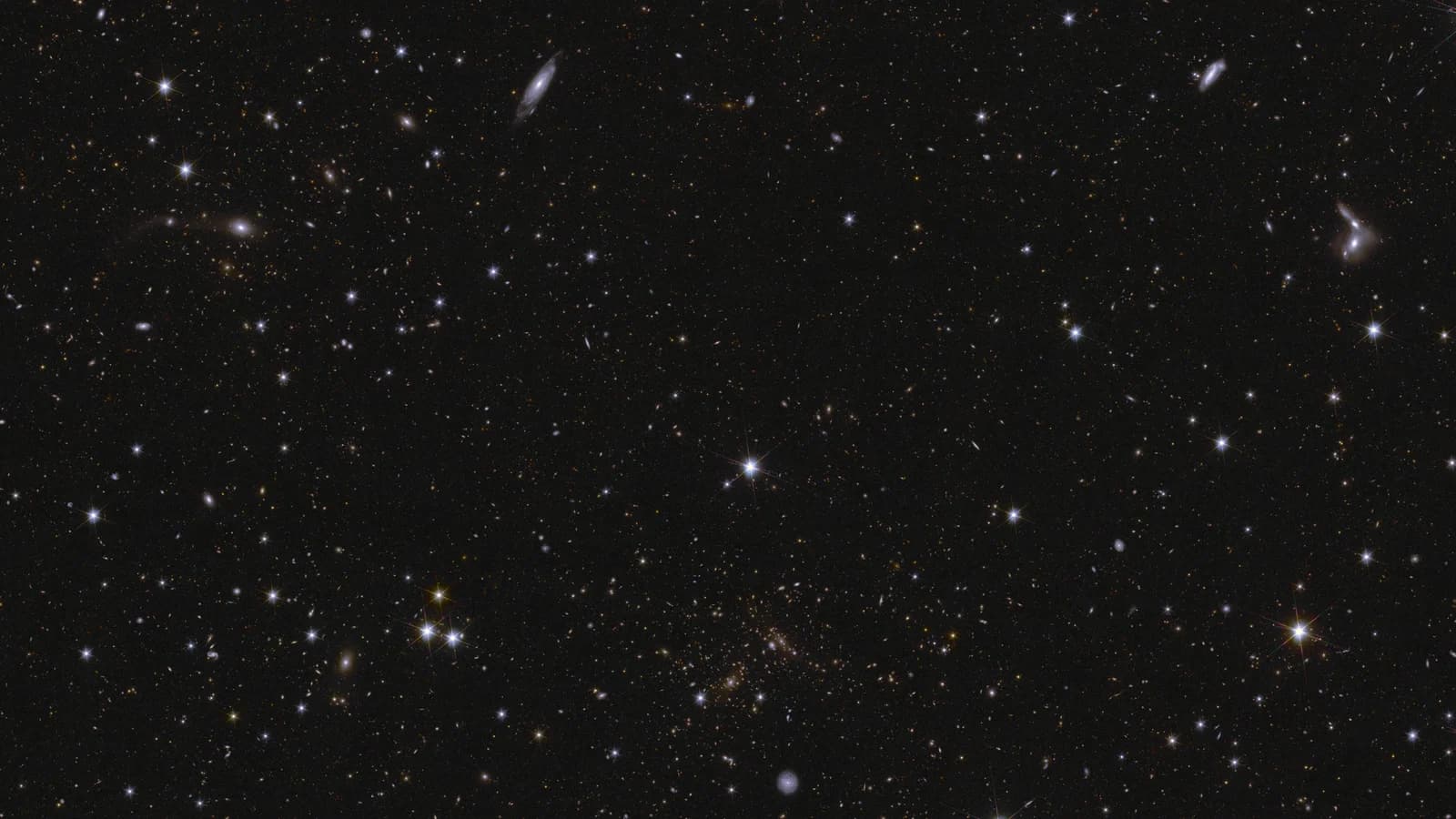
- Euclid reconstructs the distribution of mass using galaxy light and positions. A telescope image is not a photograph of dark matter itself.
What is dark matter in simple terms?
Imagine trying to weigh a distant system that cannot be placed on a scale. Astronomers measure how its stars and gas move and how its gravity changes the path of light. They then compare the inferred mass with the material accounted for through radiation and other observations. In many systems, the visible contents are insufficient. Dark matter is a physical explanation for the additional gravitational contribution.
“Invisible” does not mean empty space. The proposed component has mass and influences the material around it. Its microscopic nature, however, still needs to be established. It helps to separate two questions: how strongly observations support additional mass, and whether a proposed constituent has been detected in a laboratory. A strong answer to the first does not automatically answer the second.
Why do stars in galaxies point to hidden mass?
One historical argument concerns orbital speeds. In 1933, Fritz Zwicky noted a mismatch between galaxy motions within a cluster and the mass estimated from its light. Later studies of spiral galaxy rotation, associated with Vera Rubin and her colleagues, revealed a related problem: stars in the outer regions moved faster than expected when only known material was included.
This leads to the model of an extended halo: much of the mass is distributed beyond the bright stellar disc. The Milky Way is also studied together with such a surrounding component. A photograph mainly shows luminous stars and dust lanes, while a dynamical model describes a larger system. A beautiful image alone cannot establish its mass: velocities, distances and a careful accounting of ordinary material are needed.
How gravitational lensing reveals the invisible
Light from a distant galaxy can pass near a massive foreground system. Curved spacetime changes the direction of its rays, making background objects appear stretched, magnified or multiplied. Bright arcs and rings are the most striking examples of gravitational lensing. The lens is produced by the total mass along the light path, so an attractive arc alone does not mean dark matter created all of it.
Researchers reconstruct a mass distribution that explains the observed distortions and compare it with the stars and gas. A scientific illustration may display the result as blue or purple shading. This is a model-based map, not light emitted by the invisible material. Such reconstructions have uncertainties and assumptions; additional observations and independent mass measurements test their reliability.
What did the Bullet Cluster show?
The Bullet Cluster became an important test because a collision between two galaxy clusters separated different components of the system. Hot gas, containing most of the ordinary matter, slowed as it interacted. The main mass concentrations reconstructed through gravitational lensing were offset from that gas. This arrangement is difficult to explain if the gas is assumed to be the sole dominant source of gravity.
In the familiar composite image, pink represents X-rays from the gas and blue represents the reconstructed mass map. The observations support a component that behaves differently from ordinary gas during the collision. They do not identify an elementary particle. Cosmological evidence and laboratory identification of the material are different results, even when both are discussed using the word “detection”.
Where do the figures 27% and 85% come from?
In the standard cosmological description, ordinary matter contributes about 5% of the total mass–energy budget, dark matter about 27%, and dark energy roughly 68%. These are rounded shares inferred by comparing a model with observations, including the cosmic microwave background. Planck’s map shows small temperature differences in the early Universe and helps test its composition independently of the rotation of any individual galaxy.
The figure 85% answers a different question: what fraction of all matter is dark matter, excluding dark energy from the comparison? Dividing roughly 27 by the sum of 27 and 5 gives a value close to that estimate. Thus “27% of the Universe’s contents” and “85% of its matter” are compatible. Confusion begins when different denominators are silently replaced by the word “everything”.
How do dark matter, dark energy and black holes differ?
Dark energy is introduced to describe the accelerated expansion of the Universe. Dark matter, by contrast, contributes to gravitational structures: galaxies, galaxy clusters and the cosmic web. Both names reflect an unknown physical nature, but do not make the two phenomena the same substance. Dark energy is not a glowing or heated version of dark matter.
Black holes are compact objects with event horizons. They are studied through their effects on their surroundings, radiation from nearby gas and other signals. They are not identical to an extended dark matter halo. Hypothetical primordial black holes, which might have formed in the early Universe, are considered as a possible contributor to hidden mass. This is a separate testable idea, not a finding that known stellar black holes explain all the missing mass.
What might dark matter be made of?
Candidates include WIMPs, hypothetical massive particles with weak interactions, and axions, proposed very light particles. Different candidates require different instruments and produce different predicted signals. “Candidate” is the essential word: a useful theoretical model does not become a detected particle merely because a large detector has been built to search for it.
The expression “cold dark matter” mainly describes the proposed component’s motion during structure formation: it must not erase small concentrations by moving too quickly. It does not mean a telescope has found cold black ice. Testing such properties connects particle physics with the galaxies and clusters that could have grown from early density variations.
How is dark matter sought underground and at colliders?
Underground experiments try to detect a rare interaction between a proposed particle and the detector material. Overlying rock and additional shielding reduce backgrounds caused by ordinary particles. Xenon detectors measure light and electrical signals. Scientists first need to understand the events produced by known physics before looking for an excess that it cannot explain.
At a collider, the task is different: testing whether collisions can produce new particles that leave the apparatus without a normal detector signal. Physicists search for missing momentum together with other features of an event. A momentum imbalance alone is not proof of dark matter: known processes and measurement errors must be excluded, and the properties of the proposed new object must then be tested.
Was dark matter found in 2026? What the LZ event means
On 1 September 2026, Berkeley Lab reported one unusual event in the LUX-ZEPLIN experiment. The analysis covered 220 live days of data collected between March 2023 and April 2024. Researchers tested a broader set of possible WIMP interactions than in the simplest search scenario. The event was difficult to explain using known background processes, making it worthy of further investigation.
The result has a significance of 2.6 sigma; the announcement explicitly distinguishes this from the 5-sigma level normally required for a particle-physics discovery. The team is not claiming to have seen dark matter. Further data may strengthen or weaken the hint. A sigma value also cannot be converted into the probability that a particular event “definitely was dark matter”: a statistical assessment of backgrounds does not answer that question.
What is the Euclid telescope looking for?
Euclid is a European cosmology mission with NASA participation. It observes visible and near-infrared light and is designed to survey more than a third of the sky outside the bright band of the Milky Way. Its task is to measure the shapes and distribution of vast numbers of galaxies, rather than point a camera at an individual invisible particle. Spectroscopic and photometric data help connect the sky map with distances.
Weak lensing is particularly important: small coherent distortions that cannot be identified reliably from a single arbitrary galaxy. Statistics across many objects allow researchers to reconstruct the distribution of mass. Comparing structures at different distances traces their evolution over time and tests cosmological models. In this way, the telescope constrains dark matter’s properties through its collective gravitational effects.
What has Euclid released, and what cannot yet be promised?
In its 19 March 2025 release, ESA presented deep fields containing 26 million galaxies and a catalogue of 500 strong gravitational lens candidates. This was the result of processing a particular survey, not an announcement that dark matter particles had been captured. Studies of galaxy shapes also help researchers understand the growth and mergers of stellar systems and star formation.
According to the Euclid/Caltech timeline current on 26 October 2026, the Q2 quick release took place on 24 June. DR1 Foundation is scheduled for 12 November 2026, and DR1 Complete for mid-2027. These are planned releases; the November release must not be described as having already happened. Neither a large map nor a new catalogue by itself guarantees a final answer about dark matter’s composition.
What still needs to be tested?
Scientists test both new forms of matter and whether our description of gravity remains complete on large scales. Any alternative must account for the combined measurements: galaxy motions, lensing, cluster collisions and the early Universe. Matching one graph matters, but does not replace testing the other independent observations.
Three questions help when reading the news: what exactly was measured, which model was compared with the data, and whether an independent method confirms the conclusion. Similar care is used when discussing exoplanets and searches for life: an observed signal and its physical interpretation are different things. For dark matter, there is already a rich picture of gravitational effects, but the identity of the material producing them remains an open question.
Sources
- NASA — what is known about dark matter
- ESA — the cosmic matter and energy inventory from Planck
- NASA / Hubble — reconstructing mass through gravitational lensing
- Chandra — the Bullet Cluster and the separation of gas and mass
- NASA — the properties of black holes
- CERN — searches for dark matter particles
- Berkeley Lab — the unusual LZ event, 1 September 2026
- ESA — Euclid mission design and objectives
- ESA — five questions Euclid will investigate
- ESA — Euclid deep fields released on 19 March 2025
- Euclid / Caltech — the current data release timeline
- ESA — questions about Euclid and the dark Universe
Questions and answers
Does dark matter exist, or is it just a guess?
Additional invisible mass is supported by several independent kinds of observation and is part of the standard cosmological model. Its microscopic composition has not yet been established.
Why can’t a telescope see dark matter?
It is not detected through the usual interactions with light. Telescopes investigate the gravitational consequences of its presence, such as distorted images of background galaxies.
Is dark matter 85% of the whole Universe?
Approximately 85% refers to matter alone, excluding dark energy. Dark matter contributes about 27% of the total mass–energy budget.
Has LUX-ZEPLIN discovered a dark matter particle?
No. The 1 September 2026 announcement describes one unusual event with a significance of 2.6 sigma. The team continues to investigate and is not claiming a discovery.
Does Euclid photograph dark matter itself?
No. It measures galaxy light and distribution. Researchers use lensing and other data to reconstruct mass and compare the result with cosmological models.
Is dark matter dangerous to people?
ESA explains that the proposed rare interactions with ordinary material can be ignored in everyday life. Dark matter is studied to understand the Universe, rather than because of an established everyday hazard.