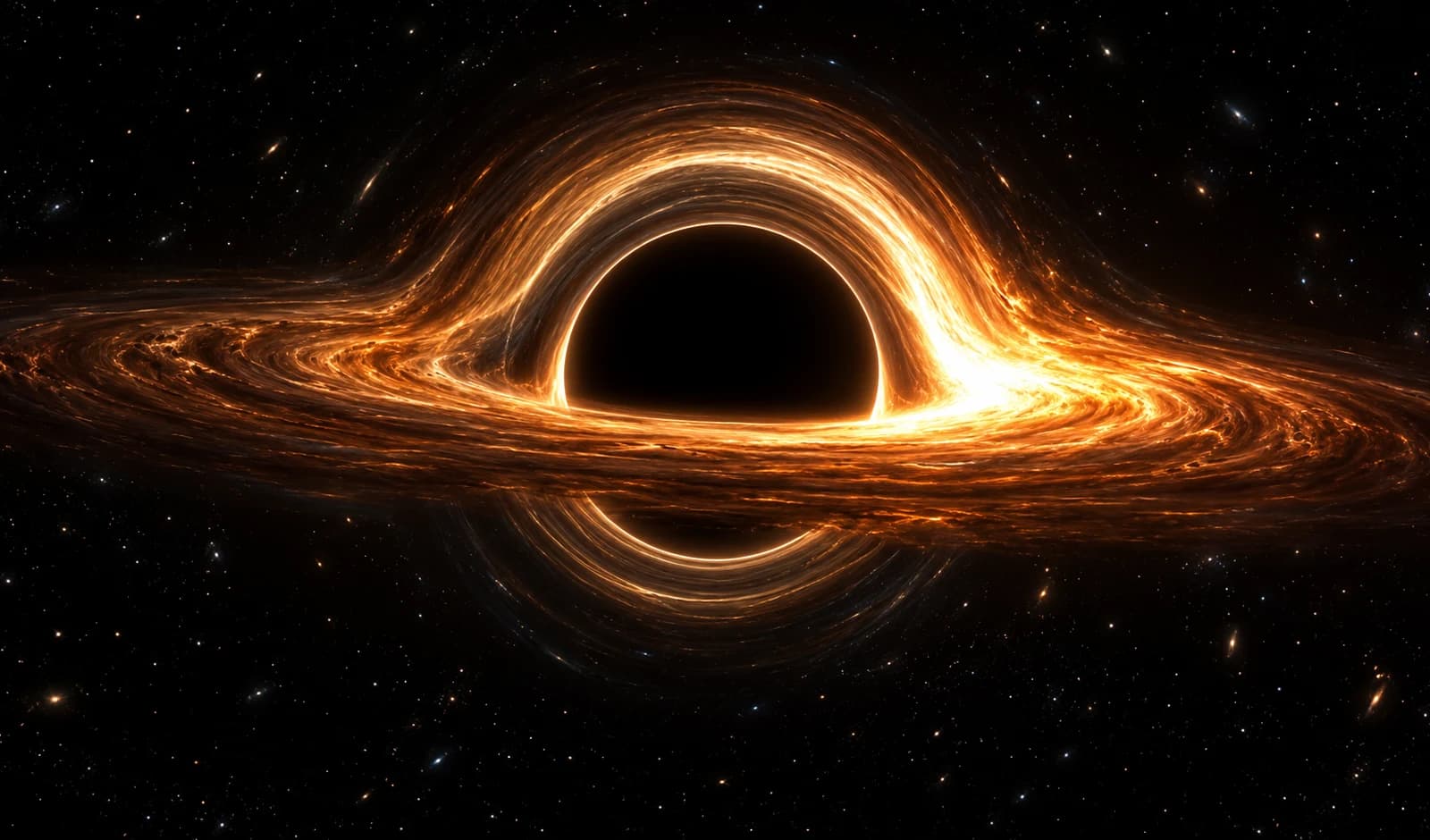
The event horizon and the glowing disk
The event horizon marks the limit beyond which every possible path into the future leads inward. It is not a shell of rock or metal. We can receive information about a black hole's surroundings, but a signal sent from inside the horizon cannot reach us. That is why “seeing a black hole” needs clarification: we observe its effects on light and matter.
Gas moving toward a black hole can form an accretion disk and become extremely hot. Gravity bends the paths of light, so the far side of the disk can appear above and below the dark center in an image. Its appearance depends on the viewing angle. Such an image helps us understand the geometry, but its colors and detail cannot replace measurements of a particular object.
Traversable wormholes in theoretical models allow passage through a throat into another region. They require a route without an event horizon, an appropriate energy source, and a stable geometry. Comparing these models with black holes helps identify observations that could distinguish their interiors.
How black holes form
One formation pathway begins with the death of a massive star. When its core can no longer resist gravitational compression, the resulting collapse can, under suitable conditions, leave a black hole. In binary systems, gas falling from a companion star can reveal the black hole through X-ray emission. The invisible object itself is identified through observable effects.
Supermassive black holes at the centers of galaxies are far heavier than stellar black holes. They grow by consuming matter and merging with other black holes, but the origin of the first large “seeds” remains an active research question. No single simple formation story explains their full diversity. It is important to distinguish established growth mechanisms from initial conditions that are still being debated.
What the first EHT image revealed
On April 10, 2019, the Event Horizon Telescope collaboration presented an image of M87*. Eight radio telescopes worked together as a virtual instrument the size of Earth. Observations at a wavelength of 1.3 millimeters were combined using radio interferometry. The result shows ring-shaped emission with a dark central region, rather than a photograph taken in visible light.
The shadow forms because light rays are bent and captured, and its size is not the same as that of the event horizon itself. Researchers compared independent data-processing methods and physical models. This verification is what turns a striking image into a scientific result. When looking at a COSMO360 visualization, it helps to ask separately: what was measured, and what did an artist add to explain it?
How to find a black hole without a photograph
A black hole may have no bright accretion disk and remain undetectable even to an X-ray telescope. Its gravity still affects a visible companion star, however. By measuring the star's motion and the period and shape of its orbit, astronomers estimate the mass of the invisible object. They then check whether an ordinary star or another type of system could explain the observations.
This is how Gaia BH1 and Gaia BH2 were discovered. Data from the Gaia space observatory were combined with ground-based measurements of stars moving toward and away from us. Researchers established that the invisible companions were much heavier than the Sun, yet the radiation expected from ordinary stars of those masses was absent. This is a different kind of evidence: instead of imaging glowing matter, astronomers study the motion of a neighboring body. The absence of a beautiful disk therefore does not mean that a black hole is absent.
A brief radio pulse does not by itself prove that a black hole is present either. Fast radio bursts are studied as a distinct class of phenomena, with magnetars among the leading explanations. To establish a source, researchers compare the signal’s properties with its location in a galaxy and other observations. The object is identified from the combined evidence, rather than simply from how unusual a burst appears.
Gravitational waves provide another way to study close binary systems. Changes in the signal during inspiral and merger are used to estimate the components’ masses and spins by comparing the data with calculated waveforms. This method probes the system’s dynamics rather than photographing an event horizon. Its results therefore complement EHT images and observations of stellar orbits without replacing them.
Why one side of the disk looks brighter
Many images show a disk with unequal brightness on its two sides. Moving gas can cause this pattern: radiation from material approaching the observer is amplified, while radiation from the receding side is reduced. Speeds close to a black hole are high enough for relativistic effects to change the image substantially. A brighter patch therefore does not automatically mean a hotter or denser region; the motion and viewing angle must be considered first.
Streams of particles called jets sometimes emerge above and below the disk. They originate in the surroundings of the black hole, outside its event horizon. They are not matter that has escaped from inside that boundary. The disk, shadow, and jets are different components of the same system, and their scales in an image may differ enormously. Captions and observing wavelengths provide a better basis for comparing them than their resemblance to a science-fiction landscape.
Does a black hole suck in everything around it?
At a sufficient distance, orbits obey gravity just as they would around any other body of the same mass. A black hole is not a cosmic vacuum cleaner: an object must follow an appropriate trajectory to fall into it.
One danger of approaching closely comes from tidal forces: differences in gravitational attraction between different parts of an object. The nature of these conditions depends on the black hole's mass and the distance from it.
Sources
- NASA: Anatomy of a Black Hole
- NASA: Types of Black Holes
- ESO: First Image of a Black Hole, 2019
- ESA: Gaia discovers a new family of black holes: detection through stellar orbits
- NASA — fast radio bursts and Webb studies of their host galaxies
- LIGO — what gravitational waves reveal about merging stars and black holes
- Zhao et al.: a wormhole model, October 2026
Questions and answers
Why does a black hole look bright?
The bright radiation comes from heated matter outside the horizon. Light does not escape toward us from inside the horizon itself.
Are the shadow and the event horizon the same thing?
No. The observed shadow is related to the paths of light and is larger than the horizon. These are different concepts, although both describe the surroundings of the same object.
Can a black hole be detected without a glowing disk?
Yes. If a star orbits nearby, its motion can reveal the mass of an invisible companion. This is how Gaia BH1 and Gaia BH2 were found. The absence of light alone does not prove the presence of a black hole: researchers compare the orbit, mass, and other observations.