A fast radio burst, or FRB, is a short, powerful pulse of radio waves, typically lasting milliseconds. Most arrive from other galaxies. In 2020, a similar burst was recorded from a known magnetar in the Milky Way, connecting the mystery with extremely dense neutron stars. A single universal explanation for all FRBs remains elusive, and new observations reveal how diverse their sources can be.
- FRB is the name of an observed radio pulse. The term does not by itself identify the object that produced it.
- Some sources produce many bursts. A lack of detected repetition does not prove a source can burst only once.
- SGR 1935+2154 linked an FRB-like pulse with a magnetar on 28 April 2020. This is important evidence for a possible origin, rather than a solution to the entire problem.
- On 8 October 2026, NASA reported that Webb had studied the host of FRB 20240304B, seen as it was 3 billion years after the Big Bang.
What is a fast radio burst?
FRB stands for Fast Radio Burst. A radio telescope records a sharp arrival of energy at radio frequencies, after which the signal quickly fades. The typical timescale is thousandths of a second, and a burst may contain even shorter structures. A faint dot in a photograph and an FRB are different kinds of observation: timing, frequency and changing intensity are central here.
The first example of this class was discovered in 2007 through an analysis of archival data. Researchers now study an entire family of events, rather than a single undeciphered message. They compare duration, brightness, polarisation and environment. A shared name is useful for cataloguing, but similar short pulses do not guarantee identical histories for all their sources.
How do astronomers catch a millisecond-long signal?
Searches need radio telescopes, rapid data recording and software that can identify a short pulse among interference. Sky coverage matters too: a narrow antenna cannot be aimed in advance at every future burst. CHIME/FRB catalogues contain not just event names but positions, durations, frequency-related measurements and detection confidence estimates.
Recording a burst and identifying its host galaxy are separate steps. Widely spaced antennas improve the position measurement, while optical and infrared telescopes investigate the surroundings. Repeating sources are especially helpful: astronomers can revisit the area and accumulate measurements. Each observation, however, samples a limited period of time and a particular frequency range.
Why do some FRBs repeat while others have been seen only once?
A repeating source produces several distinct bursts from the same location. This does not necessarily imply a precise cosmic clock: pulses may arrive irregularly and activity can change. Repetition also shows that, in at least these cases, the source survives one burst and can produce another. A simple one-off destruction of the object does not explain that behaviour.
The label “non-repeating” often describes the limits of the observations. A subsequent faint pulse may have occurred while the telescope was looking elsewhere, or fallen below its sensitivity. Studies of repeating-source statistics account for such selection effects. The absence of a second detected burst therefore cannot establish that a source is fundamentally a one-off event.
What is a magnetar, and why is it a plausible source?
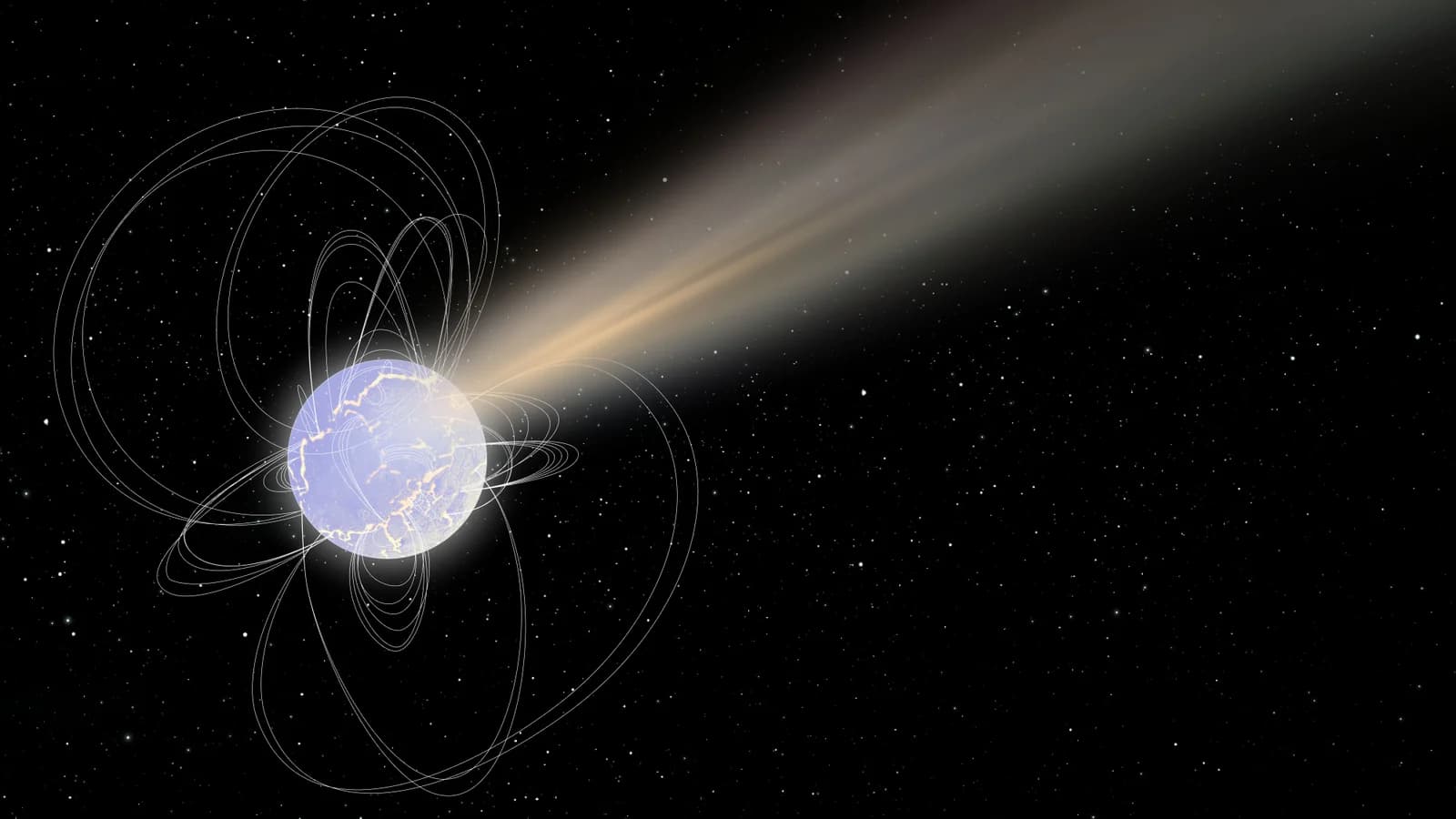
A magnetar is a neutron star with an extraordinarily strong magnetic field. Neutron stars are compact remnants of stellar evolution, concentrating a large mass within an object roughly the size of a city. The magnetic field stores energy and influences charged material nearby. Rearrangements in this environment can produce powerful outbursts observed at different wavelengths.
A magnetar differs from a black hole: it has a stellar surface, and its magnetosphere is a surrounding region of strong magnetic field and plasma. Identifying a plausible object is only part of the task. Researchers must also explain how energy becomes a short, bright radio signal and how that radiation escapes. The mechanism launching an FRB remains a central question.
X-ray pulses also help probe the structure of a neutron star. As it rotates, hot surface regions change in apparent brightness, while strong gravity bends the outgoing light. The pulse shape and independent mass constraints can reveal the radius and test the properties of matter inside.
What happened to SGR 1935+2154 in April 2020?
On 28 April 2020, magnetar SGR 1935+2154 in our galaxy produced a bright, brief radio pulse alongside an X-ray burst. CHIME and the independent STARE2 system recorded the radio signal, while space observatories including Integral investigated the high-energy emission. Matching position and timing connected the radio pulse with a specific known object.
This was an important bridge between Milky Way magnetars and distant FRBs. The CHIME team estimated that a similar event in another galaxy would resemble some known fast radio bursts. The FRB population, however, spans very different energies and activity patterns. The observation demonstrated that a magnetar can produce an FRB-like pulse without automatically identifying every extragalactic source.
Where does the radio flash form: near the star or in a shock?
Two broad groups of models are discussed. In one, emission forms within the magnetosphere or very close to the compact object. In the other, an outburst launches a disturbance outward and radio waves arise farther away in a shock. Emission-region size, polarisation and frequency-dependent behaviour help distinguish between these possibilities.
X-ray observations provide additional information. NICER and NuSTAR studied SGR 1935+2154 around another FRB in October 2022. They observed changes in rotation and outbursts, but the precise causal sequence remained under investigation. Not every energetic X-ray outburst is accompanied by a detected FRB: an available energy reservoir alone is not a complete explanation.
How did scintillation help locate the emission region?
In a study published in Nature in January 2025, researchers investigated FRB 20221022A. Plasma scatters radio waves along their path, giving the signal characteristic frequency-dependent intensity variations called scintillation. This pattern can constrain the size of the emitting region even when the object itself lies in another galaxy.
The inferred compact scale is more consistent with emission within or near the magnetosphere than with the large-distance shock models considered. A changing polarisation angle supplied an independent clue. This is strong evidence for that particular burst and a useful way to test other events. It does not make all observed FRBs copies of one mechanism.
Why does an FRB in an old galaxy complicate the picture?
FRB 20240209A proved to be a repeating source on the outskirts of an old elliptical galaxy. In research presented by Northwestern in January 2025, its stellar population showed no evidence of recent active star formation. This environment fits poorly with a simple picture in which every FRB must occur shortly after a young massive star dies.
This does not rule out a neutron star. Other formation routes are discussed for compact sources in old systems, including interactions and mergers of stellar remnants. An origin in a dense star cluster was also considered for this FRB, but the presence of such a cluster at the burst position still needed confirmation at the time. An observed environment and a definitive formation history are different levels of inference.
What did Webb reveal about a distant FRB in October 2026?
On 8 October 2026, NASA reported on the host galaxy of FRB 20240304B. MeerKAT detected the radio pulse itself on 4 March 2024. Webb subsequently found the faint galaxy and measured its redshift: 2.148. We see this system at an epoch about 3 billion years after the Big Bang. NASA’s announcement described it as the most distant FRB with an identified host at that time.
The galaxy was small and actively forming stars. This young environment favours a young magnetar and makes a slow neutron-star inspiral scenario less suitable for this event. Webb was studying the galaxy’s light: it did not photograph the radio burst itself or directly observe the surface of its proposed source. The conclusion concerns this particular system.
What do FRBs reveal about matter between galaxies?
As a pulse travels through diffuse plasma, waves at different frequencies arrive with different delays. Lower frequencies generally arrive later. This phenomenon is called dispersion and helps estimate the number of free electrons along the line of sight. The calculation must distinguish contributions from our galaxy, the intergalactic medium and the source’s own surroundings.
When the host’s distance is known independently, these measurements can probe the faint gas of the cosmic web. Here, “missing matter” means diffuse ordinary material that is difficult to see, rather than automatically meaning dark matter. Dark matter is mainly investigated through gravitational effects; radio-signal dispersion measures a different aspect of the Universe.
Does an unexplained radio signal imply a message from a civilisation?
A short radio pulse does not by itself indicate a deliberate transmitter. FRBs already have observed connections with natural compact objects, including a known magnetar. Repetition, high brightness and an unfamiliar spectrum are properties requiring a physical explanation, rather than ready-made evidence of an artificial origin.
When reading a sensational report, identify what was found: a new pulse, a repeating source, a host galaxy or a constraint on a particular model. Then check whether independent instruments observed the event and which part of the interpretation remains hypothetical. A headline claiming that every signal has been explained usually goes beyond a result obtained for one object.
Sources
- NASA — the magnetar’s radio and X-ray burst on 28 April 2020
- ESA — the first observational connection between an FRB and a magnetar
- McGill / CHIME — a bright radio burst from a Galactic magnetar
- NASA — NICER and NuSTAR study a magnetar before and after an FRB
- Nimmo et al., Nature — constraining an FRB’s emission region through scintillation
- MIT — how scintillation helped investigate FRB 20221022A
- Northwestern — a repeating FRB on the outskirts of an old galaxy
- NASA / Webb — the distant host of FRB 20240304B, 8 October 2026
- ICRAR — FRBs as a way to measure ordinary matter between galaxies
- CHIME / FRB — a catalogue of observed bursts and repeating sources
- Yamasaki et al. — observational biases in counting repeating sources
- NICER: how light bending shapes a pulse
Questions and answers
What does FRB mean?
FRB stands for Fast Radio Burst: a short pulse of electromagnetic radiation at radio frequencies, typically on a millisecond timescale.
Do magnetars produce every fast radio burst?
Magnetars have a confirmed connection with FRB-like pulses. The origins of the entire diverse population and the precise emission mechanisms are still being investigated.
Is a repeating FRB a periodic signal?
Not necessarily. A repeating source produces multiple bursts, but the intervals can be irregular and its activity can change.
Do fast radio bursts occur in the Milky Way?
On 28 April 2020, an FRB-like radio pulse was recorded from Galactic magnetar SGR 1935+2154 alongside an X-ray burst.
Did Webb detect the most distant radio pulse?
MeerKAT detected the radio pulse FRB 20240304B. Webb studied its host galaxy, measured its redshift and helped establish the source’s environment.
Do FRBs detect dark matter?
Dispersion measures free electrons in ordinary plasma along the signal path. It is not a direct detection of a dark matter particle.