Nobody knows the date of Betelgeuse’s explosion. The red supergiant will indeed reach a catastrophic end, but neither its dimming nor new images of its companion mean a supernova is coming in 2026. Observations from 2025–2026 are helping explain its changing brightness, while a distance of hundreds of light-years separates a spectacular sky event from a threat to Earth.
- Astronomers have no confirmed explosion date for Betelgeuse. The estimate of roughly 100,000 years is a model-based expectation, not a countdown.
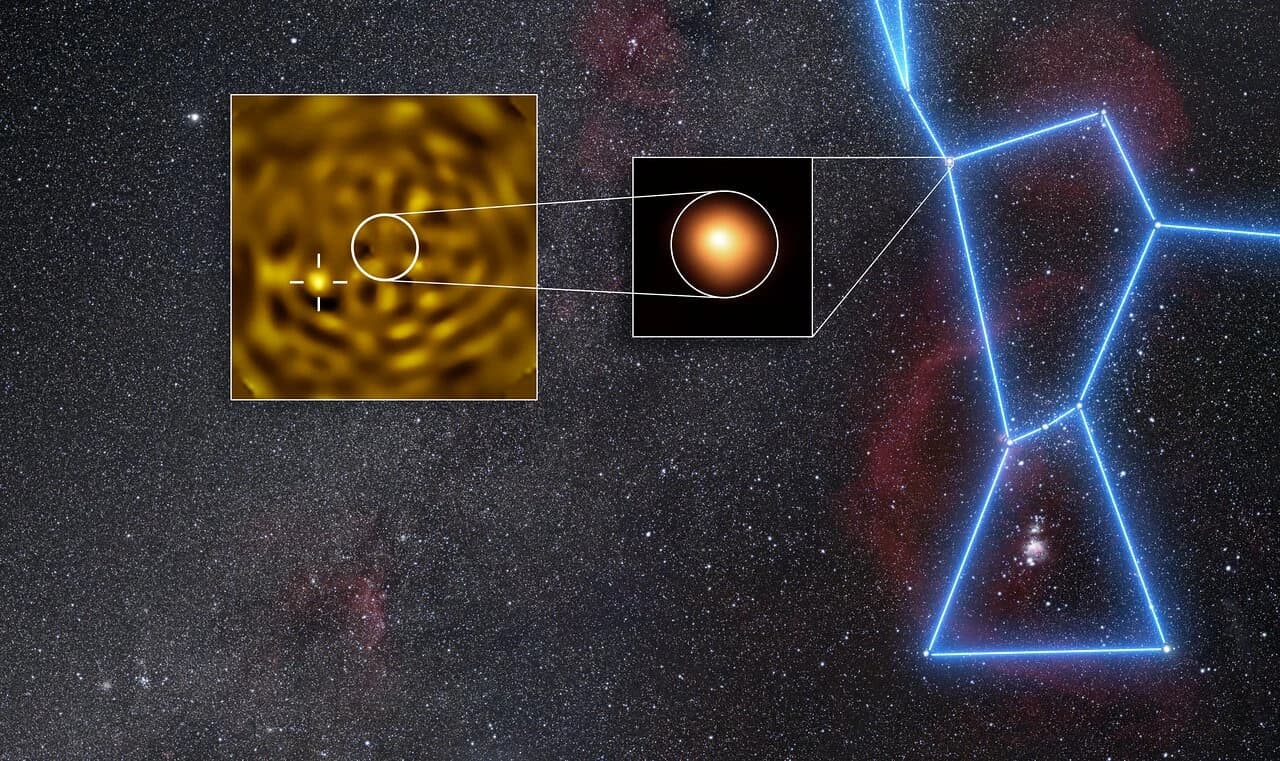
- In July 2026, ESO presented the strongest image yet of the likely companion Betelgeuse B. It reveals the system’s structure, rather than signalling an explosion.
- The Great Dimming of 2019–2020 is explained by ejected material and dust obscuring part of the star from Earth.
- Betelgeuse is distant enough that its expected supernova would not threaten our planet. You can already see the star without a telescope.
When will Betelgeuse explode? What we know on 25 October 2026
The short answer is that the exact year is unknown. NASA’s general explanation gives a timescale of roughly another 100,000 years. That indicates an expected scale of time, rather than scheduling a date. We cannot see directly into the stellar core; its state must be inferred from radiation, gas motions, size and changes in brightness. Different assumptions about the interior produce different estimates.
The headline “Betelgeuse will explode soon” often mixes human and stellar timescales. A hundred thousand years is a comparatively short remaining lifetime for a massive star, but thousands of generations for an observer. Scientific uncertainty also cannot establish that an explosion is inevitable in the coming months: not knowing the date does not demonstrate that the event is imminent.
What kind of star is it, and why is it red?
Betelgeuse is a red supergiant in Orion, also known as Alpha Orionis. It is a massive star with an enormously expanded outer envelope. The orange-red colour reflects the temperature of its visible layers: they are cooler than the Sun’s surface, although the whole star radiates much more energy because of its immense area. “Cooler than the Sun” still describes intensely hot gas.
Its diameter is not the size of a solid sphere. A diffuse atmosphere, uneven structure and observations at different wavelengths affect its apparent boundary. Scientific and popular accounts therefore give different radii. Several hundred solar radii conveys the scale; a more precise number is meaningful only alongside the measurement method.
How far away is Betelgeuse, and could it already have exploded?
Betelgeuse lies hundreds of light-years away. NASA material uses a rounded estimate of about 700 light-years, while ESO’s August 2026 account uses roughly 600. This does not mean the star has moved between the two publications: differing estimates and rounding reflect the difficulty of measuring the distance to such a bright, uneven object.
We see light that began its journey many centuries ago. The statement “it could already have exploded” is therefore logically possible, but does not report a discovery. Until light or another signal reaches Earth, that claim cannot be tested. Adding the light-travel time to an arbitrary year does not predict when we will observe a flash: first we would need to know when the explosion occurred.
Why did Betelgeuse dim in 2019–2020?
During the Great Dimming, the star faded enough for the change to be noticeable without a telescope. VLT observations showed a substantial darkening across part of its visible disc. Ejected gas cooled, and newly formed dust blocked light along our line of sight. Local surface cooling helped create suitable conditions for dust grains to form close to the star.
Two different effects must be distinguished: a star can emit less energy overall, or it can appear fainter because material lies in front of it. Betelgeuse’s observations point to an important role for the latter mechanism. NASA explicitly notes that the enormous mass ejection did not demonstrate an imminent supernova. The atmosphere’s recovery and its disrupted oscillations are research questions in their own right.
What was discovered beside Betelgeuse in 2025–2026?
In July 2025, NASA reported a probable direct detection of the predicted companion using Gemini North. The challenge was to separate a much fainter neighbour from the supergiant’s overpowering glow. Thousands of short exposures and processing of atmospheric interference revealed a source at the expected position. It is not a planet or a piece broken off Betelgeuse, but a candidate star in its own right.
On 28 July 2026, ESO presented stronger imaging evidence from the VLT’s SPHERE instrument, based on observations made in December 2024. The publication year should therefore not be confused with the observing date. Betelgeuse B’s estimated mass is around two to three solar masses. The team considers the evidence strong, while noting that observing the object again on the other side of the supergiant is needed to complete the test.
The companion and hotspots: why does the brightness change?
The observations contain variations on several timescales, and they need not share one cause. Pulsations alter the envelope’s dimensions and conditions; large gas motions create uneven structures; dust changes the light reaching us. A close companion adds another possible source of periodicity. Understanding the long cycle is particularly important when inferring the star’s interior.
A 2026 study by Dupree and colleagues links changes in absorption and outflow to a possible wake left by a companion travelling through the extended atmosphere. An ALMA image released by ESO in August shows an uneven surface and a persistent bright region. Researchers are examining whether the longevity of such regions could be connected to the neighbour. These remain explanations under investigation; a hotspot does not schedule an explosion.
Why do explosion forecasts disagree?
One reason is ambiguity in interpreting the oscillations. Saio and colleagues’ 2023 study treats the longest period, about 2,200 days, as the fundamental radial mode. With that choice, the model places the star late in core carbon burning, a much more advanced stage than explanations with a long remaining lifetime. The conclusion depends on whether that period has been given the correct physical interpretation.
If the companion’s orbit plays a substantial role in the long cycle, the same brightness variations cannot simply be treated as a pure pulsation measurement. New images help test the models’ assumptions, but do not automatically turn them into an exact calendar. Asking which observations support a forecast is more useful than choosing the shortest number in a dramatic headline.
What physically happens in a supernova?
A massive star is supported by a balance between gravity and the pressure of hot material. Successive nuclear reactions change its interior composition. Late stages create heavier elements, but that sequence cannot supply energy indefinitely: an iron core cannot be sustained in the old way by continuing energy-releasing fusion. Once support fails, rapid collapse begins.
A shock develops and the outer layers are expelled. How the explosion is launched and travels through the star remains an active research problem, tested against observations of very young supernovae. A neutron star or black hole may remain at the centre, while the ejected gas eventually forms a supernova remnant. Today’s dusty outburst and that future collapse differ in both mechanism and scale.
What would the explosion look like from Earth?
An exceptionally bright object is expected within Orion’s familiar pattern, potentially visible even in daylight. That does not mean a second disc the size of the Moon. Brightness and angular size are separate properties: a distant source can look like an intensely bright point. The exact light curve will depend on explosion energy, the remaining envelope and surrounding material, so a precise day-by-day display cannot be promised.
A supernova is not expected to flash and vanish in a fraction of a second like a meteor. The outward-moving layers and radiation take time to develop the observed display, followed by gradual fading. Its brief earliest stages are especially valuable, however. For SN 2024ggi, astronomers examined the explosion’s shape shortly after discovery, when waiting just another day would have lost some of that information.
Would Betelgeuse threaten Earth?
Betelgeuse’s expected supernova is not considered a threat to our planet: it is hundreds of light-years away. That is far beyond the distances of tens of light-years discussed in general estimates of serious effects from an ordinary nearby supernova. An event’s enormous total energy and the energy reaching one planet are different quantities; radiation spreads across an ever larger area.
Not every gamma-ray-burst scenario can be applied to this star. A narrowly directed relativistic jet is a particular physical situation, not a mandatory feature of every supernova. Stories about oceans instantly boiling usually add conditions that have not been established for Betelgeuse. The issue for observers on Earth is a remarkable sky event and rare scientific measurements, rather than preparing protection from the blast.
Could we receive an early warning?
Neutrino detectors offer an alert channel different from ordinary sky images. Some neutrinos are emitted before collapse, followed by a strong burst during collapse itself. These particles interact weakly with matter and can reveal activity before the visible flash escapes. This is a brief physical head start, rather than a way to draw up a supernova calendar years ahead.
A study of the Super-Kamiokande alert system evaluated a possible high-confidence warning for Betelgeuse up to roughly nine hours before core collapse, under its assumed stellar and detector conditions. That figure is not a guaranteed notification time for every person. Detector sensitivity, the star’s properties and statistical confidence determine whether a signal can be recognised early enough.
The neutrino burst from a stellar collapse and the record cosmic neutrino detected by KM3NeT belong to different energy regimes. The former probes processes inside a dying star; the latter may trace extreme accelerators or cosmic-ray collisions with background photons. The unknown source of a single ultra-high-energy particle provides no basis for announcing an imminent Betelgeuse explosion.
How to find Betelgeuse in the sky now
You do not need to wait for a supernova to see the star. Find the three closely spaced bright stars of Orion’s Belt; reddish Betelgeuse marks one shoulder, while bluish Rigel lies diagonally across the figure, at a foot. From northern mid-latitudes, Orion is conveniently observed during the colder part of the year. Hours, altitude and direction depend on the date and city, so check a sky chart for your location.
Unaided eyes and a clear view are enough to identify Betelgeuse. A dark site reveals more of the constellation, but the bright star is also visible from cities in clear weather. To compare its brightness across nights, use the same comparison stars and record the conditions. Camera settings, clouds and altitude above the horizon can easily create a false impression of a sudden change.
How to assess the next explosion headline
First establish what the report actually concerns: a new image, a published model, a brightness measurement or detection of an explosion itself. Then find the primary source and observing date. Betelgeuse B’s December 2024 observations were announced by ESO in July 2026, more than a year and a half later. That is an ordinary data-analysis timeline, not evidence that the object suddenly appeared on publication day.
A useful scientific result does not have to answer “when”. Finding a neighbour, tracking gas or testing the origin of a long cycle narrows the range of possible explanations. That is how stellar evolution is refined. A dramatic date without a testable method or uncertainty bounds adds no reason to expect an immediate supernova.
Sources
- NASA — Betelgeuse: properties and expected fate
- ESO — imaging the likely companion, 28 July 2026
- NASA — detection of the predicted companion, July 2025
- ESO — dust behind the Great Dimming
- NASA — Betelgeuse’s recovery after its mass ejection
- ESO — Betelgeuse’s surface imaged by ALMA, August 2026
- Dupree et al. — the companion’s wake in Betelgeuse’s atmosphere
- Saio et al. — modelling the evolutionary stage from pulsations
- NASA — the lives and deaths of stars
- NASA — why a distant supernova does not threaten Earth
- Super-Kamiokande — a pre-supernova alert system
- ESO — the first hours of red-supergiant supernova SN 2024ggi
- NASA — observing Betelgeuse and its evolutionary timescale
- KM3NeT, the original event analysis in Nature
Questions and answers
Will Betelgeuse explode in 2026?
There is no confirmed forecast for 2026. The exact date is unknown, and brightness changes or discovery of a companion do not themselves indicate that a supernova is beginning.
Why is 100,000 years often quoted?
It is an evolutionary-model timescale quoted in NASA material, not a measured interval remaining before explosion. It can be revised as the star’s interior is better understood.
Would a Betelgeuse supernova destroy Earth?
The expected event is not considered a threat to Earth because of the distance. Hazardous nearby-explosion scenarios cannot automatically be applied to a star hundreds of light-years away.
Would Betelgeuse become a second Moon?
That comparison normally concerns brightness, not apparent size. The supernova could be extremely bright without becoming a large lunar disc in the sky.
What is Betelgeuse B?
It is the red supergiant’s likely stellar companion. Imaging and spectral observations support its existence; ESO estimated a mass of around two to three Suns in 2026.
Can I see Betelgeuse without a telescope?
Yes. It is a bright reddish star in Orion. Use a sky chart set to your date and location to choose a time; no telescope is needed to identify it.