How the Moon formed
The leading model links the Moon's birth to a giant collision between the young Earth and a roughly Mars-sized body about 4.5 billion years ago. Ejected material could have gathered to form a moon. The name Theia refers to the proposed impactor in this model, rather than an object astronomers observed directly.
Samples returned by the Apollo missions allowed researchers to study the composition and age of lunar rocks. Their similarity to terrestrial material became an important constraint on impact models. The exact collision geometry and subsequent processes remain debated, however. It is more accurate to describe a model that explains a body of evidence than to present a popular animation as a recording of the actual event.
Why the far side is not always dark
The Moon rotates on its axis in approximately the same time it takes to orbit Earth. One hemisphere therefore faces us most of the time. The far side is hidden from an Earth-based observer, but not from the Sun: it experiences day and night, just like the near side. Phases result from changing illumination and viewing geometry.
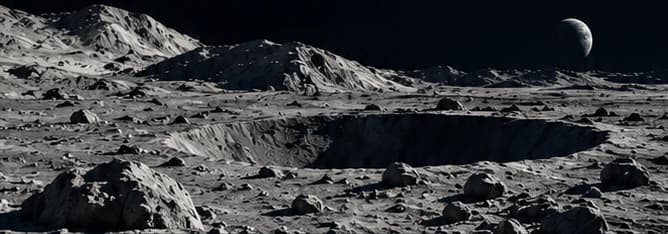
The dark “seas” on the near side are ancient lava plains, rather than bodies of water. Bright highlands and numerous craters reflect a different geological history. Impacts shattered rocks and created regolith, a layer of dust and debris. In a lunar image, we can read not only the shape of the terrain but also the sequence of processes that formed it.
Where water was found on the Moon
Permanently shadowed regions near the poles are especially interesting. Sunlight does not warm them as it does illuminated slopes, so deposits of ice can survive there. Different missions study hydrogen, water molecules, and surface properties using different techniques. These data should be compared, rather than combining every signal into one identical “water discovery.”
In 2020, SOFIA observations confirmed molecular water on the sunlit surface as well. This does not mean rivers flow across the Moon: molecules and ice occur in particular forms and conditions. Using the resource in the future requires understanding its accessibility, distribution, and extraction methods. A substantial engineering challenge separates detecting traces of water from operating a system to extract it.
Lunar phases and eclipses are different phenomena
The Sun always illuminates approximately half of the Moon. As the Moon moves around Earth, we see different portions of the illuminated hemisphere, producing the phases. An ordinary crescent is not Earth's shadow.
Earth's shadow falls on the Moon during a lunar eclipse. This does not happen at every full moon because the lunar orbit is tilted relative to the plane of Earth's orbit. An eclipse requires an additional geometric alignment.
The solar eclipse of August 2, 2027 will demonstrate a different geometry: at new moon, the Moon’s shadow will cross a narrow strip of Earth’s surface. Observers inside it will see the solar disk completely covered, while the view outside it will differ. An eclipse date therefore always needs a visibility map and circumstances for the specific location.
You can check the phase for a personal milestone too. When making a birth-date star map, examine both the illuminated fraction of the disc and the Moon’s position relative to the local horizon. Its presence on a general diagram does not necessarily mean it was visible from your city at the chosen hour.
Why is a lunar day so long?
The Moon's rotation is synchronized with its orbit around Earth, so it shows us almost the same side. The Sun still illuminates different regions, however: the time between one sunrise and the next is about 29.5 Earth days.
The far side experiences day and night too. The term “dark side” may work in artistic writing, but is misleading when describing illumination and temperatures.
What lunar rocks reveal about the past
A model of the Moon’s origin is not tested simply by making a simulation end with a convincing-looking satellite. It must explain rock composition, the distribution of material, and the properties of the Earth–Moon system. A calculation that reproduces one feature but contradicts another needs revision. The resemblance between terrestrial and lunar material matters because it restricts the possible collision scenarios.
Overlapping landforms preserve a sequence of events on the lunar surface. A crater superimposed on a lava plain formed after that area took shape. Relative order does not by itself provide an age in years, however. An absolute chronology requires laboratory measurements and a connection between a sample and its original location. A rock loses part of its scientific value if its collection site and surroundings are unknown.
The water question requires the same attention to location. Molecules detected in one sample do not establish a continuous ice layer beneath the entire Moon. Distribution maps, illumination conditions, and measurements from different sites are needed. On a lunar globe, first locate the poles and the day–night boundary, then compare the terrain with the study’s caption. A result from one crater cannot simply be extended to the next plain.
Sources
Questions and answers
Why doesn't the Moon turn its other side toward us?
It rotates synchronously with its orbit around Earth. This is not an absence of rotation, but a match between two periods.
Are there liquid seas on the Moon?
No. Lunar seas are dark lava plains. The water detected is associated with molecules and ice deposits, rather than open bodies of water.