There were stars above your city on the day you were born, even if you arrived at noon and sunlight hid them. You can recreate that scene today: turn a virtual sky back in time, find the Moon and discover which constellations were above the horizon. It is a personal way into astronomy, with no telescope required.
- A map needs a date, local time and location. Check the time zone for the date you are using.
- Celestial positions can be calculated; a map alone cannot reconstruct the weather or actual visibility.
- An astronomical sky map and a symbolic birth-data profile answer different questions.
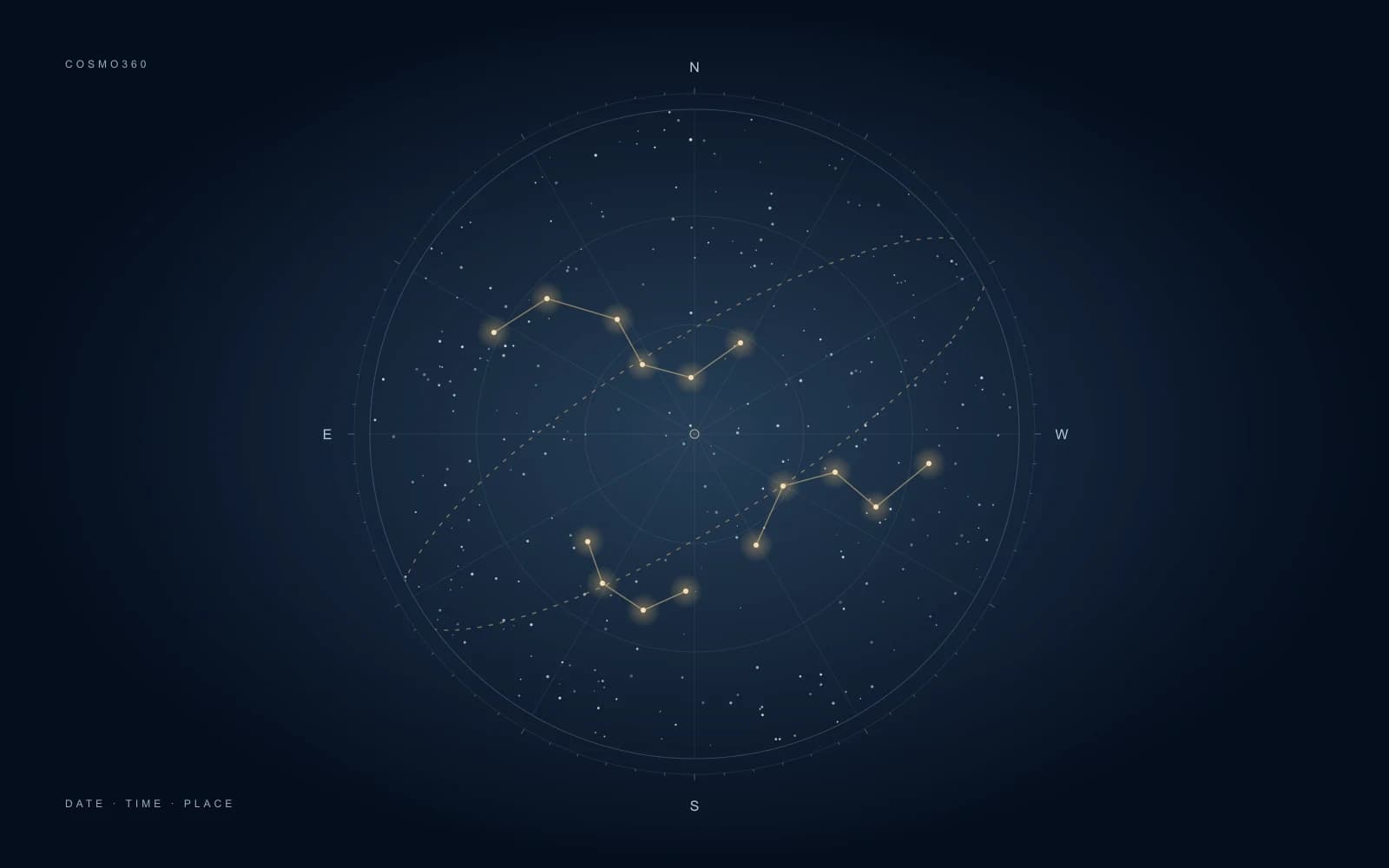
What a birth-date star map shows
Imagine a transparent dome above the place where you were born. On a typical circular map, the rim represents the horizon and the centre is the zenith, directly overhead. The picture shows directions towards celestial objects for a particular observer. It differs from a map of the entire celestial sphere: objects below the local horizon do not belong to that half of the sky.
Lines between stars help you recognise a pattern, but do not physically connect those stars. A modern constellation is an area of the celestial sphere with an agreed boundary. Stars in a familiar pattern may lie at very different distances. The map therefore records a view from Earth rather than the three-dimensional arrangement of every object.
Why the time and place matter as much as the date
Earth’s rotation changes the horizon’s position relative to the stars throughout the day. The same star may be below the horizon in the morning and high above it in the evening. Latitude determines which regions are accessible from your city, while longitude helps relate the local horizon to the selected moment. Two maps for the same calendar date can consequently look quite different.
Start with the time recorded in a document or family note, and establish whether it is local time. For an old date, the time zone in force then matters: today’s UTC offset may not apply. If a service chooses a zone from the city, check whether it accounts for historical changes and daylight saving. A one-hour error affects the orientation of the whole sky, not just the caption on a poster.
How to recreate the sky yourself
Open the Stellarium planetarium, choose a city or set the observer’s coordinates, then enter the date and time. Check the time zone and pause the clock so the scene does not keep changing while you explore it. Begin with the horizon and cardinal directions enabled: they make it easier to understand where you are looking. Then add constellation names and connecting lines.
Find one bright object and note its position: above the eastern horizon, for example, or high in the south. Advance the time by an hour and see what changes. This small experiment explains how the map works better than a long list of coordinates. To identify a constellation from a photo in a family archive, you need a separate photograph containing stars: a calculated map alone cannot establish what a camera recorded.
The Moon and planets: details worth looking for
The Moon adds a changing detail: both its phase and its position relative to the horizon matter. The illuminated fraction of its disc depends on the geometry of the Sun, Earth and Moon. A crescent does not mean Earth’s shadow has covered part of the Moon; that shadow is central to a lunar eclipse. Check the time too: a beautiful crescent on a calculated diagram might have been below the horizon at the moment you selected.
Planets move against the star background, so today’s view cannot stand in for every past date. For an independent check of a particular planet, JPL Horizons provides calculated ephemerides. You choose a target, observer location and time to obtain coordinates and visibility information. It is useful for a focused check, while a visual planetarium is easier for a first exploration.
What if you do not know your exact birth time?
Do not enter noon as though it were a known fact. Instead, make several versions, including the beginning and end of the interval you do know, and compare them. Across a wide interval, stellar positions above the horizon change and some objects rise or set. Uncertainty does not prevent an interesting exploration, provided the map’s caption makes it explicit.
If you only know the date, describe the result as “the sky at a chosen time on this day”. For a gift image, you can choose an evening hour and print it alongside the map. If your interest is specifically the birth event, separate the data you know from your assumptions. The personal story remains meaningful, and its basis becomes easier to understand.
How a sky map differs from a birth-data profile
Similar form fields do not necessarily produce the same kind of result. A planetarium asks where celestial objects were and what lay above the horizon. Natal charts and other symbolic systems use celestial positions as a basis for their own interpretations. Accurate coordinate calculations do not by themselves establish that those coordinates can reliably reveal someone’s personality or future events.
The vocabulary differs too. The sign of Aries in the tropical zodiac is a sector of the ecliptic equal in size to the other signs; the astronomical constellation Aries is an area with specific boundaries. Constellations have different sizes, so the two systems are not interchangeable. First establish what your chosen service displays: the visible sky, a coordinate diagram, or a symbolic language for reflecting on yourself.
From your own sky to personal reflection
Interest in your birth sky often begins with a very human question: “How does the wider world connect with my own story?” You can keep the map as a memento, or continue exploring yourself through questions and notes. A simple approach is to choose one topic, recall a specific situation and record your response, without trying to explain your entire life at once.
For a symbolic self-reflection exercise, you can create a Hologenetic Profile on Hologen, a Russian-language service, using your birth date, time and place. Its free offering includes an 11-sphere map, detailed descriptions of four Activation spheres and a PDF without registration. It is a symbolic self-reflection format based on Gene Keys, rather than an astronomical prediction or a genetic test. You can begin with one sphere and one question about your own experience.
Turn a personal map into an introduction to the real sky
Choose a constellation from the map that is visible from your city in an appropriate season, then look for it outdoors. Begin with bright stars and a broad pattern rather than the faintest dots on screen. A light pollution map can help you choose a location, but also check the cloud forecast and lunar illumination before setting out: a calculated chart cannot tell you how transparent the atmosphere will be.
Keep two separate notes: what you discovered about the sky and what you noticed about yourself. The first might contain the lunar phase, the direction of a bright planet and your observing time; the second might hold a memory or a question you want to revisit. Your birth date then becomes an invitation to look more closely at both the wider world and your own story.
Sources
Questions and answers
Can I create a birth-date star map for free?
Yes. The free Stellarium planetarium lets you choose a location, date and time and explore a calculated sky. Design and export options depend on the version you use.
Are a star map and a Hologenetic Profile the same thing?
No. A star map shows celestial positions relative to an observer. A Hologenetic Profile belongs to the symbolic Gene Keys system and is used for contemplation and self-observation. Shared input data do not make an interpretation an astronomical finding.
What is free on Hologen?
At publication, the free offering includes an 11-sphere map with keys and lines, detailed descriptions of four Activation spheres, and Activation PDF/TXT downloads without registration. Other sphere descriptions and personal readings are separate offerings.