Aries: weekly horoscope
—
Begin the week with a small step that needs no elaborate preparation. Give one idea a chance to become an action before looking for the next.
Plans and focus
Choose one task you have been putting off and identify its smallest first step. Leave the rest in your notes for now.
Communication
Instead of guessing someone else's plans, ask one direct, friendly question. Give them time to answer.
This week's activity
Open the Aries map, remember Hamal and try to recognize the three main stars in a photograph without connecting lines.
The weekly horoscope is original entertainment and a prompt for reflection, not a scientific prediction or a description of your personality. Its suggestions are not based on the influence of stars and do not replace your own judgment.
Constellation Aries.
A sign is a conventional zodiac sector; a constellation is a region of the starry sky. The sign dates above do not describe when the Sun is within the constellation's boundaries.
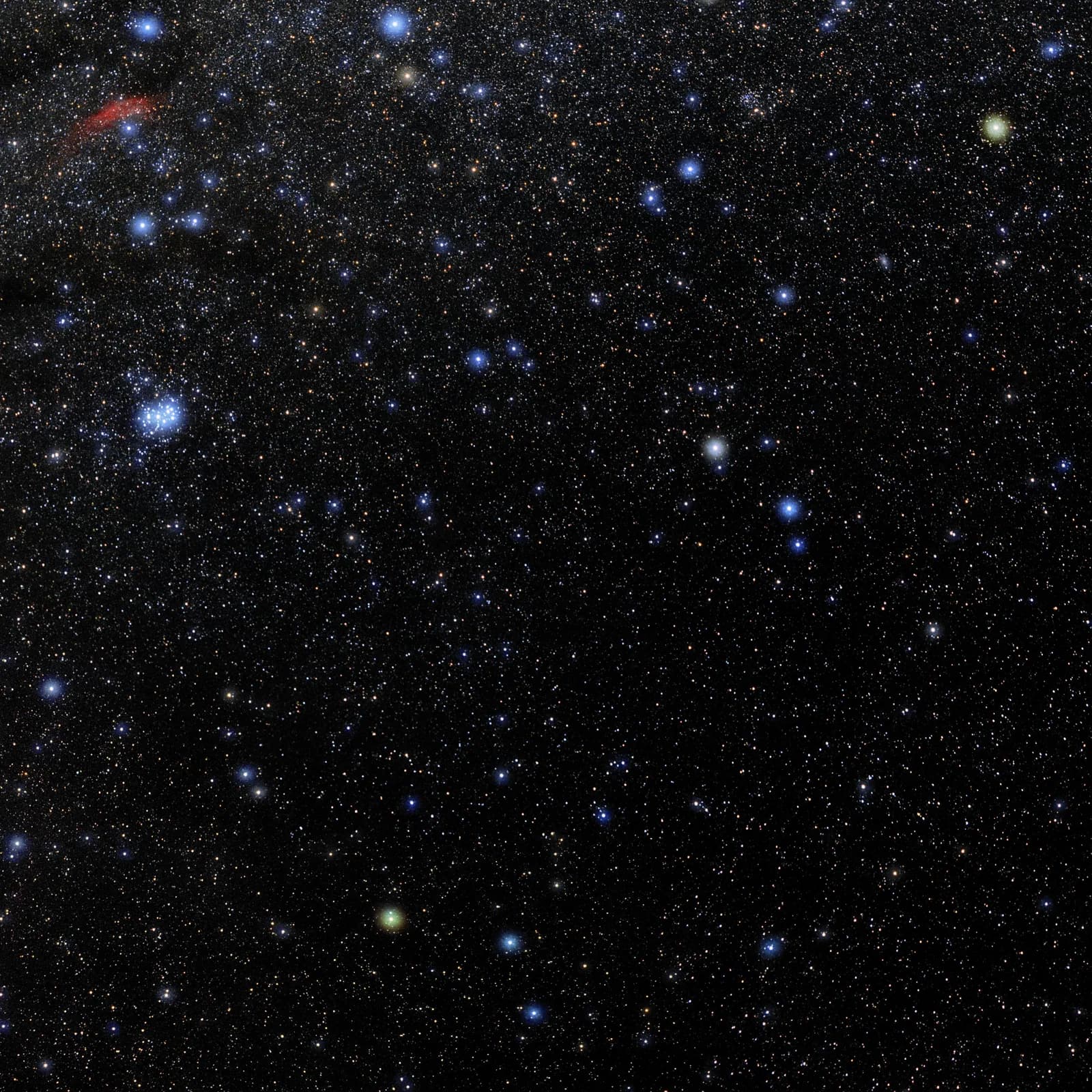
- Main guide star
- Hamal — α Arietis
- Two more stars
- Sheratan — β, Mesarthim — γ
- On the map
- Ari; between Pisces and Taurus
Seeing a ram in a handful of stars
The Latin word Aries means ram. On a modern star chart, the short chain of Hamal, Sheratan and Mesarthim draws the eye. To begin, simply remember the distances between them: your imagination fills in the animal's detailed silhouette.
Start with Hamal and check the neighboring stars one by one rather than trying to take in the entire constellation at once. Aries borders Pisces and Taurus in the atlas; those names will help you stay oriented as you zoom out.
From a paper atlas to a sky map
Aries appears on the Urania's Mirror cards published around 1825. Holes were punched through the stars: held up to the light, a card revealed the familiar pattern against an illustrated figure. The atlas made recognizing constellations a small act of discovery.
Try the same approach without paper: look at a photograph of Aries, turn the lines on and then hide them again. Look for a few reference points first, rather than an exact match to a drawing in an old atlas.
How to check that you have found Aries
It is easy to reverse the direction of Aries’ short chain. Begin with the wider view: locate neighbouring Pisces and Taurus, then centre Hamal and the next two reference stars. Compare the lengths of the gaps and the point where the chain changes direction. This check is more reliable than searching for imagined horns: the small bend remains recognisable when a chart is rotated or a photograph is framed differently.
Try a short exercise before going outdoors. Hide the names on a photograph, mark the three likely reference points, and then restore the labels. Matching just one bright point is not enough. Return to the wider field and check its neighbours. The aim is not a fast guess but the habit of confirming an identification with several stars, a useful skill for other inconspicuous constellations too.
What to compare in an old star card and a modern photograph
A historical card shows how its maker connected star positions to a cultural image. A modern photograph records something different: faint objects, colours, and background detail that an illustrator could leave out. Align the principal stars first, then examine the ram’s pose. Otherwise a convincing silhouette may encourage false matches when the photograph simply has a different orientation or scale.
In Urania’s Mirror, light passed through holes representing stars. Switching between a photograph and chart lines creates a related experience on screen, but the lines remain human guidance. They are not luminous threads in space. In your own notes, separate the pattern you can actually identify from the image that helps you remember it. Both are interesting, although they answer different questions.
A short observing route through Aries
Set your location and time on the map, then check Hamal’s height. If a roof or tree blocks the direction, magnifying the image will not help; choose another position or a later hour. Give the first session a single goal: confidently recognise the chain. Fainter, distant targets can wait for another night, once the basic pattern is familiar.
Compare the unaided view with a wide binocular field if binoculars are available. Keep the main reference stars inside the field; a tight close-up can turn a simple chain into unfamiliar isolated points. You do not need to detect every possible star at once. Maintaining the connection between the naked-eye view, the instrument, and the selected chart region is more useful.
After observing, make a small sketch and record the date, time, and conditions: moonlight, clouds, and the stars you confirmed. Compare the drawing with the chart at home. This record shows progress more clearly than simply writing “good visibility”. Next time you will have a specific task: check a missed star or recognise the same bend without an on-screen hint.
What the star pattern looks like
Questions about the sign and constellation
Which star should I start with to find Aries?
Hamal, marked α Arietis on the map. Then compare its position with Sheratan and Mesarthim. Before observing, check whether the constellation is above the horizon at your location and chosen time.
Why does Aries look different in different atlases?
The ram is a way of remembering the stars. Different authors may connect them differently; the astronomical constellation is defined by the boundaries of a region of the sky.
Sources and photograph
The sources below support the astronomical information. The horoscope is original COSMO360 entertainment content; it is not a conclusion drawn by NASA, the IAU or observatories.
- IAU / Sky & Telescope: constellation chart for Aries
- Royal Museums Greenwich: Urania's Mirror cards
- IAU: constellations, their names and official boundaries
- NASA Space Place: constellations, astronomy and astrology
- NASA Night Sky Network: zodiac signs and constellations
- Original photograph — E. Slawik/NOIRLab/NSF/AURA/M. Zamani
- CC BY 4.0 terms
- Chart: HYG 4.1 catalog, J2000 coordinates