Taurus: weekly horoscope
—
Do not rush to complicate what already works. This week, try finding support in a familiar rhythm and simple activities you enjoy.
Plans and focus
Return to one useful routine: gather your notes, clear your workspace or finish a small piece of something you have started.
Communication
Suggest a relaxed activity with someone close to you, with no need to keep rushing somewhere.
This week's activity
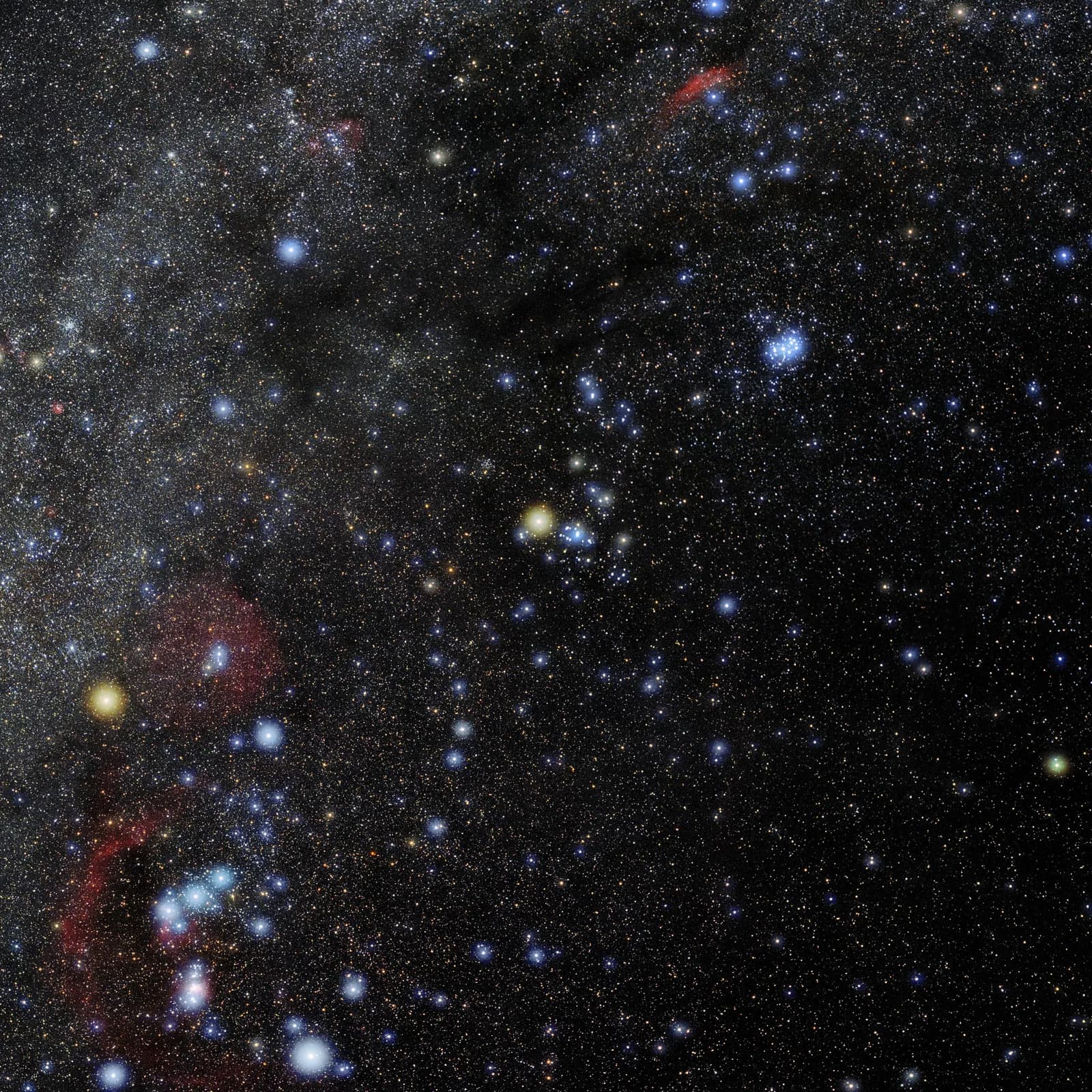
Compare the Hyades and Pleiades on the map. Write down one difference you can explain without a prompt.
The weekly horoscope is original entertainment and a prompt for reflection, not a scientific prediction or a description of your personality. Its suggestions are not based on the influence of stars and do not replace your own judgment.
Constellation Taurus.
A sign is a conventional zodiac sector; a constellation is a region of the starry sky. The sign dates above do not describe when the Sun is within the constellation's boundaries.
- Bright guide star
- Aldebaran — α Tauri
- The bull's head
- The V-shaped Hyades
- Star cluster
- The Pleiades — M45
The bull's head and two star clusters
Taurus is the celestial bull. Aldebaran marks its eye on the map, while long chains of stars suggest its horns. The recognizable V-shaped Hyades let you move from one bright point to a whole region of the sky.
Find Aldebaran in a wide-field image, then the Pleiades. These are separate landmarks within one constellation, so do not look for the entire Taurus pattern inside the compact Pleiades group.
Why Aldebaran is not part of the Hyades
Aldebaran appears in the same direction as the Hyades, but it is closer to us and is not a member of the cluster. Our view of the sky brings together objects at different distances: proximity in a photograph does not necessarily mean proximity in space.
The Pleiades is also an open cluster, separate from the Hyades. Take in the whole group first: wide-field binoculars help you see more stars than the naked eye. The number of points you can distinguish depends on the conditions and your eyesight.
Why the Hyades and Pleiades need different fields of view
The Hyades form a much more spread-out pattern in the sky than the compact Pleiades. If a field tightly framed around the Pleiades is moved to the bull’s head, part of the Hyades’ V will fall outside the view. First assess the whole region without magnification, then inspect each group separately. Choose the chart scale according to the task: locating Taurus or exploring a particular cluster.
On a photograph, locate Aldebaran and imagine removing it from the Hyades pattern. This separates an attractive line-of-sight arrangement from actual cluster membership. Then find the Pleiades and compare the density of visible points. The two sights can look quite different even though both are open clusters; that classification does not mean every group has an identical appearance.
Why the distance to the Pleiades matters
Different methods once produced noticeably conflicting distances for the Pleiades. Comparing satellite astrometry, Hubble observations, and radio interferometry helped test the result. The distance matters for more than an impressive number: it affects the stars’ inferred true brightness. An error in the cluster’s address also affects conclusions about its stellar properties.
Apparent brightness tells us how much light reaches us, not how much energy a star emits. Imagine identical lamps placed at different distances: the nearer one appears brighter. Stellar observations also require allowance for absorbed light. A photograph of Taurus is therefore useful for relative positions, but it cannot replace distance measurements and calculations of physical properties.
How to explore Taurus without expecting seven identical stars
Do not turn the number of visible Pleiades into an eyesight test. Sky brightness, atmospheric transparency, and individual perception all affect it. Instead, record the points you can confidently identify that evening and compare them with a photograph. Seeing far more stars in the image does not mean your observing attempt failed; a camera and the eye collect information differently.
For a personal chart, draw the broad Hyades V and the small Pleiades group separately, then mark the gap between them. Use another colour for Aldebaran and label it as foreground. This simple drawing reinforces orientation without suggesting that all the bright points lie on one plane. It also provides a useful reference for later comparisons with a star atlas.
Finish with three short answers: where the Taurus figure lies, which clusters you found, and why Aldebaran is marked separately. If you can explain these without the mythological illustration, the region has become more familiar. On a later visit, change just one factor—observing time, location, or instrument—and compare the impression of the same pattern.
What the star pattern looks like
Questions about the sign and constellation
Is Aldebaran part of the Hyades cluster?
No. It lies in the foreground. The V-shaped group and the bright orange star form one pattern only from our point of view.
Is the Pleiades a separate constellation?
No, it is the star cluster M45 in Taurus. Its compact pattern is often recognized before the sprawling figure of the constellation itself.
Sources and photograph
The sources below support the astronomical information. The horoscope is original COSMO360 entertainment content; it is not a conclusion drawn by NASA, the IAU or observatories.
- IAU / Sky & Telescope: constellation chart for Taurus
- NASA: the young stars of the Hyades and Pleiades
- NASA Space Place: constellations, astronomy and astrology
- NASA Night Sky Network: zodiac signs and constellations
- Original photograph — E. Slawik/NOIRLab/NSF/AURA/M. Zamani
- CC BY 4.0 terms
- Chart: HYG 4.1 catalog, J2000 coordinates