Pisces: weekly horoscope
—
Give your imagination a concrete form: a drawing, a note or a small finished story. Do not judge the idea too early; first try to express it.
Plans and focus
Save one idea you like in a tangible form. A few sentences or a sketch can be something to return to.
Communication
Share something that surprised you, and invite the other person to tell you about a small discovery of their own. You do not have to reach a shared conclusion immediately.
This week's activity
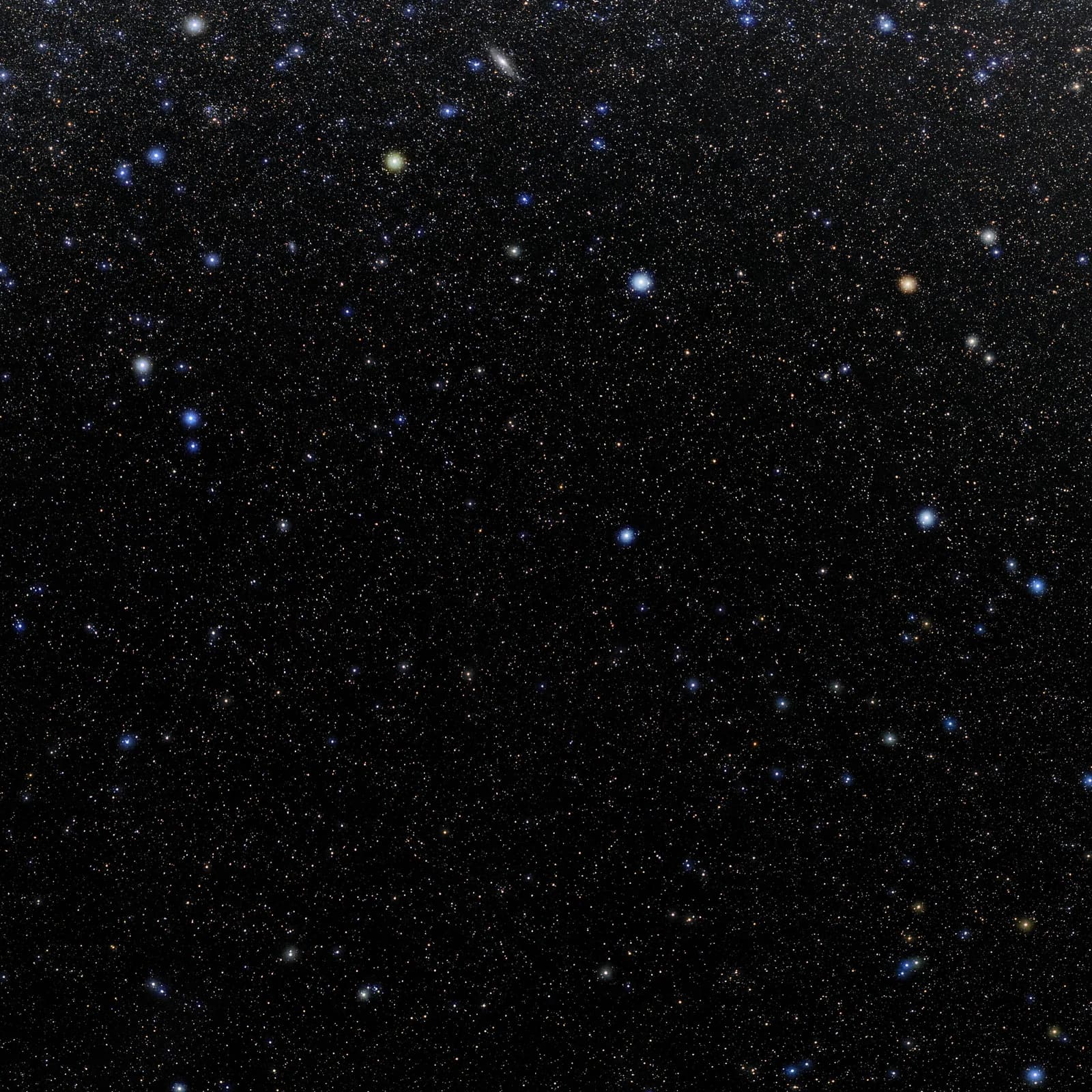
Compare a wide-field view of Pisces with a close-up of M74. Think about how many different scales fit into one direction in the sky.
The weekly horoscope is original entertainment and a prompt for reflection, not a scientific prediction or a description of your personality. Its suggestions are not based on the influence of stars and do not replace your own judgment.
Constellation Pisces.
A sign is a conventional zodiac sector; a constellation is a region of the starry sky. The sign dates above do not describe when the Sun is within the constellation's boundaries.
- Guide star
- Alrescha — α Piscium
- Deep sky
- M74 — spiral galaxy
- Distance to M74
- About 32 million light-years
Two fish and a long stellar connection
On the map, Pisces depicts two fish linked by long lines. Alrescha is labeled α Piscium; from this region, you can trace the diverging chains and gradually assemble the larger figure.
Start with a wide field near Pegasus, then compare individual segments. If faint stars disappear against the city sky, photographs and maps can prepare you for observing under darker conditions.
Why M74 is considered a difficult target
We see M74 almost face-on, so its spiral arms stand out in photographs. It lies about 32 million light-years away and was discovered by Pierre Méchain in 1780.
A beautiful photograph does not make M74 an easy visual target. Because of its low surface brightness, it may look like a very faint patch through a small telescope. It is especially important here to distinguish the richness of a long exposure from the experience of looking through an eyepiece.
Assembling Pisces’ long figure step by step
Pisces does not fit into an imagined small sky icon. Start at Alrescha and follow only one branch, remembering its turning points. Return to the beginning before tracing the other. Jumping between distant ends can confuse scale and join the wrong stars. Two short verified routes are more useful than a single approximate outline.
Keep the surrounding Pegasus region visible in the first photograph, adding detail after recognising the broad area. Hide the lines and try locating the turning points yourself. If the figure falls apart, do not brighten every point until they look alike. Restore the overview and check the initial reference. Long-gap proportions matter more than resemblance to an illustrated fish.
What M74’s low surface brightness means
An extended galaxy’s total light is spread over an area. An object with a measurable integrated brightness can therefore have extremely faint outer regions. The eye needs contrast against the background. M74’s nearly face-on view exposes its spiral structure in photographs without concentrating all its light into a compact point. This explains difficult detection without suggesting the galaxy has switched off.
Compare a wide field with a detailed arm portrait. Use the first for stellar references and the second for the target’s structure. Do not transfer professional processing contrast into eyepiece expectations. A faint rounded glow at a verified position can be a successful first record. Calling it a failure because coloured arms are absent would compare different methods without allowing for their capabilities.
A patient approach to learning Pisces
Choose several turning points in the atlas and note the order in which you will find them. A long letter list is unnecessary; a simple “start–bend–branch” sketch will do. Reproduce the route without the screen after your outing. This reinforces relative positions, allowing the next search to begin with a familiar structure rather than an entire field of faint stars.
Mark M74 separately as a galaxy so Pisces’ long lines do not suggest membership in one connected stellar chain. A single diagram combines vastly different distances. Explain this to a friend using the constellation chart followed by the galaxy image. If the transition makes sense without inventing a shared distance, the map is becoming a tool for understanding space.
Choose one improvement for a second session: a clearer view, less interfering light, or a region studied beforehand. Record the stars you confirmed and whether the deep-sky target appeared. Do not copy an atlas result in place of your own impression. Pisces makes it particularly rewarding to watch modest preparation turn an uncertain scatter into a recognisable celestial address.
What the star pattern looks like
Questions about the sign and constellation
Are Pisces and Piscis Austrinus the same constellation?
No. Pisces has the abbreviation Psc. The Southern Fish is a separate constellation, Piscis Austrinus, abbreviated PsA.
Why is M74 bright in photos but almost invisible through a telescope?
Its light is spread over a large apparent area. A camera accumulates signal during an exposure, while the eye does not produce the same image instantly. Sky conditions and the instrument strongly affect the result.
Sources and photograph
The sources below support the astronomical information. The horoscope is original COSMO360 entertainment content; it is not a conclusion drawn by NASA, the IAU or observatories.
- IAU / Sky & Telescope: constellation chart for Pisces
- NASA / Hubble: the spiral galaxy M74
- IAU: constellations, their names and official boundaries
- NASA Space Place: constellations, astronomy and astrology
- NASA Night Sky Network: zodiac signs and constellations
- Original photograph — E. Slawik/NOIRLab/NSF/AURA/M. Zamani
- CC BY 4.0 terms
- Chart: HYG 4.1 catalog, J2000 coordinates