Aquarius: weekly horoscope
—
Try a small experiment with your usual routine. Test one new idea and allow yourself to keep only what turns out to work well.
Plans and focus
State a hypothesis and devise a simple way to compare the result with your usual approach. Give yourself permission to abandon the idea.
Communication
Suggest an unusual activity together: exchange favorite space images or share a short story about an unexpected discovery.
This week's activity
Look at a photograph of the Helix and label what belongs to the star and what belongs to its gaseous shell.
The weekly horoscope is original entertainment and a prompt for reflection, not a scientific prediction or a description of your personality. Its suggestions are not based on the influence of stars and do not replace your own judgment.
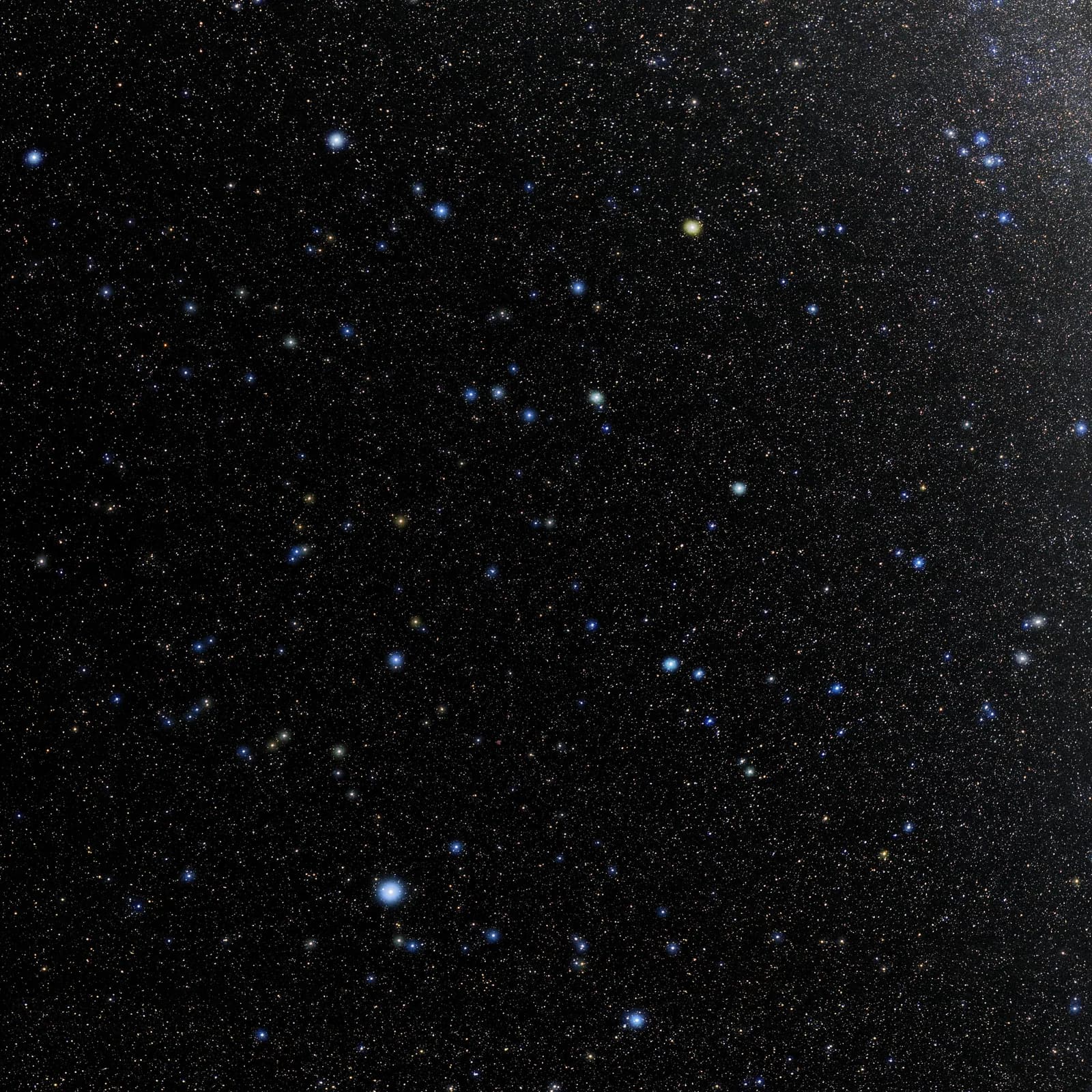
Constellation Aquarius.
A sign is a conventional zodiac sector; a constellation is a region of the starry sky. The sign dates above do not describe when the Sun is within the constellation's boundaries.
- α Aquarii
- Sadalmelik
- β Aquarii
- Sadalsuud
- Helix Nebula
- NGC 7293 — planetary nebula
A celestial water bearer without a bright signpost
The name Aquarius refers to a water bearer. Its stars do not form one bright, compact group, so begin with Sadalmelik and Sadalsuud, labeled on the map.
Locate Aquarius relative to Capricornus and Pisces. Then zoom in gradually: jumping straight to individual chains makes it easy to lose the scale of the larger figure.
The Helix: a shell, not a planet
The Helix Nebula, NGC 7293, lies in the direction of Aquarius. Its gaseous shell comes from a late stage in the life of a star that shed its outer layers. A hot, compact stellar remnant remains at the center.
The term 'planetary nebula' does not mean a planetary system. Images of the Helix show gas structures revealed through observations at different wavelengths. Such a photograph is a way to study stellar evolution, not a portrait of a celestial water bearer.
Finding your way through extensive Aquarius
Aquarius is easier to learn through several local chains than by trying to recognise a complete water-bearer at once. Connect Sadalmelik and Sadalsuud to their surroundings first, then choose a small area to check. Return to the overview after each close-up. New stars acquire a place in the broader figure rather than remaining a list of accidentally noticed points.
In an unlabelled photograph, mark only references you can confirm from their relative positions. Add the imagined stream of water as a separate layer after checking the stars. The cultural figure should help memory rather than decide which points must fit. This is especially useful when sky brightness hides parts of long faint chains and imagination fills the gaps.
Reading a multiwavelength Helix image
The gaseous shell and the hot central remnant emit differently. A composite Helix image may combine several instruments, with colours used to present their signals. Before comparing two pictures, check the wavelengths included in each. Different colouring does not mean the nebula suddenly changed colour between exposures or that one image must be inaccurate.
In a close-up, distinguish the central region, internal structures, and faint outer shell. Outer detail may require a different contrast setting from the bright interior. A cropped photograph can therefore look complete while showing only part of the object. The frame boundary reflects observing choices and composition, not necessarily the nebula’s physical edge.
What to expect when searching for NGC 7293
Do not look for a small bright planet merely because the nebula is called planetary. The name reflects a historical classification; the observing target is faint and extended. Confirm the surrounding star field first. If the target remains undetected, retain the route and compare conditions rather than declaring the nearest round point to be the Helix.
Prepare two drawings: Aquarius with its main references, and a separate target field. Mark direction and scale on the latter so a nebula portrait does not replace a finding chart. The photograph reveals the structure of an identified object; the chart guides you to its location. When switching views, ask whether you are finding an address or examining physical structure.
After exploring the Helix, retell its brief story: a star shed its outer layers, the material formed the observed shell, and a compact remnant remained. Identify what the selected image actually shows and what comes from research. This explanation provides more understanding than comparing the nebula to an eye or another familiar object, although visual associations can still aid memory.
What the star pattern looks like
Questions about the sign and constellation
Is the Helix a galaxy?
No. NGC 7293 is a planetary nebula: a shell of gas associated with the evolution of an individual star. It is a different kind of object from a galaxy containing billions of stars.
Which stars help me navigate Aquarius?
Sadalmelik is α Aquarii and Sadalsuud is β Aquarii. Find them in a wide field, then gradually move to the fainter stars; check local visibility using your time and coordinates.
Sources and photograph
The sources below support the astronomical information. The horoscope is original COSMO360 entertainment content; it is not a conclusion drawn by NASA, the IAU or observatories.
- IAU / Sky & Telescope: constellation chart for Aquarius
- NASA: the Helix Nebula and a star's shed outer layers
- NASA Space Place: constellations, astronomy and astrology
- NASA Night Sky Network: zodiac signs and constellations
- Original photograph — E. Slawik/NOIRLab/NSF/AURA/M. Zamani
- CC BY 4.0 terms
- Chart: HYG 4.1 catalog, J2000 coordinates