Capricorn: weekly horoscope
—
Choose a manageable pace and the next stretch of a larger journey. Leave room in your plan for everyday life, and celebrate a small completed stage on its own.
Plans and focus
Break one large task into short stages and choose only the one you can realistically finish now.
Communication
Agree on a simple shared task so that each person has a clear, comfortable role. Ask questions instead of silently assigning responsibilities.
This week's activity
Find M30 on the Capricornus map and read about the difference between a globular cluster and an open cluster.
The weekly horoscope is original entertainment and a prompt for reflection, not a scientific prediction or a description of your personality. Its suggestions are not based on the influence of stars and do not replace your own judgment.
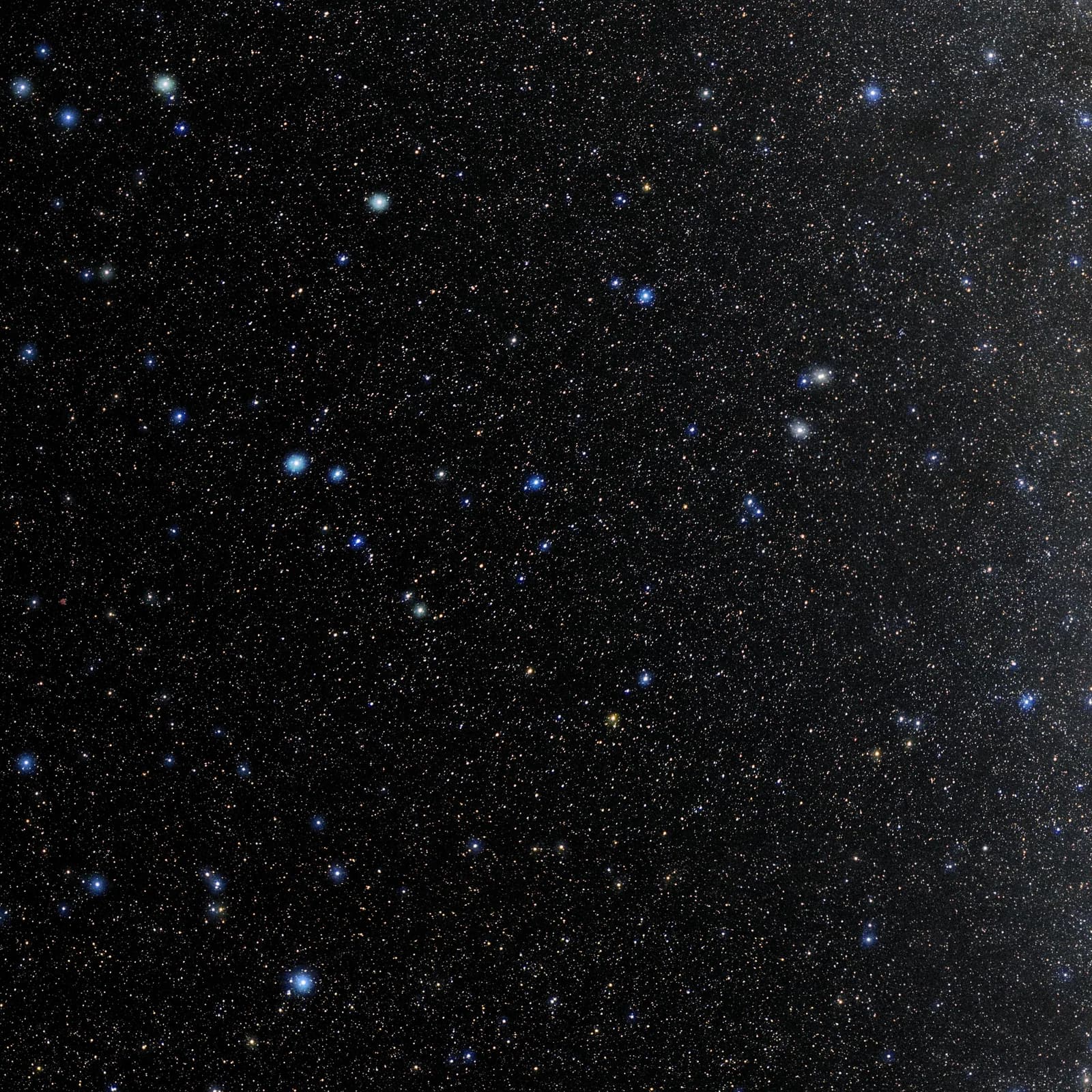
Constellation Capricorn.
A sign is a conventional zodiac sector; a constellation is a region of the starry sky. The sign dates above do not describe when the Sun is within the constellation's boundaries.
- Guide star on the map
- Deneb Algedi — δ Capricorni
- Deep sky
- M30 — globular cluster
- Distance to M30
- About 28,000 light-years
Where to find the sea goat
The traditional image of Capricornus is a sea goat, an imaginary combination of goat and fish. On a star chart, a broad, angular figure between Sagittarius and Aquarius takes the place of a detailed animal.
Start by marking Deneb Algedi, then compare the distances to the other vertices of the pattern. At northern latitudes, choose an open southern horizon and check the constellation's altitude for your location in advance.
Ancient stars in M30
The globular cluster M30 lies about 28,000 light-years away. Charles Messier discovered it in 1764. Unlike the imagined figure of Capricornus, it is a dense physical system of many stars.
Hubble images let astronomers study M30's 'blue stragglers', stars that appear younger than the surrounding old population. Mass transfer in binary systems and collisions help explain how this difference arises.
Why Capricornus is best approached as a wide outline
Capricornus need not immediately resemble a mythical animal. Mark the main corners of its angular outline and locate Deneb Algedi. Compare the whole figure with neighbouring Sagittarius and Aquarius before inspecting small chains. Starting with a close-up can leave faint stars without context; the broad outline gives them a stable setting.
On paper, retain only three or four turning points with their actual proportions. Add the remaining chart stars in another colour. The sketch shows which references help you recognise Capricornus and which details still depend on guidance. It is more useful on a first outing than trying to memorise a long list of faint-star names.
Why some M30 stars look unexpectedly young
An old globular cluster can contain stars whose properties seem unusual for its general population. These are called blue stragglers. Interactions help explain the mismatch: matter can pass between binary components, and close encounters can alter individual objects. “Looks younger” therefore does not mean that the entire cluster was recently born again.
Detailed M30 imaging matters because it separates the light of many stars. The same area may remain an unresolved glow in a backyard instrument. The impressions are compatible: different instruments reveal different levels of detail. Check whether a scientific statement concerns the whole cluster or selected stars within it. One unusual population does not describe every member.
Connecting a Capricornus chart to the search for M30
Retain Deneb Algedi as a starting reference, but prepare a detailed field for M30. Do not estimate the cluster’s location from the sea-goat illustration. Deep-sky targets need an accurate address relative to nearby stars. Save both the overview and the target field, making sure the transition remains understandable without constellation lines.
Begin by searching for a faint compact glow and confirming its position. Do not expect to resolve a multitude of stars immediately. Note how magnification changes the view and whether reference stars remain near the field edges. An excessively tight field can make it harder to distinguish the cluster from an unfocused star or a transient observing artefact.
Capricornus brings together three independent stories: the cultural sea-goat image, the visible stellar outline, and M30’s physical evolution. Label them separately. The myth’s antiquity then cannot be mistaken for a measurement of cluster age, and a zodiac sign cannot replace an actual sky region. This turns a familiar name into the beginning of a precise astronomical account.
What the star pattern looks like
Questions about the sign and constellation
Why is Capricorn drawn with a fish's tail?
This traditional imaginary sea-goat figure has survived in celestial cartography. It helps us remember the name, but does not describe a physical relationship between the stars.
What does M30 mean on a map of Capricornus?
It is a globular star cluster in the Messier catalog. Its light takes about 28,000 years to reach us; it lies far beyond the stars used to recognize the constellation's pattern.
Sources and photograph
The sources below support the astronomical information. The horoscope is original COSMO360 entertainment content; it is not a conclusion drawn by NASA, the IAU or observatories.
- IAU / Sky & Telescope: constellation chart for Capricorn
- NASA / Hubble: the globular cluster M30
- IAU: constellations, their names and official boundaries
- NASA Space Place: constellations, astronomy and astrology
- NASA Night Sky Network: zodiac signs and constellations
- Original photograph — E. Slawik/NOIRLab/NSF/AURA/M. Zamani
- CC BY 4.0 terms
- Chart: HYG 4.1 catalog, J2000 coordinates