A total solar eclipse on 2 August 2027 will offer a maximum totality duration of about 6 minutes 23 seconds. Its narrow shadow path will cross southern Spain, North Africa and parts of the Middle East. Russia will not experience totality, although parts of European Russia will see a partial eclipse. Choose a site using the exact shadow boundaries, and check timings for that location rather than using the global maximum quoted in a headline.
- Six minutes 23 seconds is the longest total phase anywhere along the path, not the duration at every location.
- Totality is visible only inside a narrow path; most European observers will see a partial eclipse.
- Check the local beginning, maximum and end separately. A table in UTC and one in local time show different clock readings.
- Within Russia’s partial-eclipse region, direct viewing requires proper solar filters throughout the event.
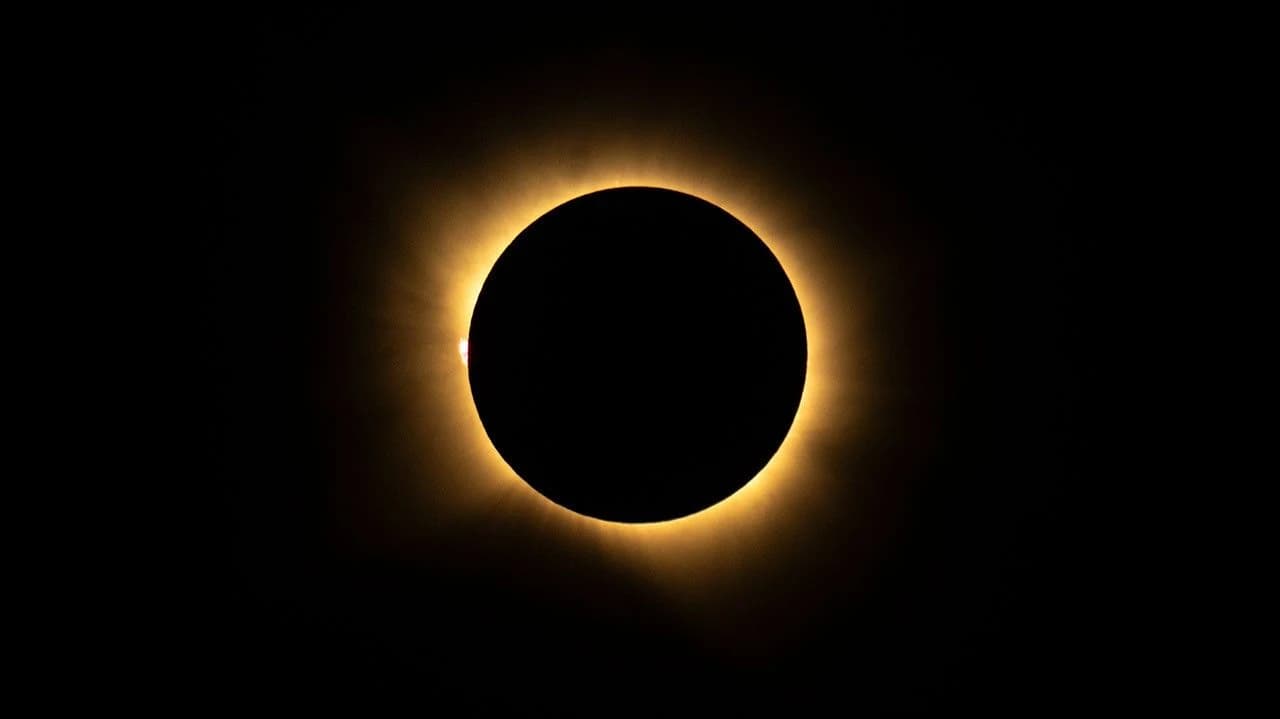
What will happen on 2 August 2027?
The Moon will pass between the Sun and Earth, and its shadow will sweep across our planet’s surface. Inside the central path, the lunar disc will completely cover the Sun’s bright face. The corona, the outer solar atmosphere normally overwhelmed by that bright light, will become visible. Outside that path but within the penumbra, the Sun will be only partially covered.
Saying that an eclipse is visible in a country does not establish which type a particular observer will see. A city can be close to the totality path and still miss totality. Even a very deep partial eclipse differs from a total one: an uncovered edge of the solar disc remains bright, so eye protection is still required.
Where will the total eclipse be visible?
The total shadow begins in the Atlantic, crosses the Strait of Gibraltar region and travels through North Africa towards Egypt. It then crosses the Red Sea and parts of Saudi Arabia and Yemen before heading into the Indian Ocean. NASA’s regional list includes southern Spain, Morocco, Algeria, Tunisia, Libya, Egypt, Saudi Arabia and Yemen. Those names identify sections of the path, rather than promising totality throughout each country.
IGN gives more detail for Spain: the path includes Ceuta and Melilla, almost all of Cádiz province, part of Málaga province, and the southernmost parts of Granada and Almería provinces. Choosing “Spain” or the nearest major city is not enough. The observing site’s coordinates must lie inside the total shadow boundaries, which can be checked on NASA’s interactive map or IGN’s maps.
How long will totality last at different locations?
The longest totality anywhere along the path will be about 6 minutes 23 seconds, in the Egyptian section. That is unusually long, but not an all-time record for solar eclipses. Other locations get less time. Near the edge of the path, the interval with the whole solar disc hidden becomes shorter; beyond the boundary, there is no total phase.
For example, IGN gives approximately 4 minutes 48 seconds of totality for Ceuta, 2 minutes 54 seconds for Cádiz, 1 minute 48 seconds for Málaga, and 4 minutes 34 seconds for Melilla. These are figures for the specified cities, not universal values for their surrounding areas. The full sequence from the Moon’s first contact with the solar disc to its final departure lasts much longer than those few minutes.
Will the eclipse be visible in Russia?
Russia is outside the totality path on 2 August 2027. The overview visibility map shows a partial eclipse in parts of European Russia, with generally deeper coverage in the southwest than near the northern limit. This does not imply visibility throughout the country: the observer’s position determines whether they enter the penumbra at all and how much of the Sun the Moon covers.
For Moscow, St Petersburg, Sochi or any other city, consult the local-circumstances calculation separately. Check the beginning, maximum coverage, end and solar altitude. Do not expect total darkness or an exposed corona within Russia’s partial-eclipse region. Direct viewing requires a proper solar filter throughout, even if the Sun appears as only a slim crescent.
When to watch: global maximum versus local time
There is no single starting time for every city. IGN’s Spanish information places morning totality at roughly 10:45–10:50 in mainland Spain’s official time, depending on the city. That is neither the start of the entire eclipse nor Moscow time. NASA’s map reports local circumstances in Universal Time, so check the stated time system before observing.
The global maximum occurs at approximately 10:06 UTC in the Egyptian region; converting that instant to Moscow time gives about 13:06. That conversion does not determine Moscow’s local maximum, which needs its own calculation. Tables can differ by seconds because of their models and treatment of the uneven lunar limb. For an observing session, check an up-to-date calculation for the chosen site and the local time zone in force near the date, particularly when abroad.
Why will this eclipse last so long?
The Moon’s apparent size changes as it moves along its elongated orbit. The Sun’s apparent size changes too, because Earth’s distance from it varies during the year. A sufficiently large-looking lunar disc can completely cover the Sun; a smaller one produces an annular eclipse. The shadow’s path across Earth and the observer’s motion with the rotating planet also affect the duration.
This connects to the changing lunar distance discussed in explanations of a supermoon, but a full Moon and a solar eclipse require different alignments. For a solar eclipse, the Moon must be between Earth and the Sun, at new Moon. At full Moon, it is on Earth’s opposite side. A claim of a full-Moon supermoon occurring simultaneously with a solar eclipse mixes up different events.
How to view the eclipse safely with your eyes
For direct viewing of the partial phases, use eclipse glasses or a handheld solar viewer conforming to ISO 12312-2 from a reputable manufacturer. Ordinary sunglasses are unsuitable. Inspect the filter first: do not use one that is damaged, torn or scratched. Cover your eyes before looking towards the Sun, and turn away before removing the viewer. Children need adult supervision.
Inside the totality path, unaided viewing without a filter is possible only during the brief interval when the Sun’s bright face is completely hidden. Replace protection as soon as the first bright portion returns. That exception does not apply to a partial eclipse and does not replace the separate rules for optics. Russia will have no such interval of totality on 2 August.
Telescopes, binoculars and cameras need different protection
Eclipse glasses worn over your eyes do not make it safe to look through unfiltered binoculars, a telescope or an optical viewfinder. The instrument gathers and concentrates light, which can damage the viewer and your eyes. Such equipment needs a suitable solar filter securely mounted over its front, Sun-facing aperture. Discuss the choice and mounting with an experienced solar observer beforehand.
For a first eclipse, a suitable handheld viewer or safe projection is a simpler starting point. Do not leave binoculars or a telescope pointing at the Sun unattended, especially around children. If taking photographs, prepare the filtration and aiming method in advance; a phone’s illuminated display alone does not establish that the whole imaging setup is safe.
Can you observe without eclipse glasses?
You can observe the Sun indirectly: a small hole in an opaque card projects its image onto another surface. Stand with your back to the Sun and look at the projection. As the Moon moves across it, the image becomes crescent-shaped. The hole is not a filter, and must never be used to look at the Sun. Small gaps between leaves can produce a similar pattern of solar images on the ground.
How to prepare and choose a viewing site
First decide which experience you want: totality requires being inside the path, while a partial eclipse is visible over a wider region. Then check the exact site on a map, the relevant horizon and all contact times. Clear skies matter more than a few additional predicted seconds: clouds can hide the entire short total phase. Long-term weather statistics help compare regions, but cannot guarantee conditions on the day.
A night-sky light-pollution map is not the main site-selection tool for a daytime eclipse: clouds and obstructions in front of the Sun matter more. Prepare verified filters, water, ordinary sun protection and enough travel time. If totality is the reason for a trip, check its duration at the actual observing site rather than relying only on a region’s promotional description.
Sources
- NASA — future eclipses and visibility regions
- IGN — the total solar eclipse of 2 August 2027
- NASA GSFC — interactive map and local circumstances
- NASA GSFC — totality-path table
- NASA GSFC — overview visibility map for 2 August 2027
- NASA — types of solar eclipses
- NASA — eclipse viewing safety
- American Astronomical Society — eye safety
- American Astronomical Society — solar filters and vetted manufacturers
Image
Questions and answers
Will 2 August 2027 be the longest eclipse in history?
No. A maximum of about 6 minutes 23 seconds makes it unusually long, but not the all-time record for total solar eclipses. The figure applies to the most favourable part of the path.
Will Moscow see a total eclipse?
No. Moscow is outside the total shadow path. Check city-specific calculations for partial-eclipse timings and coverage; the global maximum does not give those values.
Does the whole eclipse last six minutes?
No. That is approximately the longest total phase at one location. Partial phases before and afterwards last much longer, and the precise schedule depends on the coordinates.
Can I remove eclipse glasses when 99 percent of the Sun is covered?
No. Direct viewing needs proper protection while any part of the Sun’s bright face remains visible. The exception applies only to genuine totality inside its path.
Can I use binoculars while wearing eclipse glasses?
Not with unfiltered binoculars. The optics need their own correctly mounted solar filters over the front apertures. Without suitable preparation, use a handheld viewer or projection instead.