When is the next supermoon in 2026?
Mark two dates towards the end of 2026: November 24 and December 24. Both appear in NASA's list of upcoming supermoons. Russian readers should convert UTC to local time immediately: Moscow uses UTC+3, while other regions have different offsets. The international date and the date on a local clock do not always match. The same astronomical event occurs at one instant worldwide, but local calendars describe it differently.
In Moscow, the November full phase occurs at 17:54 and the December full phase at 04:28. Those numbers do not tell you when the Moon appears above your building. Moonrise and moonset depend on the observer's location. Select your city in an astronomical calendar, then check the local horizon and cloud forecast. For photography, that is more useful than waiting beside a window for the exact instant of full Moon.
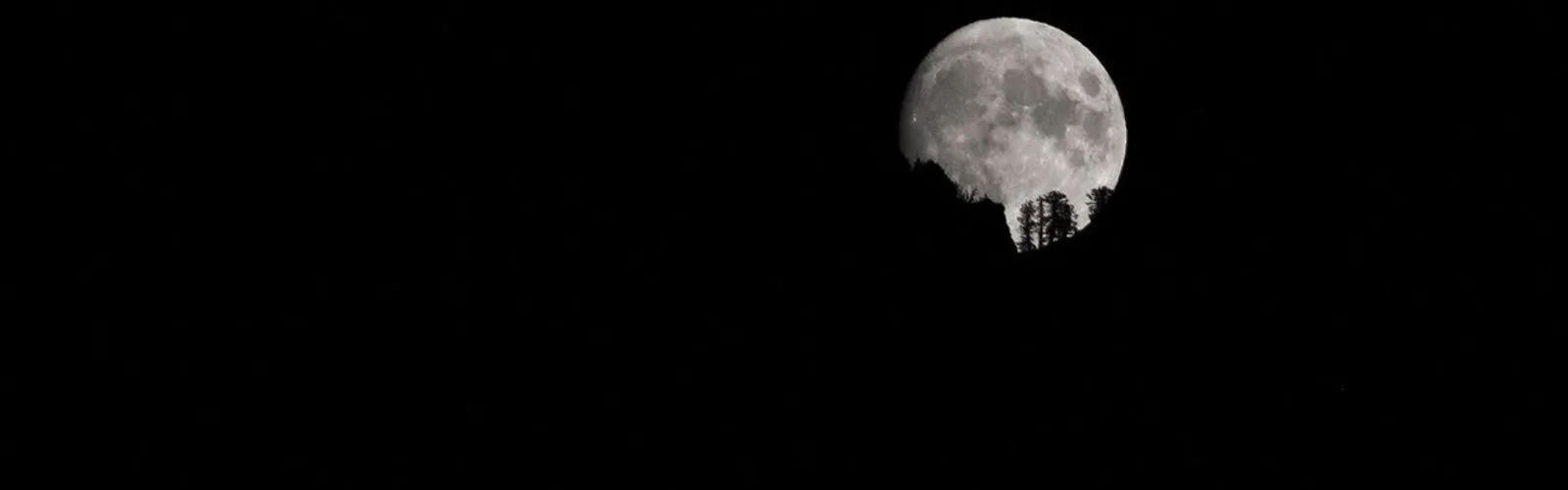
What is a supermoon in simple terms?
The Moon follows an elliptical orbit around Earth, so its distance changes. The closest point is called perigee and the farthest apogee. A full Moon occurring sufficiently close to perigee is popularly called a supermoon. It remains the same physical object: what changes is the distance from which we view its illuminated side, rather than the Moon acquiring a new surface or a different source of light.
This is not a strictly defined official category of astronomical event. Sources can draw the boundary of 'sufficiently close' differently, which is why annual lists sometimes disagree. For observing, the particular full-Moon date and lunar distance are more useful than an argument about the label. This article follows NASA's calendar for the two forthcoming events and gives the times separately in UTC and Moscow time.
How does a supermoon differ from an ordinary full Moon?
Full Moon is a phase: nearly all the Moon's sunlit face is visible from Earth. It repeats about every 29.5 days. Perigee describes a different property, the Moon's position in its orbit. The two events do not have to coincide. Their proximity, rather than any special new source of lunar light, is what makes a full Moon 'super'. A full Moon can also occur when the Moon is farther away.
Moonlight is reflected sunlight. During a supermoon no extra lighting switches on at the surface, and the Moon's physical diameter does not change. Its angular size increases: a nearby object occupies more of your field of view than an identical distant one. It is the same basic geometry that makes a streetlamp nearby look larger than another lamp farther down the road.
How much larger and brighter will the Moon look?
NASA gives an extreme comparison: a nearby full Moon can appear up to 14 percent larger and 30 percent brighter than a full Moon near its farthest distance. That compares two ends of the range. It is not a promise that the November 24 disk will be 14 percent larger than the one you saw yesterday. The difference between adjacent nights is far less dramatic than the headline numbers suggest.
Photographs at the same scale are the best way to check the effect. Keep the focal length fixed, do not change digital zoom and do not stretch one frame during editing. Otherwise a settings change can overwhelm the astronomical geometry. NASA's Moon Phase and Libration visualisation shows how distance and apparent diameter vary throughout 2026 without relying on pictures made with different lenses.
Why does the Moon look enormous near the horizon?
A huge-looking Moon above buildings does not necessarily mean a supermoon. Near the horizon, the Moon illusion changes how we perceive the disk compared with its appearance high in an empty sky. Photographs taken on the same night with the same zoom show almost the same horizontal disk width. The atmosphere can slightly flatten a low Moon, but does not magnify it several times over.
Try a simple experiment: photograph the rising Moon, then use the same camera and zoom when it is higher. Compare the widths of the disks rather than your impression of the entire scene. Buildings, trees and mountains help a viewer judge scale, while a long lens lets you frame them effectively beside the Moon. A strong composition is impressive without inventing a larger satellite.
How to choose a viewing time and place
Start with your aim. For a scenic photograph, find the local moonrise or moonset and choose a foreground in advance. For surface detail, wait until the disk clears the murkiest air near the horizon. If you want craters with long shadows, choose another phase: relief stands out near the boundary between lunar day and night more clearly than on an almost uniformly lit full disk.
You do not need a perfectly dark rural sky just to observe the Moon: it is bright enough for city viewing. Clouds and streetlights shining directly into your eyes or lens are more important concerns. Check where it will rise relative to nearby buildings and arrive early. The outing need not last all night; a well-chosen half hour with an open horizon may achieve more than hours at a poorly placed site.
Do you need to watch at the exact minute of full Moon?
No. The calculated instant of full phase is a useful calendar reference, but the eye sees no abrupt switch at that second. On neighbouring evenings the Moon still looks almost full. If the exact date is cloudy, make use of a nearby clear evening. For a first observation, a change in weather matters more than a small difference in the fraction of the disk that is illuminated.
A practical 2026 plan is to check November 23–25 for the November event and December 23–25 for the December event, then choose a window using local moonrise and weather. That is an observing range, not a change to the date of full Moon itself. At northern locations, check lunar altitude as well: geography determines both the available period and the Moon's position above the horizon.
How to photograph a supermoon with a phone
Clean the lens and put the phone on a stable support. Tap the Moon on the screen so the camera uses it for focus and exposure metering. If it becomes a featureless white patch, reduce exposure until disk detail appears. Flash is useless for this task: it cannot illuminate the distant Moon. A timer reduces movement caused by pressing the shutter button.
Try several frames at twilight, while the sky is not completely black. The camera then has an easier time balancing a bright Moon with the landscape. Be cautious with digital zoom, which often merely crops the image. If your phone automatically reconstructs lunar details, that result is not an honest measurement of apparent size. Keep original files and identical settings for a comparative experiment.
Do you need binoculars or a telescope?
Your eyes are enough to see the event itself. Binoculars reveal more: dark lunar seas, bright regions and conspicuous ray systems around large craters. Keeping the view steady is the main challenge. At high magnification, shaking hands interfere with observation much more than the small difference between a supermoon and an ordinary full Moon. A supported instrument often gives a more rewarding view than simply increasing magnification.
A telescope does not automatically make full Moon the best phase for studying terrain. With nearly frontal illumination, shadows are short and the surface looks flatter. Observing on different days reveals how the same features change in appearance. A supermoon can inspire the start of that series: identify the seas now, then return to craters when the boundary between light and dark reaches your chosen region.
Supermoon, eclipse and red Moon are different things
A supermoon concerns lunar distance and full phase. A lunar eclipse occurs when the Moon enters Earth's shadow. A reddish colour near the horizon can result from light passing through the atmosphere. These features should not automatically be combined: a nearby full Moon does not have to be eclipsed or red. Each description refers to a different physical circumstance, even when more than one applies on the same night.
Names such as Beaver Moon or Cold Moon do not describe new lunar physics either. They are traditional seasonal names that are convenient in calendars. An observer gains more by checking phase, local moonrise, altitude and weather. Those four things determine whether a beautiful disk appears above the horizon on November 24 or December 24, rather than the excitement of a headline in a news feed.
By comparison, the solar eclipse of August 2, 2027 occurs at new moon, when the lunar disk passes in front of the solar disk. It is a separate event with a narrow path of totality, rather than an extension of the November or December supermoon. The observing rules differ too: viewing the Sun while it is not completely covered requires special protection.
Sources
- NASA — Supermoons: definition, apparent size and upcoming dates
- NASA — Moon Phases
- NASA — Moon Facts
- NASA — The Moon Illusion
- NASA — Photographing the Moon Illusion
- NASA SVS — Moon Phase and Libration, 2026
- NASA — Lunar Photography Guide
- NASA — How to Photograph the Moon
- NASA — Moon Viewing Tips
- NASA — Eclipses
- NASA — future eclipse calendar
Image
Questions and answers
When is the next supermoon in 2026?
After October 23, the next dates are November 24 and December 24, 2026. NASA lists the full-Moon times as 14:54 UTC and 01:28 UTC respectively.
What time are the supermoons in Moscow?
Full phase occurs at 17:54 Moscow time on November 24 and 04:28 on December 24. For viewing, separately check your local moonrise and choose a clear sky.
Will the Moon be several times larger than usual?
No. Up to 14 percent is the extreme difference in apparent diameter between near and far full Moons, not a several-fold enlargement or a comparison with the previous evening.
Can you see a supermoon from a city?
Yes. The Moon is bright, so urban light pollution affects it much less than faint stars. Find an open horizon, avoid direct streetlight and check cloud cover.
How long does a supermoon last?
The full phase has a precisely calculated instant, but the disk appears almost full on nearby nights. A beautiful observation does not require catching one particular minute.
Can you photograph a supermoon without a professional camera?
Yes. Stabilise the phone, focus on the Moon and reduce exposure if the disk is overexposed. Twilight and a foreground chosen in advance often work well for a landscape image.