Eight planets: from Mercury to Neptune
The planets of the Solar System in order from the Sun are Mercury, Venus, Earth, Mars, Jupiter, Saturn, Uranus, and Neptune. Earth is third and Neptune is eighth.
Pluto is a dwarf planet and is not included in this list. It remains part of the Solar System.
- Mercury
- Venus
- Earth
- Mars
- Jupiter
- Saturn
- Uranus
- Neptune
| Planet | From the Sun, million km | Year, Earth time |
|---|---|---|
| MercuryTerrestrial planet | 57.9 | 88 days |
| VenusTerrestrial planet | 108.2 | 225 days |
| EarthTerrestrial planet | 149.6 | 365 days |
| MarsTerrestrial planet | 228 | 687 days |
| JupiterGas giant | 778.5 | 12 years |
| SaturnGas giant | 1,432 | 29 years |
| UranusIce giant | 2,867 | 84 years |
| NeptuneIce giant | 4,515 | 165 years |
Distances are averages, rather than the planets' current positions. Year lengths are rounded: the time taken to complete one orbit around the Sun, expressed in Earth days or years. NASA data; sources are listed at the bottom of the article.
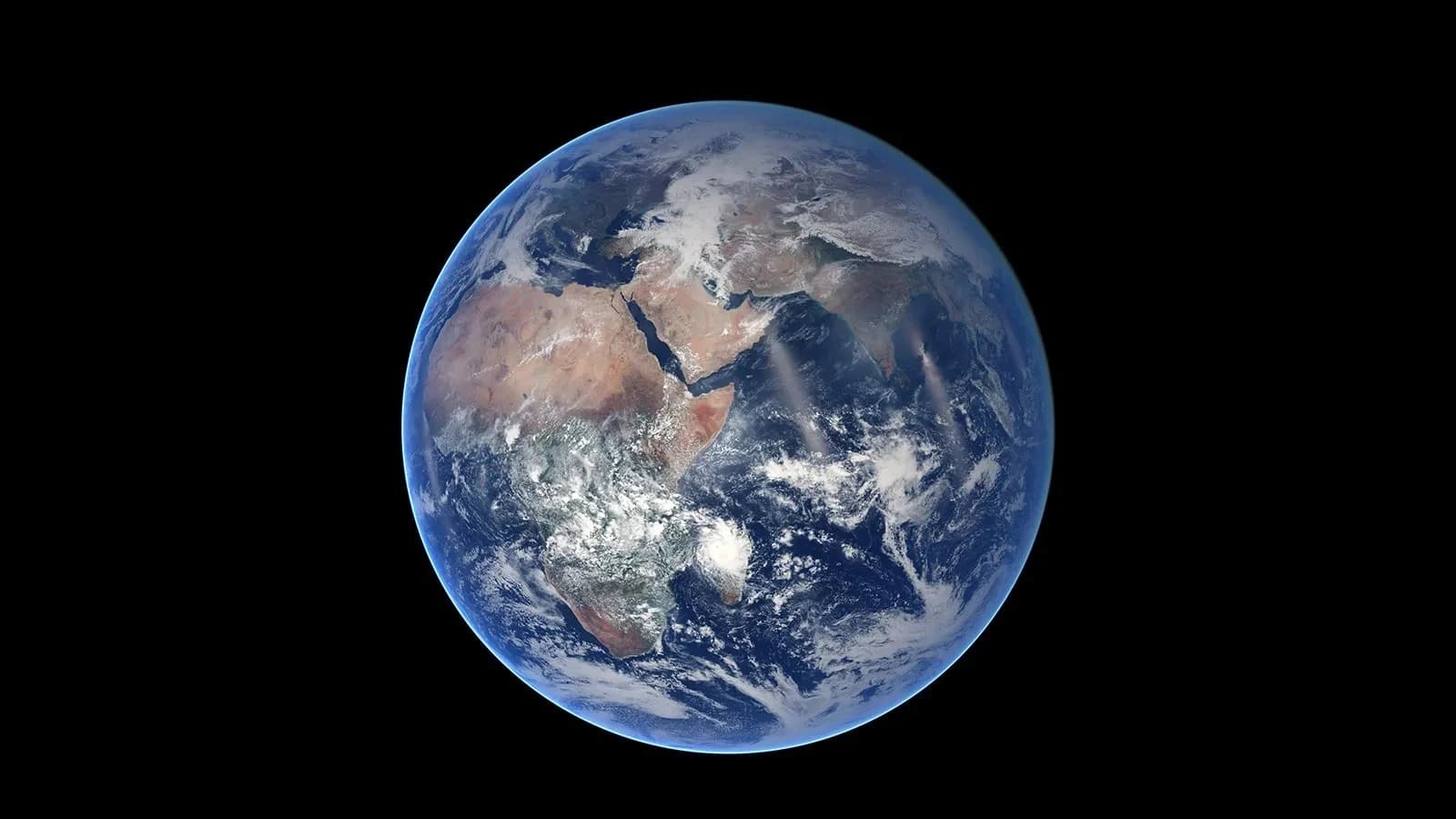
How the Solar System is arranged
The Sun is at the center. Four rocky planets orbit closer to it, followed farther out by Jupiter, Saturn, Uranus, and Neptune. The system also contains dwarf planets, natural satellites, asteroids, and comets. A moon is defined by the body it orbits: the Moon is Earth's satellite, rather than an independent planet in the list of orbits around the Sun.
Beyond Neptune lies the Kuiper Belt. Still farther out is the proposed Oort Cloud, an extremely extensive reservoir of icy bodies that should not be treated as a directly photographed shell. The Solar System therefore has no single edge resembling a wall. The boundary of the solar wind's influence and the distant orbits of objects answer different questions about its size.
Voyager 1 illustrates this distinction. It crossed the boundary of the region dominated by the solar wind and measures the interstellar medium, but that does not mean it has passed every distant object gravitationally bound to the Sun. Before discussing a departure from the Solar System, it helps to specify which boundary is meant.
Studying small bodies helps us understand both the planetary system’s past and methods of planetary defence. The Hera mission is heading to the Didymos–Dimorphos pair to investigate the result of DART’s impact. Measurements of this specific object allow models to be tested; they cannot be applied without adjustment to every other asteroid.
From a dust cloud to planets
The modern picture of formation begins with the gravitational collapse of part of an interstellar cloud. Matter accumulated at the center as a rotating disk formed around it. The central region became the Sun; particles in the disk collided, joined together, and gradually contributed to the growth of larger bodies. This was a long history of accumulating matter, rather than the simultaneous appearance of fully formed spheres.
Temperature and composition in different parts of the disk influenced the materials of future worlds. Traces of this history are studied in meteorites, planetary rocks, and observations of young stars with disks. Here, the word “model” does not mean arbitrary fantasy: an explanation must agree with several independent kinds of evidence at once. Details of individual planets' migrations and collisions are still being refined.
The asteroid Psyche offers an opportunity to test how traces of early heating and the separation of materials survived in a small body. One explanation connects it with a partly exposed planetesimal core, but this remains to be established. The Psyche mission is intended to distinguish possible formation histories using composition, topography and other physical properties. A large inferred metal content does not by itself establish what the parent body was like.
The rearrangement of planetary orbits can also be tested through Jupiter’s Trojan asteroids. Their diversity allows the possibility that small bodies came from different outer regions and were later captured into stable groups. Lucy should compare the composition and geology of several Trojans to test this scenario. Surface differences could also have developed later through irradiation and collisions.
Why Venus is hotter than Mercury
The order of orbits is not a temperature ranking. Mercury is closest to the Sun, but Venus has the hottest planetary surface. Its dense atmosphere, made mostly of carbon dioxide, traps heat through a powerful greenhouse effect. Surface temperatures reach approximately 470 °C, even though Venus occupies the second orbit.
Instead of a dense atmosphere, Mercury has a tenuous exosphere. Its sunlit surface can heat to about 430 °C and cool to −180 °C at night. These values describe different conditions, rather than a single average planetary temperature. When comparing worlds, consider their distance from the Sun, atmosphere, and where measurements were taken: proximity to a star alone does not determine climate.
Why Pluto is a dwarf planet
In 2006, the International Astronomical Union established three conditions for a Solar System planet: orbiting the Sun, having a shape determined by its own gravity, and being dynamically dominant in its orbital neighborhood. Pluto meets the first two conditions, but shares its region with other Kuiper Belt bodies. It was therefore placed in a separate category.
Dwarf planet is a scientific classification, rather than a judgment of a world's beauty or importance. Pluto has not disappeared from the system or become a moon. The way we describe the family of objects has changed. It remains a separate stop in the COSMO360 journey: it is useful to explore the world itself while understanding why the modern official list of major planets contains eight names.
Why aren't the planets on the 3D map shown at one scale?
A single screen cannot show planets in detail while preserving the real distances between them. If Earth were reduced to a small dot, the outer planets' orbits would lie far beyond the visible composition.
The visual map therefore adjusts scales to support exploration. Compare physical quantities in the tables: an image's size does not measure a planet's diameter, and the length of an on-screen journey does not represent spaceflight time.
Why planets have different years and days
A year is one complete orbit around the Sun, while the length of a day is related to rotation around a planet’s own axis. These are separate motions. A distant planet has a longer orbital path and a lower average orbital speed, so its year lasts longer. Distance from the Sun does not directly set the spin rate, however: a planet’s position in the sequence cannot tell you how long its day will be.
When comparing reference values, check whether “day” means a full turn relative to the stars or the interval between successive appearances of the Sun in the same part of the sky. The periods can differ significantly. Gas giants introduce another complication: they have no marked solid surface, and clouds at different latitudes move at different rates. A table is easier to interpret when each quantity comes with a definition and a unit.
Sources
- NASA: Solar System Facts
- NASA: How Did Our Solar System Form?
- IAU: adopted Resolutions B5 and B6, 2006
- NASA: Planetary Fact Sheet: average planetary distances
- NASA: About the Planets: planetary order and types
- NASA: Jupiter Facts: year length
- NASA: Uranus Facts: year length
- NASA: Neptune Facts: year length
- NASA: Venus Facts: atmosphere and surface temperature
- NASA: Mercury Facts: daytime and nighttime temperatures
- NASA — Voyager 1 and the interstellar mission
- ESA — Hera and the investigation of DART’s aftermath
- NASA — science objectives of the Psyche mission
- NASA — science goals: geology, composition and physical properties
- NASA — Trojan origins and migration scenarios to be tested
Image
Questions and answers
What is the order of the planets from the Sun?
Mercury, Venus, Earth, Mars, Jupiter, Saturn, Uranus, and Neptune. This is the order of their orbits by average distance from the Sun; the planets do not stand still in a line.
Does the Solar System have eight planets or nine?
Under the IAU definition, there are eight planets. Pluto belongs to the Solar System as a dwarf planet.
Has the Oort Cloud been photographed?
No. It is a proposed distant population of icy bodies; its existence is inferred indirectly, including from the properties of long-period comets.
Which Solar System planet is the hottest?
Venus: its dense atmosphere traps heat, and its surface temperature is approximately 470 °C. Mercury is closer to the Sun, but lacks a dense atmosphere and has large temperature differences between day and night.