Voyager 1 continues its science mission in interstellar space. According to NASA information checked on 26 October 2026, two science instruments remain operational and the spacecraft is more than 25 billion kilometres from Earth. Another symbolic milestone lies ahead: it is expected to reach a distance of one light-day from us on 18 November. NASA has not set an exact date for the end of communications.
- Voyager 1 crossed the heliopause on 25 August 2012, but has not yet passed through the distant Oort Cloud.
- NASA's current status page lists the MAG magnetometer and PWS plasma wave system as operational.
- The LECP instrument was switched off in April 2026 to save power. This did not shut down the entire spacecraft.
- A light-day is a distance. A radio command takes about a day to cross it, and its reply needs another day of travel.
Where is Voyager 1 now?
The spacecraft is far beyond the planets' orbits and travelling through the interstellar medium, outside the Sun's plasma bubble. A useful rounded scale for autumn 2026 is more than 25 billion kilometres from Earth. This is not a second-by-second odometer reading. For its precise position on a chosen date, NASA provides a mission status page and the Eyes on the Solar System interactive model.
Distances from Earth and from the Sun differ slightly because our planet moves in its orbit. Two figures can therefore disagree even when both are correct. Voyager 1 is moving away from the Sun overall, but its distance from Earth can decrease during parts of the year. Compare distances together with their dates and reference points.
When will it reach one light-day?
NASA's page gives 18 November 2026 as the expected date of the milestone. One light-day is about 25.9 billion kilometres, the distance light travels in 24 hours. At the date of this article, that milestone is still ahead. It does not mean the spacecraft has travelled for just one day: its journey began in September 1977 and has lasted more than 49 years.
Radio waves travel at the same speed as light. At that distance, a command needs about a day to reach the probe and a report of its result needs another day to return. That is almost two days of propagation alone, before allowing for execution, communications preparation and analysis of the reply. The spacecraft cannot be steered with the immediacy of a radio-controlled model.
Why has it not left the entire Solar System?
The heliosphere is the region shaped by the solar wind and the Sun's magnetic field. Its outer boundary is the heliopause, crossed by Voyager 1 on 25 August 2012. Beyond it, the probe measures a different plasma environment, making it an interstellar explorer. But the edge of the solar wind does not switch off the Sun's gravity.
The Solar System includes more than eight planets. Far beyond Neptune and the Kuiper Belt lies the proposed Oort Cloud, an immense region of icy bodies associated with the Sun. NASA estimates that Voyager 1 still needs hundreds of years to reach its inner region, while crossing the outer regions could take tens of thousands of years. These are approximate scales: the cloud has no sharply defined wall that has been directly photographed.
How do we know the surroundings are interstellar?
The crossing was not established by a dramatic photograph. Charged-particle measurements changed, and the plasma wave system detected oscillations in the surrounding ionised gas. Their frequency provides information about plasma density. Combining the evidence showed that the probe had left the heliosphere in August 2012; the confident conclusion was announced in 2013.
This distinguishes the date of an event from the date of its discovery. Researchers needed additional evidence and tests of their explanations. Interstellar space is not an absolute void: it contains sparse matter, magnetic fields and particles. Measuring them locally at the spacecraft is a task that observations with an Earth-based telescope cannot fully replace.
Which instruments remain on in October 2026?
The official status page checked on 26 October lists two active science instruments on Voyager 1: the MAG magnetometer and the PWS plasma wave system. One measures the magnetic field; the other investigates electrical oscillations in plasma. PWS should not be confused with the separate PLS plasma instrument, which has long been out of use on Voyager 1.
The CRS cosmic-ray system was switched off on 25 February 2025, followed by the LECP low-energy charged-particle experiment on 17 April 2026. NASA's April announcement explained that the shutdown was needed to preserve the mission as power became scarce. The end of one experiment should not be reported as a loss of communications or the failure of the entire probe.
Why is power running low, and what has been saved?
The spacecraft uses radioisotope thermoelectric generators, which convert heat from plutonium decay into electricity. These are not solar panels, and the loss of power is not caused by the probe entering darkness. NASA reported in 2026 that each Voyager loses about four watts of available electrical power per year, a significant amount given the small remaining margin.
Savings require care. Switching off a heater reduces consumption, but excessive cooling can harm a needed system or freeze a fuel line. Engineers must balance warmth, equipment operation and science. Electrical power and propellant for small attitude adjustments are different resources, and both can limit the duration of useful operations.
On 4 August 2026, NASA reported a successful power-saving reconfiguration on Voyager 2, nicknamed the Big Bang. Some powered devices were replaced in operation by lower-power alternatives. The same announcement described the procedure for Voyager 1 as planned for the coming months. Voyager 2's result cannot automatically be applied to its twin: the sources checked here do not separately confirm completion on Voyager 1.
Why did Voyager 1 overtake Voyager 2?
Voyager 1 launched on 5 September 1977, after Voyager 2, but followed a faster route. It explored Jupiter in March 1979 and Saturn in November 1980. The flybys used planetary gravity to alter its speed and direction. Spacecraft numbering therefore does not describe launch order or determine which probe must be farther away.
After the Titan encounter, Voyager 1's trajectory carried it out of the main planetary orbital plane. Uranus and Neptune were visited by Voyager 2, not Voyager 1. These were different extensions of the same programme. Today, their separated trajectories help scientists compare the outer heliosphere and interstellar environment.
How can Earth hear such a distant probe?
Communications use NASA's Deep Space Network, with large antenna complexes in California, near Madrid and near Canberra. Their locations help maintain reception as Earth rotates. At this distance, receiver sensitivity, accurate pointing and the probe's directional antenna matter alongside transmitter power.
Measurements and engineering information are transmitted by radio. Because of the delay, engineers prepare command sequences in advance and carefully check their results. Switching off one science instrument, ending scientific measurements and finally losing radio contact need not happen at the same time; they are different mission states.
Why are there no new photographs from Voyager 1?
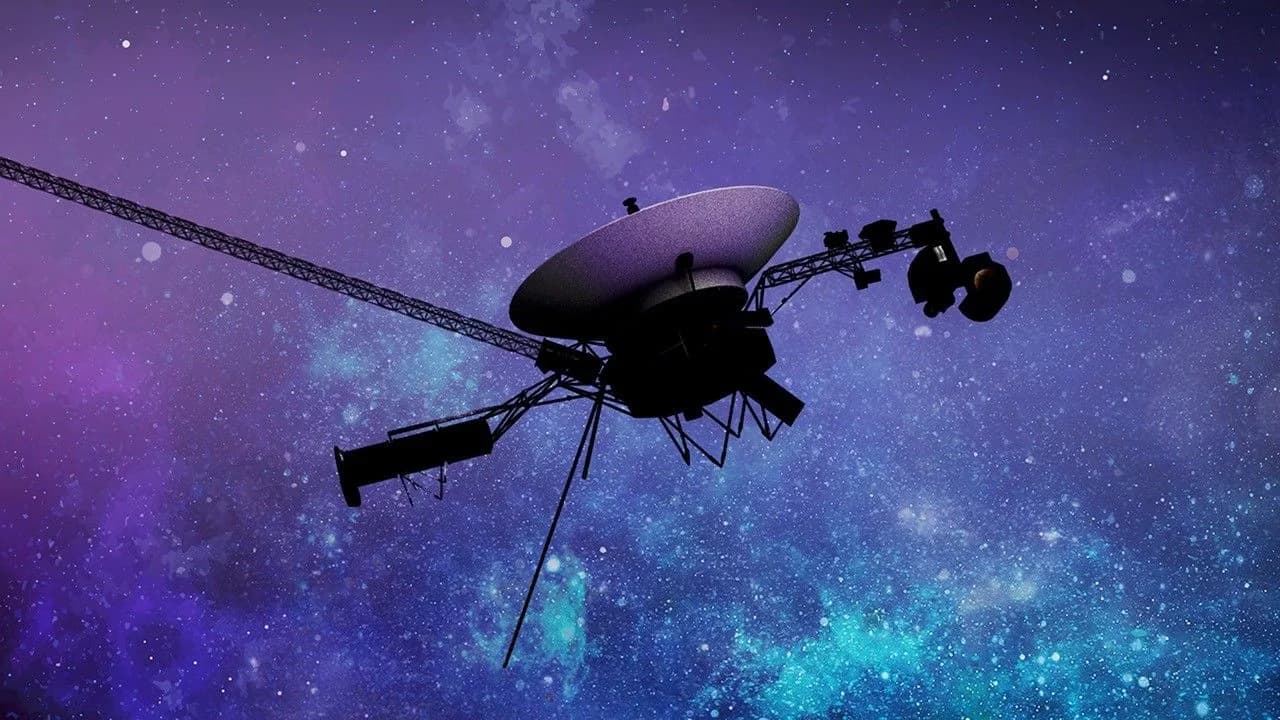
Voyager 1's cameras were switched off after its final images in February 1990. Those included the famous Pale Blue Dot, showing Earth from an immense distance. The cameras do not photograph the probe's present surroundings: heaters are off, software has changed, and the science mission now focuses on fields and plasma. Illustrations of the spacecraft among the stars must be distinguished from actual photographs taken during its journey.
When will it fall silent, and what happens next?
There is no scheduled final day. Engineers estimated in April that switching off LECP would provide roughly a year of breathing room for further decisions. That describes the expected benefit of a measure, not a promise to switch off the spacecraft in April 2027. Older forecasts pointing to 2025 should no longer be used as current end dates; mission status must be checked against recent NASA updates.
Losing the power needed for communications will not stop its flight. The probe will continue along its trajectory within the Milky Way. NASA estimates that it will pass about 1.7 light-years from Gliese 445 in roughly 40,000 years. That is not a visit to the star's planets or an exit from the Galaxy. Its Golden Record will remain aboard, carrying sounds, images and greetings in 55 languages: a physical time capsule that needs no radio transmitter.
Sources
- NASA — location and instrument status table, checked 26 October 2026
- NASA — the expected one-light-day milestone on 18 November 2026
- NASA — Voyager 1 LECP shutdown, 17 April 2026
- NASA — Voyager 2 power savings and plans for Voyager 1, 4 August 2026
- NASA — the interstellar mission and evidence of the heliopause crossing
- NASA — the Oort Cloud and the scale of the outer Solar System
- NASA — Voyager 1 history and trajectory
- NASA — the Deep Space Network
- NASA — questions about Voyager cameras and flight
- NASA — the Voyager Golden Record
- JPL — how Voyager 1's arrival in interstellar space was established, 2013
Image
Questions and answers
Is Voyager 1 still working?
NASA information checked on 26 October 2026 lists the mission as active, with MAG and PWS operational. April's LECP shutdown saved power; it did not end communications.
How far away is Voyager 1 now?
In autumn 2026, the distance from Earth exceeds 25 billion kilometres. The precise value changes and should be checked on NASA's status page with the date and reference point in mind.
Has it already reached one light-day?
As of 26 October, the milestone is still ahead. NASA's forecast checked for this article gives 18 November 2026. One light-day is approximately 25.9 billion kilometres.
Has it left the Solar System?
It has left the heliosphere and is in interstellar plasma. But if the Solar System is defined to include the distant Oort Cloud, its outer regions still lie ahead.
Why will it not stop without electricity?
Coasting does not require an engine to run continuously. Electricity is needed for instruments, communications and control; losing those functions does not erase the spacecraft's existing velocity.
Can it send photographs of interstellar space?
Voyager 1's cameras have been off since 1990. Its present-day data are environmental measurements and telemetry; pictures of the spacecraft itself are usually illustrations.