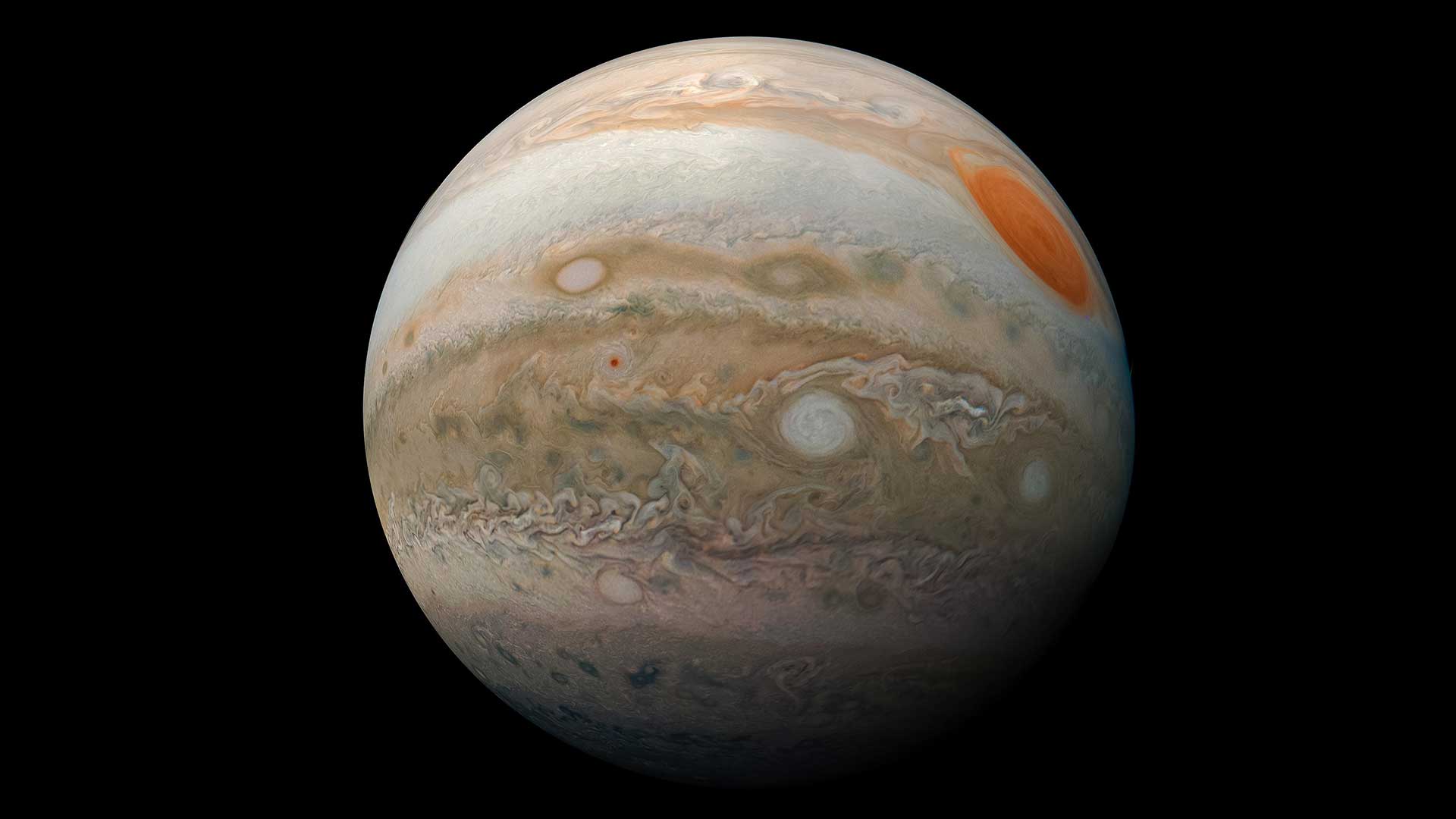
Cloud currents above an ocean of hydrogen
What we see on Jupiter is an atmosphere, not a solid surface. Bright zones, dark belts and vortices form a changing pattern. Pressure alters the state of matter with depth, so the familiar air-ground boundary does not apply here.
Jupiter: key facts
- Type
- Gas giant
- Mean radius
- 69,911 km
- Mean distance from the Sun
- ≈ 5.20 AU · 778 million km
- Orbital period
- ≈ 11.86 Earth years
- Rotation
- ≈ 9 h 55 min
- Temperature
- ≈ −110 °C · 1-bar level
- Mass
- 1,898 × 10²⁷ kg
- Mean density
- 1 326 kg/m³
Values are rounded. The distance describes the orbit, not the current distance from Earth. For giant planets, temperature refers to a reference atmospheric level: they have no solid ground. Mean radius differs from equatorial radius.
Atmosphere and appearance
Mostly hydrogen and helium. Clouds at different levels contain ammonia, sulfur compounds and water.
Great Red Spot
An enormous atmospheric vortex observed for centuries.
Deep atmosphere
Hydrogen gradually becomes liquid and, deeper down, metallic.
Moons
Io is volcanically active; an ocean may lie beneath Europa's ice.
What is inside?
Proposed structure. Composition changes gradually, and sharp boundaries between layers may not exist. Colors and region sizes are illustrative.
Clouds and atmosphere
Hydrogen, helium and multiple layers of clouds.
Molecular hydrogen
Under pressure, the gas gradually becomes a dense liquid.
Metallic hydrogen
Electrically conducting hydrogen helps generate the magnetic field.
Diffuse core
Juno data suggest a partly dissolved core without a sharp outer boundary.
The cutaway is based on physical models and indirect measurements. It is not a photograph of the interior; in 3D, you can select each layer separately.
Natural satellites
The four largest Galilean moons are Io, Europa, Ganymede and Callisto. They are different worlds: volcanically active Io, icy Europa, large Ganymede and crater-covered Callisto.
History of discovery and exploration
Known since ancient times
Jupiter is a bright planet visible to the naked eye. The discovery of its moons showed that celestial bodies can orbit something other than Earth.
- January 1610
Four new worlds
Galileo discovered Io, Europa, Ganymede and Callisto, Jupiter's large moons now known as the Galilean moons.
- 1973
The first flyby
Pioneer 10 was the first spacecraft to explore Jupiter up close, measuring its intense radiation environment.
- 1979
Volcanoes and rings
Voyager discovered active volcanoes on Io and provided a new view of Jupiter and its faint ring system.
- 1995
Orbit and descent
Galileo became Jupiter's first orbiter. Its released probe measured the atmosphere from within.
- 2016
Beneath the cloud bands
Juno entered a polar orbit to study the giant's magnetic field, gravity and deep interior.
Galileo explored the Jupiter system. Juno measures gravity, the magnetic field and the atmosphere.
Why a beautiful image does not show all of Jupiter
Visible light records Jupiter’s upper cloud scene. It does not photograph every atmospheric layer at once: clouds can conceal material below, and different wavelengths respond to different conditions. A pale zone and a dark vortex in one image therefore do not provide a ready-made cross-section. Studying depth requires combining pictures with measurements sensitive to other layers and other physical properties.
Juno’s microwave radiometer studies radiation that provides information from below the visible cloud tops. Its results are measurements and models of how material is distributed, not ordinary photographs taken through a transparent shell. When comparing mission material, check which instrument produced the data. This distinguishes the cloud pattern actually pictured from an inference about how far an atmospheric structure extends below it.
Learning about the interior without reaching the core
Jupiter’s gravity field is one of the tools used to investigate its interior. Uneven mass distribution slightly alters a passing spacecraft’s motion, and precise radio tracking measures those changes. Researchers then solve an inverse problem: finding an internal structure consistent with the data. A few attractive coloured layers in a diagram help explain the result, but are not boundaries that a camera has photographed directly.
Juno data have led to models of a dilute or “fuzzy” core, in which heavier material may be spread through a broad inner region without a sharp transition to the surroundings. “Core” therefore need not mean a compact rocky ball. A revised drawing of the interior does not imply that the planet suddenly rearranged itself; it reflects a refined explanation of physical measurements that researchers are trying to reconcile.
Auroras and the giant’s invisible surroundings
Jupiter interacts not only with sunlight but also with charged particles in its magnetic environment. When particles deliver energy to the upper atmosphere, they produce auroral emission. Some of the most striking scientific images use wavelengths outside human vision. Bright outlines in those images represent a measured signal, but do not promise the same appearance through an amateur telescope.
The magnetosphere also matters when planning missions because energetic particles can damage electronics. Trajectories, instrument protection and operating lifetimes must therefore account for the radiation environment. Distance from the visible clouds alone does not describe flight conditions. A spacecraft near the giant must contend with fields and particles as well as the possibility of hitting an object that can be seen in a photograph.
The solar wind starts to change outside the region dominated by the planet’s magnetic field. Two passes by the Juno spacecraft in December 2024 revealed different patterns: an extended region of reflected ions and a more compact transition with recurring magnetic peaks.
Comparing your own observations of Jupiter
For a first evening, choose a modest goal: identify the disc and record the positions of the conspicuous moons. On a later observation, plot the points again without altering the earlier sketch from memory. You can follow a changing system even without seeing colourful vortices. Record the date, time and instrument; otherwise the two drawings will be difficult to compare with a calculated sky chart.
Do not interpret one missing moon as an object vanishing. It may cross the planet’s face, pass behind it, or become difficult to see in its glare; an ephemeris identifies the particular circumstance. Compare cloud detail under reasonably similar conditions rather than at arbitrary screen scales. A careful sequence of simple notes teaches you more about the moving system than one attempt to match the appearance of an interplanetary spacecraft image.
Questions and answers
Can you land on Jupiter?
There is no solid surface resembling Earth's ground. Pressure and temperature increase as you descend; an ordinary landing is impossible.
What is the Great Red Spot?
A long-lived atmospheric vortex. Its size, color and outline change, so images from different years need not match.
Which moon of Jupiter is interesting in the search for habitable environments?
Europa is especially interesting because of its suspected ocean beneath an icy shell. Potential habitability does not mean life has already been found there.
Continue exploring
The model offers a cutaway, rotation, images and a flight through a reconstructed environment. You can read the information on this page without loading 3D.
Open in the journeyAll planets and the SunSources and image
- NASA: object overview
- Exploration history · ssd.jpl.nasa.gov
- Exploration history · science.nasa.gov
- Exploration history · science.nasa.gov
- Exploration history · science.nasa.gov
- Exploration history · www.jpl.nasa.gov
- Exploration history · science.nasa.gov
- Exploration history · www.nature.com
- NASA: physical parameters