When Juno crossed Jupiter’s bow shock, its instruments recorded unusual electric field oscillations and magnetic peaks spaced about eight seconds apart. The measurements returned to the news in late October 2026. Juno’s route helps explain the result: on its way away from Jupiter and back again, the spacecraft passed through two very different regions of the bow shock.
- The solar wind slows down and heats up at the bow shock before it reaches Jupiter’s magnetopause.
- Three harmonics and regularly spaced magnetic peaks were recorded during one of two crossings in December 2024.
- The data are consistent with the front periodically rebuilding itself. These measurements cannot establish how often that happens across the entire boundary.
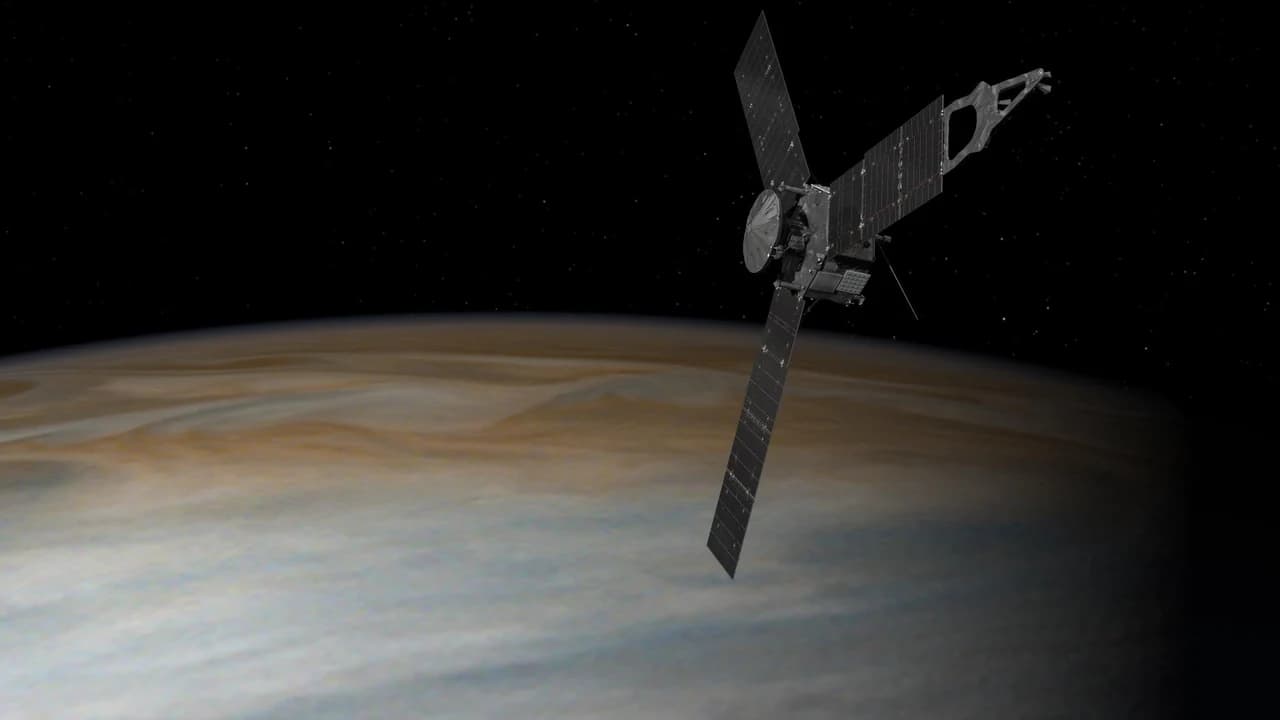
Where Jupiter meets the solar wind
The Sun continuously sends out plasma, a flow of electrons and ions. As it approaches Jupiter, the flow moves faster than disturbances in the plasma can travel back against it. A bow shock forms: the bulk flow slows, the plasma compresses, and some of its energy goes into heat and oscillating fields.
Compressed and heated solar wind flows between the bow shock and the magnetopause. Beyond the magnetopause, Jupiter’s own field dominates. Both boundaries can shift as the solar wind changes, and both lie far from the clouds.
Two crossings in ten hours
At around 17:25 UTC on December 10, 2024, Juno crossed outward through the front. Ahead of it, the instruments found an extended region of ions that the team interpreted as having reflected off the front and traveled back into the wind. Farther out, Juno recorded Langmuir waves, electron oscillations that can be excited by beams of reflected electrons.
At around 03:05 UTC on December 11, the spacecraft crossed back through the front. A compact region just ahead of the steep field jump took the place of the extended region of reflected ions. The angle between the solar wind’s magnetic field and the direction perpendicular to the front was estimated at about 17° for the first crossing and 54° for the second. At a small angle, ions can travel far along the field. With a more transverse field, they are more likely to turn back toward the front. Both crossings occurred about 5.8 million kilometers from Jupiter’s center.
How Waves distinguishes waves in plasma
Waves records oscillations in electric and magnetic fields. The researchers compared its data with readings from the magnetometer and ion detector. A field jump and the appearance or disappearance of a characteristic proton population mark a crossing. A spectrogram shows which frequencies stood out at the time, while short waveform recordings show how the shape of individual oscillations changed.
What the three harmonics mean
On the second crossing, a short packet of ion-acoustic oscillations showed peaks at 5.61, 11.13, and 16.68 kHz. The higher frequencies are close to two and three times the first, making them harmonics. The electric field record shows flattened crests. The amplitude stayed below the saturation threshold, ruling out clipping of a strong signal as the cause.
One possible cause is that the wave’s electric field traps some of the electrons. The waveform is consistent with this hypothesis. Several harmonics can transfer energy to electrons moving at different speeds. The instrument could not determine the wave’s phase velocity or polarization. In an adjacent part of the front, the team found a different pattern: about 18 peaks spaced roughly 300 Hz apart, which it linked to electron cyclotron drift instability.
Why the magnetic peaks repeated
The strongest magnetic peak coincided with the steep field jump that the authors identified as the main shock ramp. There were two prominent peaks ahead of it and four more behind it. They repeated about every 8.3 seconds, roughly one quarter of the time a proton would take to complete a gyration in the field ahead of the front.
The team’s most likely explanation is periodic shock reformation, in which a new steep transition can form ahead of the previous one. The researchers’ announcement calls the small shock structures shocklets. Juno measured the field in only one place at any given time. Ion readings were taken every 120 seconds, so their role in the eight-second cycles could not be checked directly.
What the bow shocks of Jupiter and Earth have in common
Many of the same kinds of oscillations have already been observed at Earth’s bow shock. Harmonics and regular magnetic structures stood out in Juno’s records, but two passes cannot establish how often they occur. TRACERS studies how the solar wind interacts with Earth’s magnetosphere through the polar cusps. Geomagnetic storms are associated with energy transfer between the flow and the near-Earth system. The bow shock Juno crossed lies outside the magnetopause.
What happens deeper inside Jupiter’s magnetosphere
The volcanic moon Io supplies some of the plasma inside Jupiter’s magnetosphere. The material becomes ionized and forms a ring along its orbit. The moon Europa also moves within this magnetic environment, where charged particles affect its surface. Parker Solar Probe previously measured similar ion-acoustic harmonics under different conditions, much closer to the Sun.
Where Juno is in November 2026
Juno entered orbit around Jupiter in July 2016. The Waves instrument recorded its first bow shock crossing on June 24, 2016, during the approach. The paper on the two December 2024 crossings appeared online on July 31, 2026. The University of Iowa announced it on September 21, and the result returned to the news on October 29.
As of November 4, 2026, NASA lists Juno as studying Jupiter from orbit. The extended mission schedule puts the next closest approach, PJ89, on November 13. An orbit takes about 33 days at this stage.
What remains to be measured
Multiple spacecraft at the front would help distinguish a boundary moving past a sensor from changes arising in the plasma itself. Quantifying the heating requires fuller field measurements and more frequent measurements of particle velocity distributions. Such observations could also help test the physics of energy transfer in models of stronger collisionless shocks, such as those in supernova remnants.
Sources
- Nature Communications: Joseph et al., observations at Jupiter’s bow shock
- University of Iowa: research team announcement
- NASA: Juno’s first crossing of the bow shock
- Juno team: extended mission close-approach schedule and objectives
- NASA: overview of Jupiter and its magnetosphere
- NASA: current exploration of Jupiter
- NASA: Voyager observations at Jupiter
- Juno team: the Waves instrument
- NASA/JPL: history of the Juno mission
- ScienceDaily: coverage on October 29, 2026
- NASA: first TRACERS results from Earth’s polar cusp
- NASA: Europa’s environment
Image
Questions and answers
What did Juno find at Jupiter?
During one of two bow shock crossings, the instruments recorded three harmonics of ion-acoustic oscillations and magnetic peaks spaced roughly 8.3 seconds apart. The peaks are consistent with periodic shock reformation.
Are the magnetopause and bow shock the same thing?
They are two different boundaries. At the bow shock, the solar wind compresses, slows down, and heats up. The magnetopause lies closer to the planet and separates that flow from the region dominated by Jupiter’s own magnetic field.
Can you hear Jupiter’s plasma waves?
Field measurements can be converted to audio. In its recording of the first crossing in 2016, NASA represented the waves’ frequency and amplitude through pitch and volume.
Do these waves occur at Earth?
Yes. Many of the same kinds of plasma waves are observed at Earth’s bow shock. Some strong harmonics and regular magnetic structures stood out in the Jupiter records. Two crossings cannot establish how often they occur.
Is Juno still operating in November 2026?
NASA lists Juno as studying Jupiter from orbit. The mission team scheduled the next close approach, PJ89, for November 13, 2026.