A spacecraft flies through the solar corona, where plasma temperatures reach millions of degrees, and returns scientific data. No physical laws are being broken: Parker has a heat shield, autonomous controls and a carefully designed orbit. In September 2026, NASA confirmed another successful close approach and an extension of the mission into 2029.
- About 6.1 million km separates the spacecraft from the Sun’s visible surface at its closest approaches.
- Almost 700,000 km/h is its speed relative to the Sun, not a constant speed around its entire orbit.
- The temperature of sparse plasma and the heating of the spacecraft’s surface are different physical quantities.
How close does Parker get to the Sun?
Parker Solar Probe is a robotic NASA spacecraft launched on 12 August 2018. It does not land on the Sun; it follows an elongated orbit around it. The point nearest the star is called perihelion. There the probe briefly encounters particularly harsh conditions before moving away again and gaining opportunities to transmit the data it has collected.
In December 2024, the spacecraft first approached within about 3.8 million miles, or 6.1 million kilometres, of the visible solar surface. Later flybys matched that distance. In its 10 September 2026 update, NASA confirmed the 29th close approach, on 4 September, and reported the spacecraft was healthy afterwards. The distance sounds enormous on a human scale, yet it is exceptionally close for studying the Sun.
When comparing distances, check the reference point. A distance to the Sun’s centre exceeds the distance to its visible surface by the star’s radius, a significant difference during a close pass. Distance from Earth and distance from the Sun also describe different things: the former changes with planetary positions and does not measure proximity to the corona.
What does “touching the Sun” mean?
A star has no solid surface on which to set landing legs. Its visible disc is associated with the photosphere, above which the hot atmosphere, or corona, extends. “Touching” therefore means flying through part of that atmosphere and directly measuring its material and magnetic field. It does not mean the probe has entered the dense layers of the star or reached its core.
An important boundary is the Alfvén surface, separating regions with different behaviour of plasma and magnetic disturbances; outside it, the flow becomes super-Alfvénic. This is not a smooth shell with a fixed radius. In December 2025, researchers presented continuous two-dimensional maps of the boundary, checked against Parker’s direct measurements during its crossings. As solar activity increases, the boundary becomes more uneven.
Why million-degree plasma does not melt the probe
Temperature describes particle motion, whereas spacecraft heating depends on how much energy it receives and loses. The corona contains few particles compared with dense matter. Even energetic particles in a sparse plasma do not transfer as much heat to the body as a dense medium at the same temperature would. The temperature of the corona therefore cannot simply be assigned to the instruments.
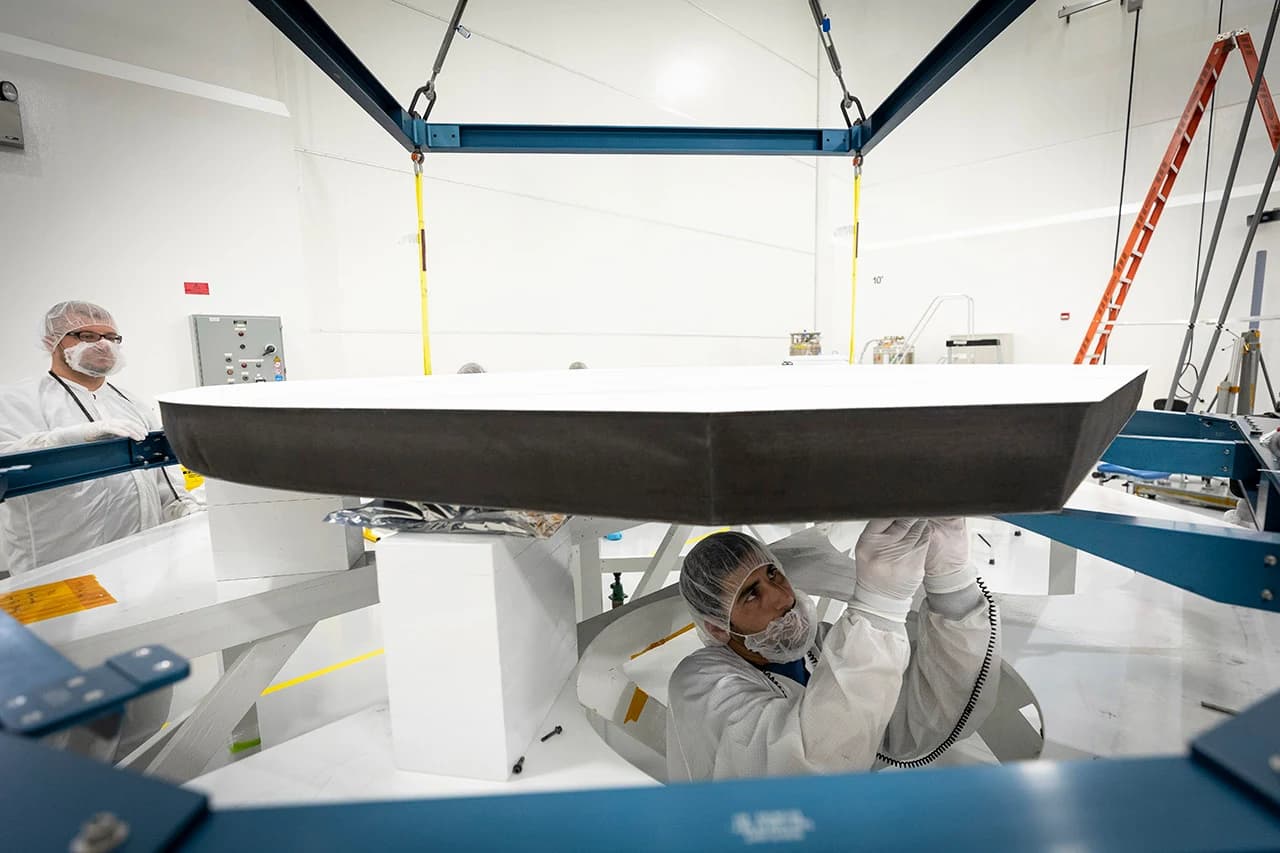
Sparse plasma does not remove the challenge of intense sunlight. The Sun-facing side of the heat shield is designed for temperatures around 1,400°C, while most equipment stays in its shadow. The shield is roughly 2.4 metres across, with a carbon-based structure and a reflective coating. This arrangement depends on correct orientation: the small spacecraft must keep its vulnerable parts behind the shield.
Where the record speed comes from
The spacecraft accelerates in the Sun’s gravitational field as it approaches and slows as it moves away. Its record of about 430,000 miles per hour corresponds to roughly 692,000 km/h. This is the speed relative to the Sun near perihelion. Comparing spacecraft records requires specifying the reference frame: speeds relative to Earth and relative to the star are different numbers.
Reaching this orbit takes more than pointing a rocket towards the bright disc. At launch, the spacecraft already shares Earth’s motion around the Sun, and that orbital energy must be changed. Gravity assists at Venus were crucial: successive encounters helped lower perihelion. The rocket began the journey, while calculations and planetary encounters shaped the trajectory that followed.
Its engines do not have to accelerate continuously to achieve the record: much of the speed change occurs while moving through the gravitational field. Manoeuvres adjust the trajectory. This is why a speed record does not make the probe a universal express service to any planet. Speed at a specific orbital point and the ability to deliver a payload along a different trajectory are different mission characteristics.
What the instruments measure beyond striking images
The mission carries four scientific instrument suites. FIELDS studies electric and magnetic fields, SWEAP measures solar-wind particles, IS☉IS examines energetic particles, and WISPR images coronal structures. Their observations complement one another: a picture reveals the form of a flow within the camera’s field of view, but cannot by itself provide every property of the material the probe passed through.
There is an engineering reason not to expect a continuous live feed. Near the star, flight geometry limits communication, and an unsafe orientation cannot wait for a reply from Earth. Sensors and the onboard computer maintain the protective attitude autonomously. After a close pass, a brief health signal may arrive first, with the much larger scientific dataset transmitted later.
Why close-up solar discoveries matter on Earth
The solar wind carries particles and magnetic fields through the solar system. Its interaction with the magnetosphere helps explain geomagnetic storms and the conditions behind the northern lights. Measurements near the source test physical models: a distant observer encounters a flow that has already evolved, with original structures potentially mixed or interacting with one another.
Parker is not an app providing exact aurora forecasts for your city. Models, observations from other spacecraft and checks against real events stand between a fundamental measurement and an operational warning. Extending the mission into 2029 offers the chance to compare the solar atmosphere across different activity levels. One dramatic flyby captures an episode; a series of measurements helps explain a changing system.
Sources
Questions and answers
Has Parker already reached the Sun?
It has repeatedly flown through the corona. It is an orbital mission: the spacecraft moves away after each close approach rather than landing.
How fast is Parker Solar Probe?
Near its closest approaches, about 692,000 km/h relative to the Sun. It travels more slowly along other parts of its elongated orbit.
When will the mission end?
In September 2026, NASA reported an extension into 2029. This is a mission plan, rather than a guarantee of spacecraft health throughout that period.