How to check the northern lights forecast quickly
Open a space-weather forecast and check the period it covers. Compare the area of expected auroral activity with your location. Next check ordinary weather: even strong activity cannot make the glow visible through a thick layer of cloud. Finally establish whether it will actually be dark during the relevant hours. These are separate checks, and none can be replaced by a single impressive activity score.
If the conditions look promising, choose a site with an open northern horizon and no bright streetlights in front of you. At middle latitudes the aurora can remain low, so a courtyard between tall buildings often loses out to an open field. A fresh check immediately before leaving is more useful than a screenshot saved in the morning or forwarded without its update time.
What causes the northern lights?
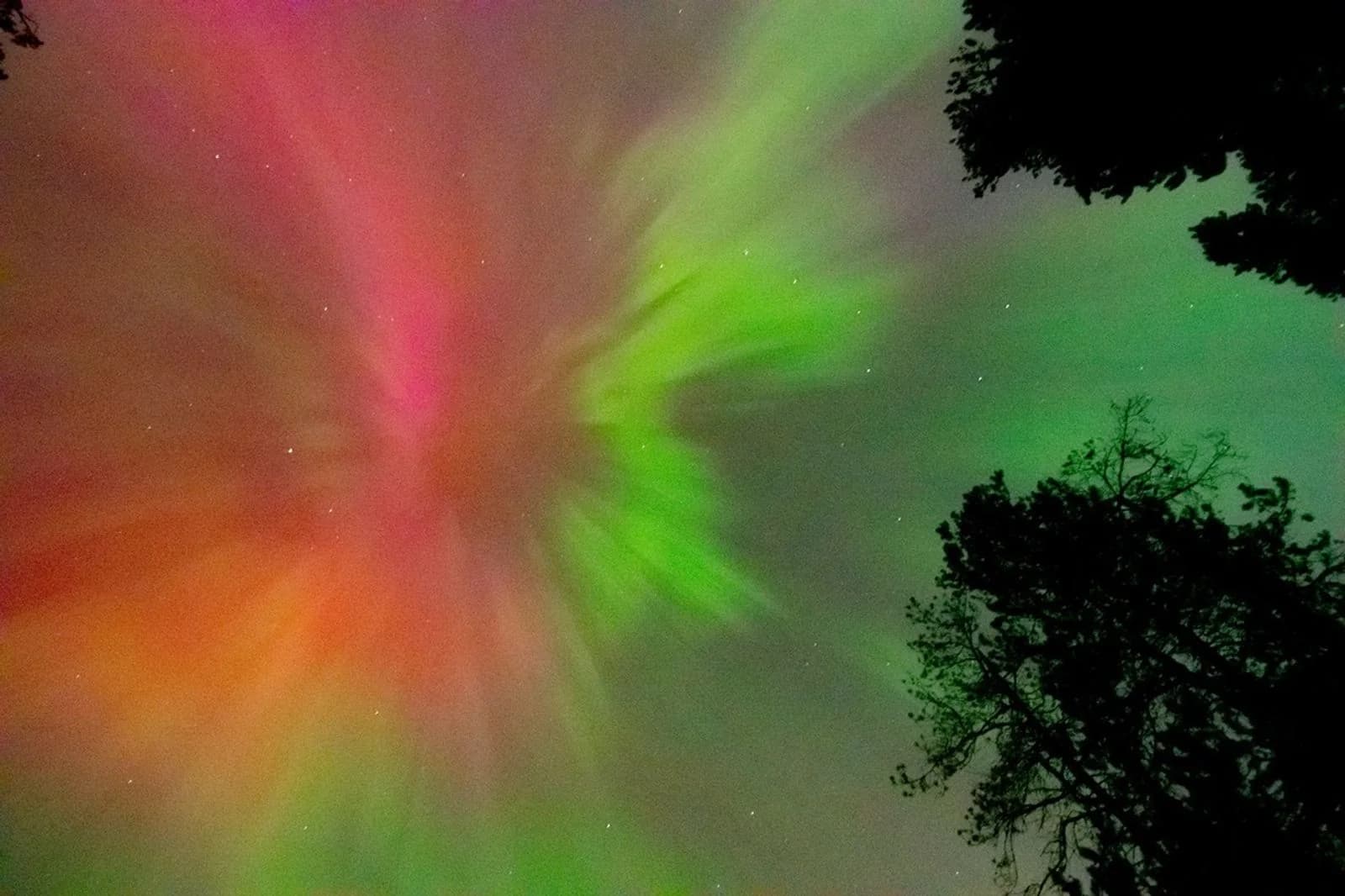
The glow forms in the upper atmosphere when energetic particles interact with atoms and molecules, which then release the received energy as light. Earth's magnetic field and processes in the magnetosphere guide the particles so that auroras appear most often in regions around the magnetic poles. The display is called the northern lights in the Northern Hemisphere and the southern lights in the Southern Hemisphere.
Oxygen can produce green and red emissions, while nitrogen produces blue, pink and purple tones. The appearance depends on altitude and the interactions involved. It is neither city light reflected from clouds nor a cloud of luminous dust that has descended to the ground. When rays and curtains appear, you are watching a changing pattern of light at a great height.
The glow alone does not reveal a geomagnetic storm’s full strength. Navigation errors depend on the ionosphere, satellite drag on upper-atmosphere density, and power-grid currents on field changes and ground conductivity.
What does the Kp index measure?
Kp describes disturbances of Earth's magnetic field on a scale from 0 to 9. It is derived from measurements at ground-based geomagnetic observatories, with a basic interval of three hours. The number therefore describes global geomagnetic activity, not the brightness of the sky outside your window. A value of Kp 6 does not mean a sixty-percent chance of seeing an aurora.
On NOAA's scale, a geomagnetic storm begins at Kp 5, corresponding to the G1 level. The higher categories are G2, G3, G4 and G5. These labels provide an overall assessment, but do not become precise viewing forecasts for every city. Distinguish an index already measured from a predicted value for a future three-hour interval: the two can look very similar on screen.
What Kp value do you need to see an aurora?
There is no universal threshold for every observer. Near the usual auroral oval, a beautiful display can occur during relatively quiet conditions. Middle latitudes generally need stronger disturbances that extend the glowing region towards the equator. Geomagnetic latitude matters as well as geographic latitude, so two cities at similar geographic latitudes need not have identical viewing conditions.
Claims such as 'Kp 5 guarantees an aurora in this city' are too definite. The oval changes, individual bursts develop unevenly and the glow may remain far north of the observer. Sometimes it can be seen near the horizon without occurring directly overhead. Supplement the index with an oval map and recent reports from nearby locations, checking the time and location of each report.
How to read NOAA's OVATION map
NOAA publishes a model of the expected position and intensity of auroras in both hemispheres. The coloured oval represents a calculated region of auroral emission, not an ordinary cloud forecast. The product covers a short lead time, typically around 30 to 90 minutes, depending on how long the measured solar wind takes to travel from the monitoring location to Earth.
First check that you have selected the correct hemisphere and a current frame. Find your region and examine the edge of the oval. Being near it makes observation more interesting, but the absence of bright shading directly over your city does not describe the whole visible horizon: high-altitude light can be visible from a distance. The map also cannot know whether a neighbouring building blocks your northern view.
Do solar-wind and Bz measurements help?
For a closer look at conditions, solar-wind speed and the orientation of the interplanetary magnetic field are useful. The Bz component describes its northward or southward direction. A sustained southward orientation, usually shown as a negative Bz, often favours energy transfer into Earth's magnetosphere. A single negative reading, however, is not equivalent to the start of a bright auroral display.
The trend over time matters. A rapidly changing graph, a gap in the data or a measurement from yesterday should not be converted into an exact viewing probability. Beginners can reasonably start with a current oval map, Kp and cloud cover. Solar-wind parameters help explain why forecasts change, but do not remove the need to get beneath a clear, dark sky.
Why do forecasts change, and how far ahead can you trust them?
Different forecasts answer different questions. A several-day outlook highlights potentially interesting periods; a short-term model refines conditions closer to the observation. Looking farther ahead does not make a forecast more precise. A notice about possible activity several weeks away can help with general preparation, but is too uncertain to promise a particular light show over a selected location.
A change does not necessarily mean an app made a mistake. New measurements become available, arrival estimates improve and the magnetic configuration of the flow changes. Services can display data with different delays and time zones. When comparing two forecasts, compare their update times and target periods first. Otherwise, a prediction for tomorrow night can easily be mistaken for a contradiction of tonight's measurements.
Where can you see the northern lights in Russia?
High latitudes are more convenient for repeated attempts: the Kola Peninsula and other northern parts of Russia offer more opportunities to be near the auroral region. But 'north' is not a substitute for a forecast. Seasonal darkness, clear weather, an accessible route and an open horizon all influence the result. Arriving at a famous destination does not guarantee a good view on every evening.
Auroras are also observed from Saint Petersburg, Moscow and other middle-latitude cities during suitable strong disturbances. An open northern view is especially important there, as a faint glow may stay low and disappear in light pollution. A list of cities mentioned in news about a past storm is not a forecast for the next one. Check current conditions rather than the frequency of attractive photographs on social media.
Cloud cover and darkness matter more than an attractive percentage
Auroras occur above ordinary weather clouds. Under an unbroken cloud layer, your screen can report a strong storm while your eyes see only cloud. Check its distribution around your location, not just a city-wide summary. A suitable accessible site beneath a gap can be more useful than travelling ever farther north under the same solid overcast. Plan the location before darkness makes the surroundings harder to assess.
You also need genuine darkness. At high latitudes in summer, the sky may never become dark enough even though auroras still occur. A bright Moon and city lights reduce the contrast of faint displays. Good space-weather conditions can therefore coincide with poor viewing conditions. They are different parts of the same problem and need to be checked separately.
When should you go out, and how long should you wait?
NOAA gives the hours around local midnight, roughly 10 p.m. to 2 a.m., as a useful general guide. It is not a fixed timetable: active conditions can bring displays in the evening or towards dawn. Choose a period that combines darkness, suitable activity and a clear patch of sky. If the forecast uses UTC, convert it to your time zone before making a plan.
Do not judge the result after a single glance. Let your eyes adapt to darkness and watch for changes along the northern horizon. The glow can brighten and fade. Endless waiting is not a substitute for checking conditions, though: if solid cloud remains and the forecast window has passed, another look at the data may be more useful than another hour in the same place.
Why does a camera show brighter colours than your eyes?
A camera can collect light during an exposure and record faint colours that human eyes perceive poorly at night. A photograph may therefore show a green or reddish area where the live view contains only a pale arc. That does not by itself imply deception. When comparing expectations with the real sky, allow for both the limitations of night vision and saturation added during editing.
Take several consecutive frames from one position and check whether the shape changes. Consider the direction and character of the light too: a stationary glow above a city may be light pollution. A star map helps establish north and recognise reference points, but cannot prove the nature of every bright patch. The strongest interpretation combines geometry, changes over time, current activity and nearby observations.
How to photograph the northern lights with a phone
Keep the phone still and start with its ordinary night mode. Clean the lens, exclude bright streetlights from the frame and use a timer to avoid moving the device. If manual settings are available, adjust the exposure after inspecting the result: a very long exposure blurs rapidly moving curtains. No single set of numbers works for every phone and every aurora.
Try several brightness levels and check that the structure of the glow survives. Do not turn every grey cloud into a green aurora by increasing saturation. Keep the original file with the date, time and location for a useful observational record. Those details distinguish a documented sighting from an attractive illustration and allow comparison with the forecast for the same period.
Three situations that are often misunderstood
First: Kp is high, but clouds cover the northern horizon. That is a reason to seek a gap or wait for weather to change, not to blame an index that does not measure clouds. Second: Kp is modest, but the observer is near the oval beneath a clear, dark sky. An attempt can be worthwhile: a major global storm is not required for every beautiful display at high latitudes.
Third: a camera records faint red light while the eye sees almost nothing. Compare several frames, check local light pollution and consult fresh data. There is no need either to announce a record aurora immediately or to dismiss the image automatically as fake. A forecast helps choose a place and time; an observation establishes what actually happened above a particular horizon.
Sources
- NOAA SWPC — Tips on Viewing the Aurora
- NOAA SWPC — Planetary K-index
- NOAA SWPC — Aurora 30 Minute Forecast and the OVATION model
- NASA — Guide to Finding and Photographing Auroras
- NASA — Auroras
- GFZ — Planetary Kp index
- University of Alaska Fairbanks — Aurora Forecast
- NOAA SWPC — Solar Wind
- NOAA SWPC — Geomagnetic Storms
- Met Office — Space Weather and aurora forecasting
- Nikon — Northern Lights Photography: advice from photographers
- NOAA — the causes and physics of geomagnetic storms
- NOAA — atmospheric heating and satellite drag
- NOAA — induced currents and electric power grids
Questions and answers
How can I tell whether the northern lights will be visible tonight?
Compare a fresh activity forecast, the auroral oval map, local cloud cover and darkness. A static article cannot confirm visibility on a specific night without updated data.
What Kp value makes the northern lights visible from Moscow?
Middle latitudes generally need elevated or strong activity, but there is no guaranteed threshold. The oval's position, sky clarity, light pollution and an open northern horizon all matter.
Where in Russia are the chances better?
High latitudes near the usual auroral oval offer more opportunities. Also consider seasonal darkness, clouds and access to an open horizon when choosing a location.
Can you see the northern lights in summer?
Auroras also occur in summer, but bright skies at high latitudes often hide them. Observers need a sufficiently dark night as well as geomagnetic activity.
Why do forecasts on different websites disagree?
Services may show measured or predicted Kp, different models, intervals and time zones. Compare the update time, source and validity period before comparing the numbers.
Can an ordinary smartphone photograph an aurora?
Yes, if the camera is sensitive enough and the phone is stable. Night mode can record faint colours before the eye distinguishes them. Results depend on the device, the display's brightness and viewing conditions.