When will Apophis pass Earth?
The celebrated close approach is set by orbital mechanics for April 13, 2029. Earth and the asteroid follow different paths around the Sun and will briefly come unusually close together. Apophis is not arriving from the surface of another planet, nor will it become Earth's permanent companion. The encounter is one short part of its own journey through the Solar System.
A calendar date alone is not enough to plan an observation. International notices generally use UTC, while local clocks in eastern Russia may already show the following day. The instant of minimum distance need not be the best viewing time in your city: the asteroid might be low above the horizon or the sky could be too bright. A useful observing schedule therefore specifies the location, time zone and altitude of the target.
How close will Apophis come?
NASA and ESA describe the encounter as a passage roughly 32,000 kilometres above Earth's surface. That last qualification matters. A distance measured from the planet's centre includes Earth's radius and produces a different number. Apparently conflicting reports can therefore both describe the same encounter correctly: one gives an altitude and the other the separation between the centres of the two bodies.
Geostationary satellites orbit approximately 36,000 kilometres above the equator. Comparing their altitude with the asteroid's helps convey the scale, but does not mean Apophis will pass next to every satellite. Space is three-dimensional, orbits have different inclinations and objects occupy different positions at different times. The phrase 'closer than satellites' describes a scale of distance, not a passage through a continuous shell of spacecraft.
Will Apophis hit Earth in 2029?
NASA's current assessment rules out a collision in 2029. Previously discussed impact scenarios for 2036 and 2068 have also been excluded. Radar measurements and a refined orbit removed the remaining 2068 risk in March 2021; NASA reported no impact threat for at least the following hundred years. Asking where Apophis will land therefore starts from a false premise: there is no predicted impact location.
The classification 'potentially hazardous asteroid' is not an announcement of an inevitable impact. It identifies objects whose size and orbital geometry merit attention. The Sentry monitoring system assesses risk using observations and the range of trajectories consistent with them. New measurements narrow that uncertainty. An asteroid making headlines or passing close to Earth says nothing by itself about its collision probability without an orbital calculation.
Why did earlier reports discuss a possible catastrophe?
When Apophis was discovered in 2004, astronomers had a much shorter record of observations. If only a small part of a path is known, several slightly different orbits can fit the measurements reasonably well. Some initially possible trajectories intersected Earth. That was a reason to gather better measurements, rather than an established account of what would happen in the future.
Imagine following a moving point on a map. Two position marks leave its route poorly constrained; many marks, supplemented by distance measurements, make the possible corridor far narrower. This is why early risk estimates must be read together with their publication dates. An old video discussing a possible collision can remain searchable for years after further observations have ruled that collision out.
What does Apophis look like, and how large is it?
NASA gives an approximate mean diameter of 340 metres. Apophis is not a perfectly round rock: radar observations indicate an elongated shape, while its detailed structure is still being investigated. Comparisons with a building's height, a ship's length or a sphere's diameter can therefore yield different impressions. An irregular body has several dimensions, and its brightness also depends on how well its surface reflects sunlight.
Apophis is classified as a stony asteroid. Detailed pictures showing individual boulders should not yet be presented as photographs of its surface. Radar data, a calculated shape model and an artist's illustration serve different purposes. The observations help measure the object, a model tests possible geometry and an illustration explains an idea to viewers. A precise caption is more informative here than impressive visual detail.
Will Apophis be visible to the naked eye?
ESA expects a brief opportunity for unaided-eye observation under clear, dark skies across much of Europe and Africa and in parts of Asia. This is not a promise of equal visibility throughout Russia. The target must be checked against the local horizon, time of day and light pollution. It may be well placed in one city yet too low or hidden by daylight in another.
Observers will see a point of light moving relative to the stars. Apophis will not become a giant disk covering the sky or leave a fiery trail: such a trail would involve material entering the atmosphere, whereas this safe encounter takes place far outside it. To distinguish the asteroid from a star, compare its position after a short interval using the same surrounding stars as reference points.
How to prepare for the observation
First check predicted visibility for your exact observing location, rather than for an entire country. Then choose a site with an open view of the required part of the horizon and few bright lamps in your field of view. Inspecting it in daylight is useful: buildings, trees and terrain can hide a target that looks accessible on a flat map. Binoculars cannot fix an obstructed horizon.
Save a star-field chart before the flyby and learn its scale in advance. COSMO360's sky map can help you recognise reference stars and constellation names, but the asteroid's precise track should be checked with an ephemeris service using an up-to-date orbit. A phone camera and compass can help establish a direction; they do not automatically turn a constellation map into an accurate tracker for every small body.
Where is asteroid Apophis now?
There is no permanent answer to 'where is Apophis now?' consisting of one constellation and one distance. The asteroid continues to orbit the Sun, changing its position relative to Earth, its direction in the sky and its lighting conditions. A distance quoted in an August report is not the current distance in October, even if search engines still display that report.
A meaningful check requires a calculation for a selected date. An ephemeris includes coordinates, estimated brightness, time and the observer's location, as well as distance. For a nearby body, the apparent position can differ noticeably between cities. A screenshot without a date and observing location cannot tell you whether the target is visible tonight. Updated calculations are more reliable than copying a rapidly outdated number into an article.
Why are Ramses and OSIRIS-APEX going to Apophis?
The encounter offers a chance to study how Earth's gravity affects a small celestial body. Apophis's rotation, loose surface material and individual surface features may change. These are possible effects to measure, not permission to announce a specific landslide or fragmentation as an established future event. Observing the response will help reveal the body's physical properties.
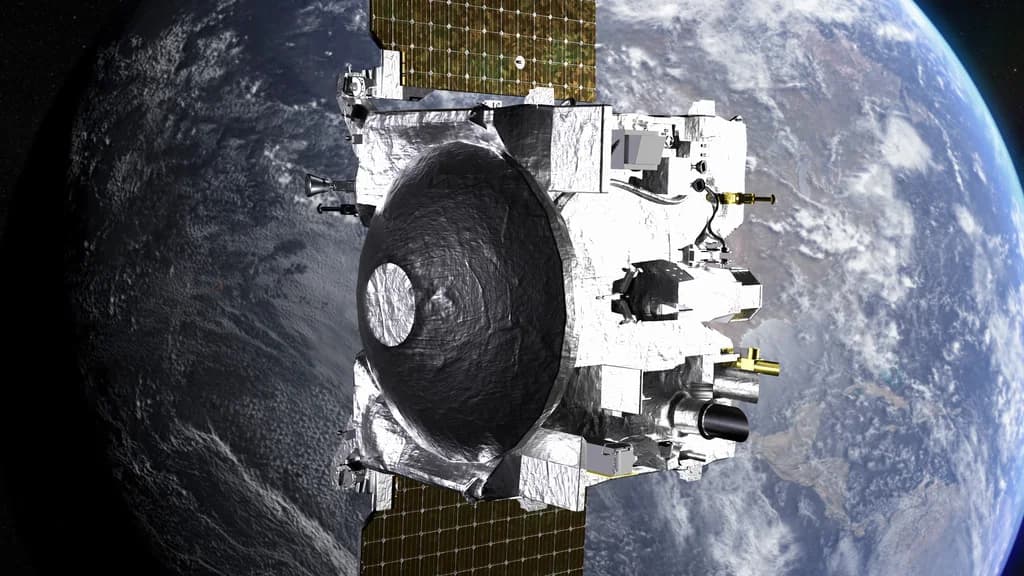
ESA's Ramses mission is intended to accompany Apophis during the encounter and compare its condition before and after the flyby. NASA is sending OSIRIS-APEX to investigate the aftermath; its mission page gives June 2029 for arrival. The spacecraft therefore examine different stages of the same event. They are scientific investigations, not an emergency attempt to push an asteroid away from Earth.
OSIRIS-APEX has a direct connection to the study of asteroid Bennu: it is the same spacecraft that operated as OSIRIS-REx and sent a capsule containing Bennu’s material to Earth. The capsule returned in September 2023, while the probe itself continued towards another target. Laboratory analysis of the returned grains and future measurements of Apophis are different continuations of the same engineering history, addressing different scientific questions.
What will the flyby teach us about planetary defence?
Protecting Earth from genuinely threatening asteroids requires knowledge of their orbits, dimensions and physical properties. A strong, solid fragment and a loose collection of rubble can respond differently to an external force. Measurements of Apophis will let researchers test models against a real object that nature is bringing close to a large planet.
The DART mission demonstrated a different approach in 2022: a kinetic impact on Dimorphos, the moon of asteroid Didymos. That experiment was not prompted by a need to protect Earth from Apophis. Observation, modelling and tests of deflection methods complement one another. The 2029 flyby is valuable precisely because it offers a rare opportunity to gather new data without an Earth-impact threat.
Sources
- NASA — Apophis Facts
- NASA/JPL — Earth Is Safe From Asteroid Apophis for 100-Plus Years
- ESA — Ramses mission to asteroid Apophis
- NASA/JPL CNEOS — How Sentry impact monitoring works
- NASA — Asteroids
- NASA — OSIRIS-APEX
- NASA — Double Asteroid Redirection Test
- NASA/JPL — Horizons ephemeris service
- ESA — Apophis: background and safe 2029 encounter
- NASA — the return of Bennu samples by OSIRIS-REx
Image
Questions and answers
When will Apophis fly past Earth in 2029?
The close approach takes place on April 13, 2029. To observe it, also check the local time and the asteroid's position above the horizon in your city.
Where will Apophis land?
There is no predicted impact site: a collision in 2029 has been ruled out. Maps of hypothetical impacts in old publications are not forecasts of a real event.
Why are distances of both 32,000 and 38,000 kilometres quoted?
About 32,000 kilometres is the altitude above Earth's surface. Measuring from the centre adds Earth's radius. Always check the point from which a distance is measured.
Will I need a telescope to see Apophis?
A brief period of unaided-eye visibility is expected in some parts of the world. Actual visibility depends on location, darkness, atmospheric clarity and light pollution.
Is Apophis an asteroid or a meteorite?
It is an asteroid orbiting the Sun. A meteorite is a fragment that has reached a planet's surface; the safely passing Apophis does not fit that definition.
Will spacecraft knock Apophis off course?
Ramses and OSIRIS-APEX are designed to study the asteroid and changes associated with the encounter. Its refined orbit does not require an impact-prevention operation in 2029.