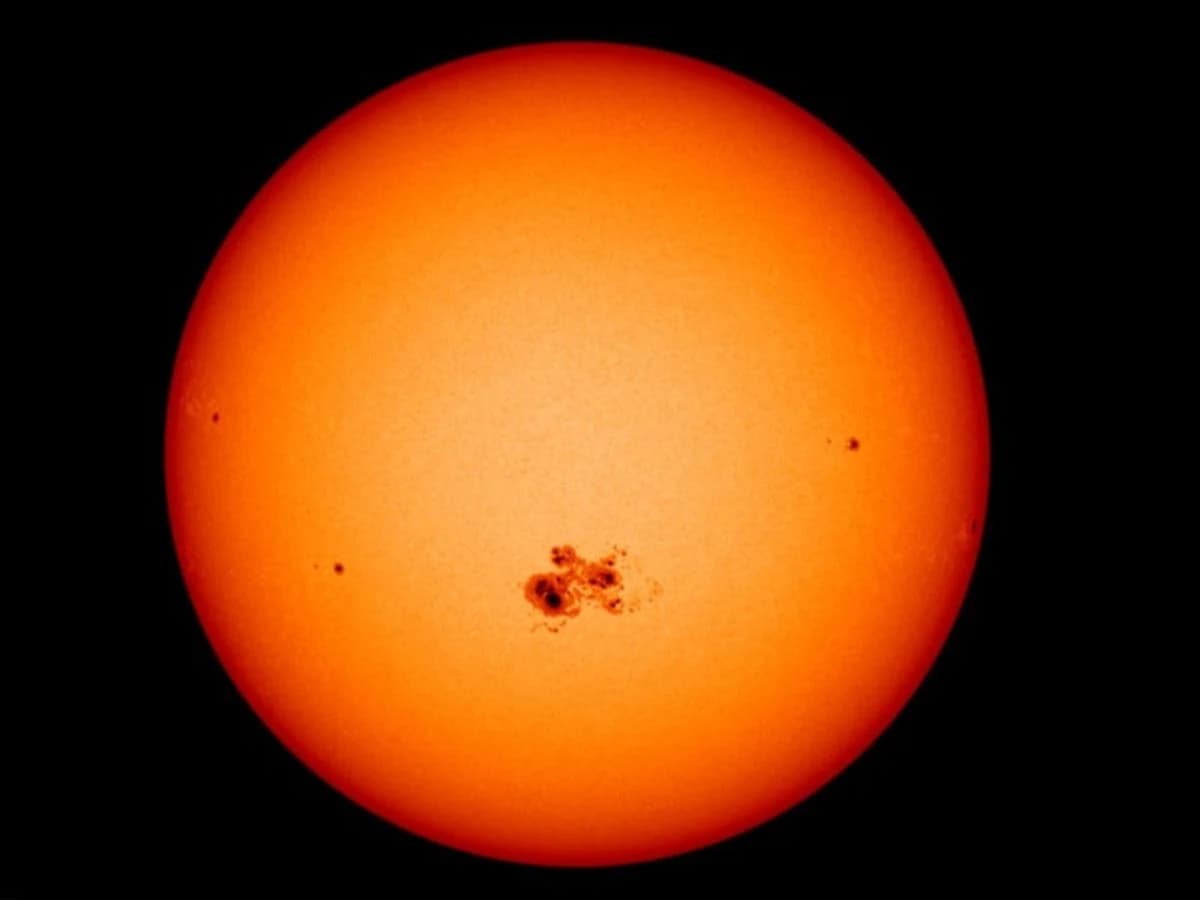
Why the Sun shines
In the Sun's core, at a temperature of about 15 million degrees Celsius, reactions turn hydrogen into helium. Some mass is converted into energy. This is nuclear fusion: combustion involving oxygen on Earth does not describe the source of sunlight. The released energy gradually travels outward through the star's inner layers.
The photosphere is the region from which most of the light we see originates. Its temperature is about 5,500 degrees Celsius. Neither below nor above it is there familiar ground to walk on: solar matter is in a plasma state. Sunspots look dark against the surrounding photosphere because they are cooler, and their formation is linked to magnetic fields.
Reactions in the solar core produce neutrinos that interact weakly with matter and allow the star's interior to be studied. Cosmic neutrinos at record energies address a different set of questions: they are used to search for particle accelerators and investigate cosmic-ray interactions. The solar flux and the KM3NeT event therefore cannot be compared solely by counting detected particles.
How the solar wind reaches the planets
A stream of electrically charged particles, the solar wind, flows into space from the Sun's outer atmosphere. It travels through the interplanetary medium together with a magnetic field. This means the space between planets is a changing physical environment, rather than a perfect vacuum. The flow's conditions depend on processes occurring on the star itself.
As they interact with Earth's magnetosphere, solar particles contribute to space-weather phenomena. This is why observing the Sun matters beyond beautiful images: changes in the environment affect spacecraft and the space surrounding Earth. When reading news, it is useful to distinguish the continuous solar wind from individual powerful ejections of matter: these phenomena are related, but are not identical.
Voyager 1 provides a view of this region’s outer boundary: its measurements allow comparisons between the environment inside the solar bubble and beyond it. This complements research near the star itself. A nearby probe helps study the origin of the solar wind, while a distant spacecraft examines its encounter with the surrounding interstellar medium.
The interaction between the solar wind and Mercury’s small magnetosphere is one of BepiColombo’s science targets. Mio’s instruments will measure particles, the magnetic field and plasma waves around the planet, complementing observations by the second orbiter. Such data allow researchers to study how the flow from the Sun changes the local environment. Joint measurements at different locations are important for this work, alongside images of the surface.
Why Parker Solar Probe flies so close
Parker Solar Probe launched on August 12, 2018. In 2021, it passed through the Sun's corona for the first time. The mission aims to investigate why the outer atmosphere is so hot and how the solar wind accelerates. Images from a distance are not enough to answer these questions: instruments directly measure particles and electric and magnetic fields.
A heat shield protects the equipment, while the trajectory allows repeated visits to our nearest star. The mission connects the picture of the solar atmosphere with what is actually recorded inside it. Here, the difference between an impressive visualization and an investigation is especially clear: a beautiful prominence reveals a shape, but instrument data are needed to understand the energy, motion, and causes behind it.
The photosphere, core, and corona: how hot is each?
The familiar visible disk is the photosphere, with a temperature of about 5,500 °C. The core reaches approximately 15 million degrees, and fusion reactions take place there. Energy travels between the core and outer layers through radiation and the movement of plasma.
The corona is the tenuous outer atmosphere, heated to millions of degrees. A statement about “the Sun's temperature” is therefore ambiguous unless it specifies the layer. A model's cross-section shows the inferred structure, rather than a photograph of the interior.
Will the Sun become a supernova?
The Sun does not have enough mass for a normal core-collapse supernova explosion. As it evolves, it will pass through a red-giant stage, shed its outer layers, and leave a white dwarf.
This process belongs to the distant future, rather than the next cycle of solar activity. Sunspots, flares, and changes in the number of active regions do not mean the star is reaching the end of its existence.
How a solar flare differs from an ejection of matter
A flare is a sudden release of energy in the solar atmosphere, observed as an increase in radiation. A coronal mass ejection sends a large cloud of plasma and magnetic field into space. The two events can accompany each other, but one does not require the other. News of a bright flare alone therefore does not establish that a dangerous cloud is heading for Earth; its direction and physical characteristics must also be determined.
Light and streams of particles travel at different speeds. Radiation takes about eight minutes to cross the distance from the Sun to Earth, whereas a disturbed flow of matter needs much longer. This is why space-weather warnings are updated after the original event: the radiation has already been measured, while the properties of approaching plasma are still being refined.
A forecast is easier to follow if you separate three questions: what happened at the star, whether the disturbance reached Earth, and how the magnetosphere responded. Solar activity varies, but a flare classification is not a complete prediction of its local effects. It describes a particular radiation measurement; aurora visibility, radio conditions, and the effects on a satellite require additional information.
Geomagnetic storms develop through the transfer of energy from the solar wind to the magnetosphere. They change operating conditions for navigation and low-orbit spacecraft and can induce currents in long power networks. These effects have different causes involving the ionosphere, upper-atmosphere density and the rate of magnetic-field change.
Sources
- NASA: Sun Facts
- NASA: What Is the Solar Wind?
- NASA: Parker Solar Probe
- NASA — Voyager 1 and the interstellar mission
- ESA — Mio and the solar wind’s interaction with Mercury
- NOAA — the causes and physics of geomagnetic storms
- NOAA — induced currents and electric power grids
- NOAA — space weather and satellite navigation
- IceCube, neutrino properties and detection methods
Image
Questions and answers
Does the Sun burn like a campfire?
No. Its main energy source is the nuclear fusion of hydrogen in the core, rather than chemical combustion.
Could we land on the Sun?
No. The star has no solid surface to land on; its temperature and plasma environment make such a walk impossible.