DART has already shown that a spacecraft impact can measurably change an asteroid’s motion. Europe’s Hera is now heading for Dimorphos to determine exactly how that experiment worked. As of 27 October 2026, the approach is still underway, with rendezvous scheduled for November in ESA’s current plan. Neither asteroid threatens Earth; the mission is building knowledge for possible future defence, rather than stopping a rock currently on its way to our planet.
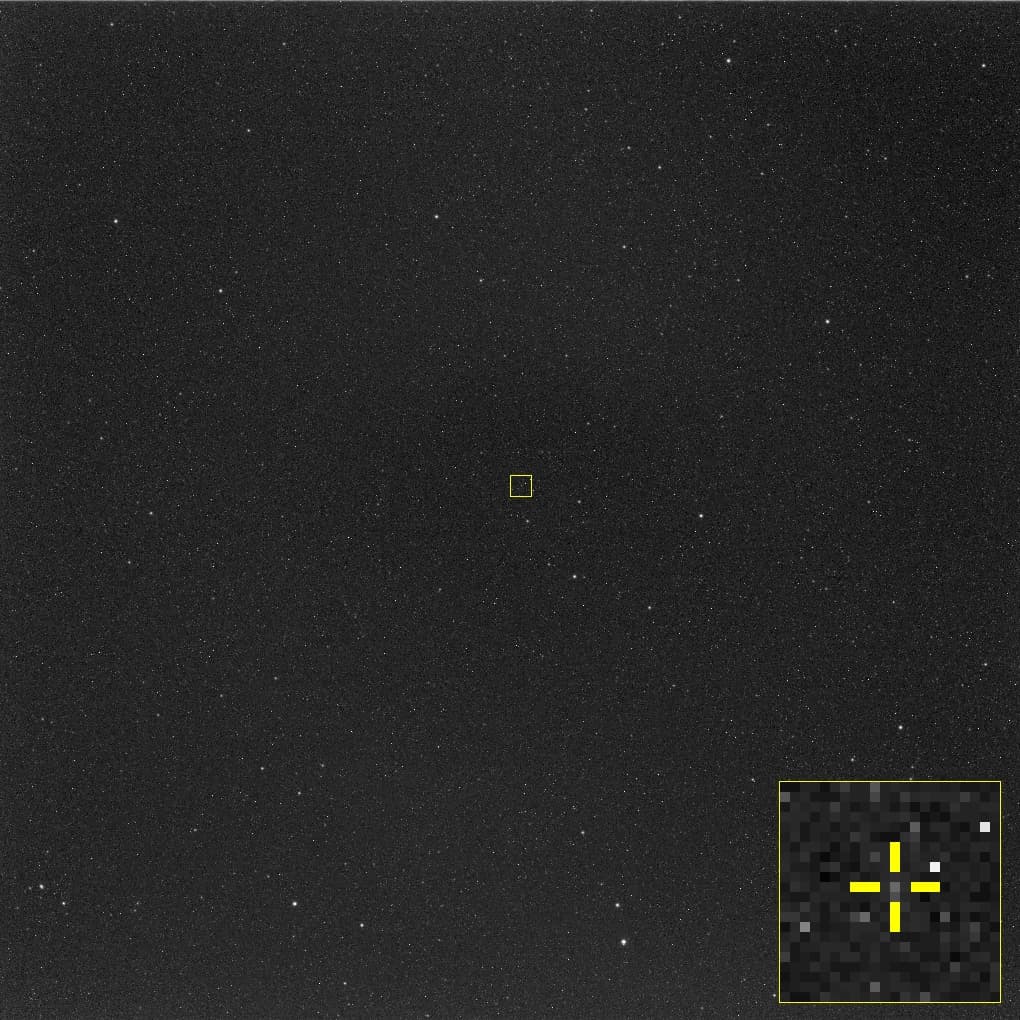
- Hera first detected its target in images released on 7 October 2026. That was not arrival or a detailed surface survey.
- DART shortened Dimorphos’s orbit around Didymos by about 33 minutes; the refined 2024 result was 33 minutes 15 seconds.
- A 2026 study also found a tiny change of 0.15 seconds in the whole pair’s orbital period around the Sun. That is a different orbit.
- A future impact’s effect depends on the target’s mass, structure and trajectory, as well as preparation time. One experiment does not make every asteroid controllable.
Where is Hera now, and when will it arrive?
Hera launched on 7 October 2024. Exactly two years later, ESA released its first detection of Didymos against the background stars, from about 236,500 kilometres away. The target was still smaller than a single camera pixel, so the team combined images and analysed the brightness. At this stage, the larger Didymos and its orbiting moonlet Dimorphos cannot be resolved separately.
The current mission description schedules rendezvous for November 2026. An October navigation-team account described preparations for braking manoeuvres, followed by observations from a safe 25–30-kilometre distance during November and December. A calendar or spacecraft-position graphic alone cannot establish that those stages have happened. The first image confirms target detection; arrival and close-range science need separate mission-team announcements.
Why choose Didymos and Dimorphos?
This is a binary system: small Dimorphos orbits the larger Didymos, while the pair travels around the Sun. Hera material gives rounded sizes of roughly 780 metres for the primary and 150 metres for the moonlet. These estimates are refined as the irregular shapes are reconstructed; a popular diagram’s metre-level figure is not a completed detailed surface map.
The pair is useful for a test because the moonlet’s motion can be measured relative to its neighbour. Telescopes record repeating changes in combined brightness when the bodies pass in front of or shadow one another. Radar provides additional position measurements. Astronomers therefore did not have to wait for a new spacecraft’s return to determine whether the mutual orbital period had changed.
What did the DART impact do?
On 26 September 2022, DART deliberately collided with Dimorphos. Its goal was to transfer momentum and change the asteroid’s motion, rather than destroy the target with an explosion. This method is called kinetic impact. Italy’s small LICIACube spacecraft observed the aftermath nearby, while ground-based and space telescopes watched from farther away.
The impactor’s own mass is not the only contributor. Ejected rock and dust carry momentum away, adding recoil to the remaining body. Predicting the outcome therefore requires understanding how strongly the material is bound and how much can leave the surface. A 2026 study estimated that ejecta roughly doubled the effect of the spacecraft alone. That is an analysis of this particular impact, not a fixed multiplier for every asteroid.
How much did the orbit change: 32, 33 or 33 minutes 15 seconds?
Before impact, Dimorphos orbited Didymos in roughly 11 hours 55 minutes. NASA’s first announcement on 11 October 2022 estimated a shortening of 32 minutes, with an uncertainty of about two minutes. Later summaries commonly round it to “about 33 minutes”. These figures represent different stages of analysis; different headlines do not by themselves establish a contradiction.
The study presented by NASA on 19 March 2024 refined the settled period to roughly 33 minutes 15 seconds shorter than before, about 11 hours 22 minutes 3 seconds. The immediate post-impact change was slightly smaller; motion continued evolving as material was lost. Researchers also reconstructed a more eccentric orbit and a change in Dimorphos’s shape. Hera will test this combined imaging, radar and light-curve model up close.
What new result emerged in 2026?
On 6 March 2026, NASA reported another effect: the whole pair’s motion around the Sun had changed. A shift of 0.15 seconds was measured in its roughly 770-day orbital period. This concerns the much larger heliocentric orbit, not Dimorphos’s 33-minute change around Didymos. The results cannot be mixed or treated as two estimates of the same period.
Such a fine measurement used stellar occultations as well as conventional observations and radar. Several observing stations record a background star’s brief disappearance, helping determine the body’s position precisely. The work used 22 occultations recorded between October 2022 and March 2025. It demonstrates why a small change in motion made sufficiently early matters for planetary defence.
Why send Hera after a successful test?
Knowing the period change is not enough to calculate the next impact on a different target. Researchers need Dimorphos’s mass, volume, porosity and internal structure, together with refined motion and ejecta properties. The same outside dimensions can conceal a dense monolith or a loosely packed collection of blocks, which absorb energy and transfer momentum differently.
Hera is intended to connect DART’s outcome with this asteroid’s physical properties. Cameras, a laser altimeter, spectral observations and thermal measurements will provide different parts of the picture. Radio signals and spacecraft motions will help constrain gravity and mass. That turns a single experiment into a test of models that could guide the design of a future mission.
Surveying an asteroid in space and delivering material to a terrestrial laboratory provide different kinds of data. OSIRIS-REx returned Bennu samples that can be examined with instruments unavailable on a small probe. Hera is intended to relate its target’s shape, mass and motion to the impact’s outcome. Comparing these approaches helps explain why the composition of an individual grain does not replace measurements of the whole body, while a detailed surface map does not automatically reveal all of its chemistry.
The Psyche mission, heading for a metal-rich asteroid, addresses a different question. It is intended to investigate the body’s composition and interior to test ideas about early planetary building blocks. Hera relates the properties of its small moon to the consequences of an impact, while Psyche will study an object with a different history and set of scientific questions. This comparison shows why one asteroid mission’s findings cannot automatically be applied to every small body.
Will Hera find a conventional crater?
That remains an open question. Modelling reported by ESA in February 2024 allows for an impact that reshaped much of Dimorphos as a whole. In a very loose, weakly bound body, deformation need not remain a separate circular bowl. An absence of a conventional crater would therefore not mean that DART missed or failed.
Pre-impact surface observations and ejecta analysis support a weak rubble-pile structure, but a detailed post-impact map is still missing. Close measurements will test where the model correctly described shape and material displacement, and where it needs revision. That uncertainty is the reason for the survey, rather than an already completed Hera result.
What will the two CubeSats do?
Hera carries two small spacecraft, Juventas and Milani, intended to operate near the asteroids and relay data through the main probe. Juventas is designed to probe Dimorphos’s interior with radar and make measurements related to its weak gravity. Milani will examine surface composition through reflected-light spectra and study dust. Their tasks complement Hera’s own images.
ESA’s October plan places CubeSat deployment in early 2027, after the initial survey stages. Closer navigation will rely on surface landmarks and autonomous systems. Weak gravity does not make flying easy: operations must account for two moving bodies, possible debris and the orbital precision of several spacecraft at once.
How did Mars help Hera reach its target?
On 12 March 2025, Hera performed a gravity assist at Mars. The planet’s gravity changed the spacecraft’s trajectory, shortening the journey and reducing fuel needs. Cameras and other instruments imaged Mars and its moon Deimos during the flyby, combining an equipment test at a real distant target with scientific observations.
Deimos and Dimorphos are different bodies despite their easily confused names. Deimos is a moon of Mars; Dimorphos orbits Didymos. Hera’s cruise through the Solar System is also distinct from its future manoeuvres at the binary asteroid: a successful planetary flyby does not replace preparation for sustained work in a much weaker gravitational field.
Can we now deflect any dangerous asteroid?
DART validated the method in one real case. Applying it to another asteroid requires knowing its mass, structure, rotation and orbit, choosing the impact direction and timing, and delivering a spacecraft. Early detection is especially important. A small velocity change can accumulate into a substantial trajectory difference over time; shortly before a potential Earth encounter, that time margin is gone.
The story does not need an invented present-day threat from the test target. Didymos and Dimorphos were not heading towards Earth, and the controlled impact did not put them on a collision course. Similarly, Apophis’s close passage on 13 April 2029 does not require deflection: NASA rules out an impact for at least a century. Preparing defence and observing safe encounters are related research efforts, but different specific situations.
Sources
- ESA — Hera: current schedule and mission goals
- ESA — first detection of Didymos, 7 October 2026
- ESA — Hera navigation and approach plan, October 2026
- NASA — initial orbital-period result, 11 October 2022
- NASA — refined Dimorphos orbit and shape, 19 March 2024
- NASA — change in the pair’s orbit around the Sun, 6 March 2026
- ESA — Hera measurements and CubeSats: frequently asked questions
- NASA — the geology of Didymos and Dimorphos, 30 July 2024
- ESA — Hera’s Mars and Deimos flyby, March 2025
- NASA — Apophis’s safe 2029 flyby
- ESA — modelling the reshaping of Dimorphos, 26 February 2024
- NASA — the Didymos system and its lack of threat to Earth
- NASA — the return of Bennu samples by OSIRIS-REx
- NASA — Psyche and testing the origin of a metallic asteroid
Questions and answers
Has Hera already arrived at Dimorphos?
As of 27 October 2026, ESA’s checked schedule gives November for rendezvous. The first target detection released on 7 October is not equivalent to arrival or close-up surface imaging.
Will Hera also crash into the asteroid?
Its main task is a detailed survey of DART’s aftermath and the two asteroids’ properties. It is not a second experiment to deflect the target with the same impact method.
Did DART move the asteroid by 33 minutes?
That is the shortening of Dimorphos’s orbital period around Didymos. It describes the duration of one orbit, not a displacement distance or a change to an Earth-impact date. The refined 2024 estimate is 33 minutes 15 seconds.
Does the Didymos–Dimorphos pair threaten Earth?
No. It was selected for a safe test. NASA states that neither asteroid threatened Earth before the impact or became a threat afterwards.
Why not simply repeat DART for every target?
Asteroids differ in mass, composition, strength, rotation and trajectory. Predicting the outcome requires those properties and enough preparation time; Hera is intended to help test the relevant models.