Psyche is an asteroid thought to contain an unusually large proportion of metal, and also the name of the NASA spacecraft travelling to study it. In October 2026 the mission reported a new extended phase of electric propulsion. Neither a gold mine nor an exposed planetary core has been identified there up close. The famous “$10 quintillion” grew out of a hypothetical calculation; the flight’s real purpose is to establish what this body is like and how it formed.
- The Mars gravity assist was completed on May 15, 2026. The spacecraft is still travelling; arrival in orbit around Psyche is planned for August 2029.
- Current remote estimates suggest metal may occupy 30–60% of the asteroid’s volume. This is neither a gold fraction, a metal mass fraction nor an estimate of recoverable reserves.
- A remnant core of an ancient planetary building block is one hypothesis to be tested. NASA also considers material that never underwent complete melting.
- Psyche will investigate the surface, elements, magnetic field and gravity from orbit. Landing, metal extraction and sample return are not part of the mission.
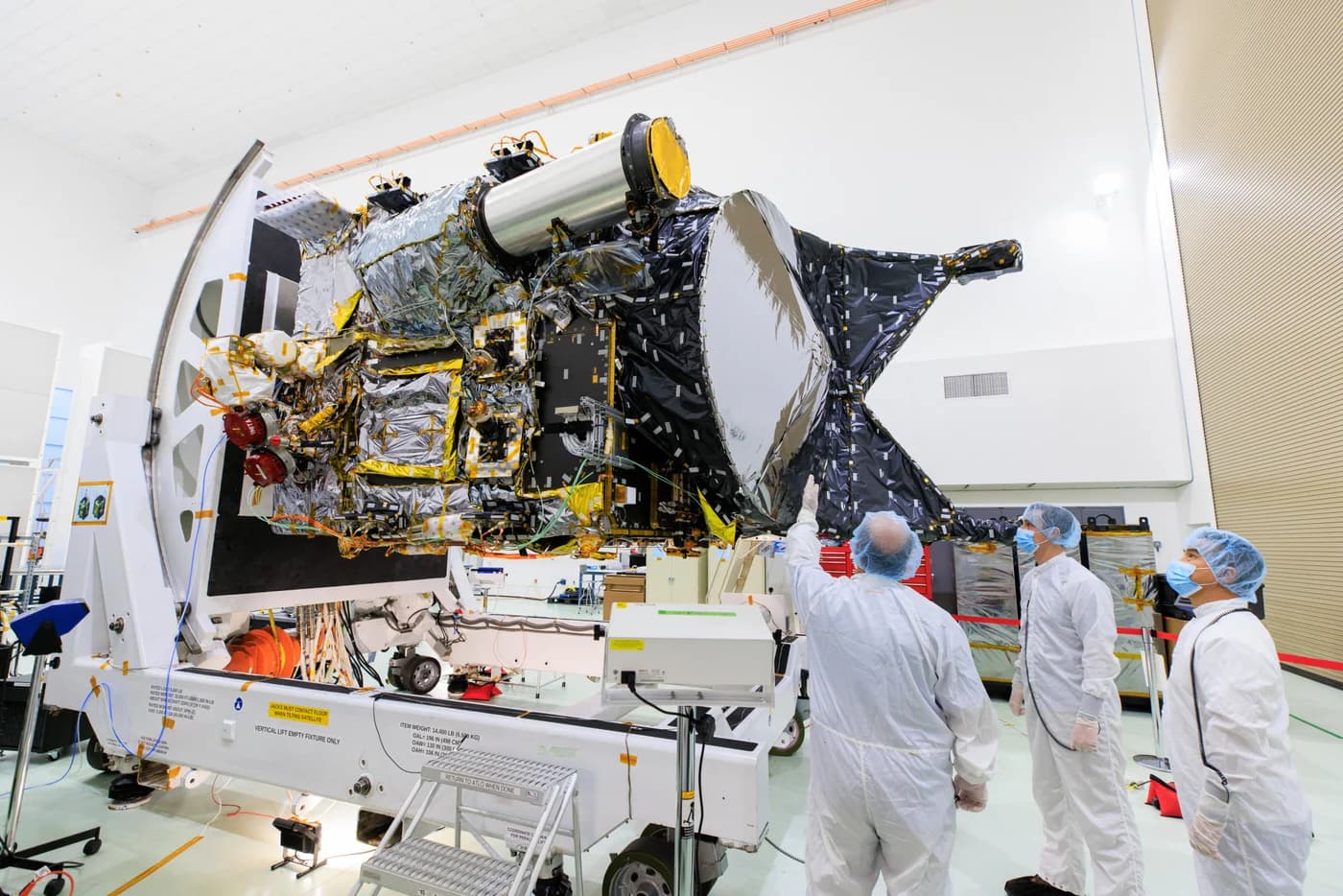
Where the Psyche mission stands in October 2026
In its October 22 update, NASA reported that the spacecraft had begun near-continuous electric propulsion toward the asteroid belt on September 28. During the remaining cruise, the team plans to use thrust for roughly 90% of the time, with pauses for communications and engineering operations. This is a cruise operating mode, rather than an announcement of arrival or the start of extraction.
Earlier, on May 15, Psyche passed approximately 4,609 kilometres above the surface of Mars. The gravity assist changed its velocity and flight direction; radio tracking confirmed its successful completion. Launch took place on October 13, 2023, and the current arrival target is August 2029. Dates in older reports describing a 2026 encounter belonged to an earlier plan and no longer describe this mission.
What asteroid 16 Psyche is
Psyche orbits in the main belt between Mars and Jupiter. It is no small rock near Earth: the irregular body reaches approximately 280 kilometres across at its widest. The number 16 denotes its place in the historical numbering of asteroids. It says nothing about size or metal content. The spacecraft carries the same English name as its destination, Psyche, so reports sometimes mix up the properties of two different objects.
So far, the asteroid has been studied from Earth and near-Earth space. Radar echoes, brightness and thermal emission help constrain its shape and surface properties, but do not provide a close-up view. Images showing intricately detailed metallic cliffs in mission coverage are generally illustrations. Even a scientific three-dimensional shape model is a product of processed measurements, rather than an existing photographic map.
How much metal Psyche may contain, and whether it contains gold
NASA gives a current estimate of metal occupying between 30% and 60% of Psyche’s volume, with rock making up the rest. The expected metallic component is primarily iron and nickel. The interval is broad because remote observations must be translated into composition through models. A solid metal sphere does not match what is currently known about this body.
A volume fraction is fundamentally different from a mass fraction: equal volumes of dense metal and less dense rock have different masses. These percentages therefore cannot be inserted into an arbitrary calculation of gold mass. Metal content does not in itself establish a gold deposit. Researchers have no map of gold ore, its concentrations or recoverable reserves; the mission must first refine the asteroid’s elemental composition and structure.
Why it is described as a possible core of a planetary building block
The early Solar System did not consist solely of finished planets. Small bodies collided and grew; some became hot enough to melt partly or completely. Within such a body, dense metal could separate and sink toward the centre, while silicate rock formed outer layers. This separation of material is called differentiation, and it helps explain the internal structure of rocky planets.
If subsequent collisions removed much of the rocky exterior, material from a former core could have been exposed. This scenario makes Psyche compelling: a conventional orbiter cannot be sent to Earth’s core, but it can visit a small remnant of an early body. The comparison concerns the history of metal and rock separating. It does not mean the asteroid reproduces the present-day pressure, temperature or structure inside Earth.
Why a core cannot already be declared discovered
Psyche contains both metal and rock, and its bulk density also depends on internal voids. Its observed properties do not specify a unique history. NASA explicitly lists testing two possibilities among the science goals: a remnant core, or metal-rich material that never underwent complete melting. Collisions and the mixing of fragments can complicate that picture further.
A single striking photograph will not distinguish every possibility. Consistent information about composition, terrain, mass and magnetic properties is needed. Strong radar echoes, for example, help identify a metallic surface, but do not by themselves reveal how the metal got there or what lies underneath. An exposed core is a reason to carry out the investigation, rather than its predetermined result.
Where the “$10 quintillion” came from
The number has a more specific history than the headlines suggest. In direct interviews with Planetary Radio and Science Friday in 2023, mission principal investigator Lindy Elkins-Tanton recalled a conversation with a journalist in January 2017. She was asked what the metal would be worth if the asteroid were hypothetically brought to Earth and sold. Comparing a presumed quantity of metal with terrestrial prices at the time produced an enormous sum.
This is a participant’s recollection, not a published reserves audit. In the interviews, she even noted that she no longer remembered exactly which metals had gone into the calculation. Confident formulas in retellings, as though a known mass of gold had been multiplied by a market quotation, therefore add certainty absent from the original explanation. Elkins-Tanton herself stressed the hypothetical nature of the example and that mining was not the mission’s purpose.
Why a hypothetical price does not become profit
Even with composition known exactly, multiplying the entire mass by the price of finished metal would not establish a project’s earnings. It would be necessary to determine what fraction could actually be recovered, how to separate it from rock, how to provide energy and transport, and what all of that would cost. No such production system exists for Psyche. A scientific estimate of metal content does not substitute for an economic assessment of a technically accessible deposit.
The price itself presents another problem: one cannot assume that selling a vast additional supply of material would leave the market unchanged. A present quotation reflects present supply and demand. The thought-experiment figure is therefore neither a promise to enrich everyone on Earth nor a future NASA budget. For this mission, Psyche’s value lies in questions about how planets formed.
What the spacecraft will do after its planned 2029 arrival
Psyche is a scientific orbiter. After arrival, approximately two years of operations in orbit around the asteroid are planned. Observations from different distances will combine a global survey with more detailed study of particular properties. The programme does not include landing, drilling, industrial processing or returning a cargo of metal to Earth.
These goals also distinguish the flight from the Hera mission investigating the aftermath of DART’s impact on Dimorphos. That investigation aims to reconstruct a small body’s response to an impact; this one seeks the composition and geological history of an unusual metallic world. A shared interest in asteroids does not make the spacecraft interchangeable: instruments, orbits and measured quantities are selected for a particular scientific question.
Lucy’s mission to Jupiter’s Trojan asteroids uses a different scheme for comparative investigation. It involves brief flybys of several targets, so detailed measurements must fit into limited windows. This route helps compare compositions and surfaces across one population. An extended stay at one object and a survey of many bodies answer different questions about planetary history.
How composition, the surface and internal structure will be investigated
A pair of multispectral cameras will image the surface through different visible and near-infrared filters. This will allow terrain features to be compared with regions that reflect light differently. The gamma-ray and neutron spectrometer has a separate role: it measures signals produced when cosmic rays interact with surface material, helping determine the abundances of chemical elements.
Radio tracking will add information about gravity. Changes in the spacecraft’s motion around the asteroid will help researchers refine its mass and gravity field and, together with the body’s shape, constrain its interior. This is an indirect physical inference from combined data. It is not a photograph through the centre or a direct weighing of a separate metallic core.
What magnetic memory could reveal
The magnetometer will look for a remanent magnetic field. In the past, molten conducting metal could have participated in a dynamo, the process that generates a field within a body. If the material preserves a trace of such an ancient field, that would provide strong evidence for a core-related history. The instrument is searching for a physical record of the past, rather than testing whether a gold coin would be attracted to the asteroid.
A remanent field does not mean that Psyche must currently contain an operating liquid core like Earth’s. A convincing reconstruction will still require magnetic data to be compared with composition and geology. This combination of measurements is what makes the mission a hypothesis test: each instrument constrains part of the history rather than delivering a universal answer through a single reading.
Why the journey takes years of gentle thrust
Four Hall-effect thrusters use electricity from the solar arrays to accelerate and expel xenon ions; the exhaust produces thrust. Only one thruster operates at a time. Instantaneous thrust is small compared with a chemical rocket, but prolonged operation gradually accumulates the required change in velocity. Electric propulsion did not replace the launch vehicle for departure from Earth.
The farther the spacecraft travels from the Sun, the less energy reaches its panels, so its thrust operating conditions change along the way. October’s news marks an important cruise development, but does not yet test the asteroid’s origin hypothesis. That test will begin with close-up measurements. If Psyche proves to be a complex mixture with a different history than expected, that result will also help explain the bodies from which rocky planets assembled.
Sources
- NASA — electric-propulsion cruise update, October 22, 2026
- NASA — successful Mars flyby on May 15, 2026
- NASA — current Psyche mission overview
- NASA — asteroid Psyche’s size, orbit and estimated composition
- NASA — science goals: a remnant core or unmelted material
- NASA — Psyche instruments and propulsion system
- Planetary Radio — direct interview with the mission’s principal investigator, March 2023
- Science Friday — the principal investigator explains the hypothetical price, October 2023
- NASA Photojournal — the real spacecraft before launch, image PIA25952
- ESA — Hera’s science investigation following the DART impact
- NASA — Trojans, trajectory and the reasons for flybys
- NASA — science goals: geology, composition and physical properties
Questions and answers
Has Psyche reached the asteroid yet?
No. As of October 30, 2026, the spacecraft is still in cruise. The Mars flyby took place on May 15, 2026; arrival at the asteroid is planned for August 2029.
Is Psyche really worth $10 quintillion?
The figure comes from a hypothetical comparison of a presumed quantity of metal with terrestrial prices. It does not incorporate verified recoverable reserves, extraction and transport costs, or an assessment of market changes. It is not the mission’s earnings.
Is the asteroid made entirely of gold?
No. NASA’s current estimate is 30–60% metal by volume, primarily an expected iron-nickel component, mixed with rock. A gold deposit has not been established.
Has an exposed ancient planetary core been confirmed?
No. A remnant core of a planetary building block is a scenario to be tested. Composition, magnetic, gravity and geological data should help distinguish it from other possible origins.
Will the mission return metal or soil to Earth?
No. Psyche will operate from orbit. Landing, industrial extraction and sample return are not planned; scientific measurements and images will be transmitted by radio.