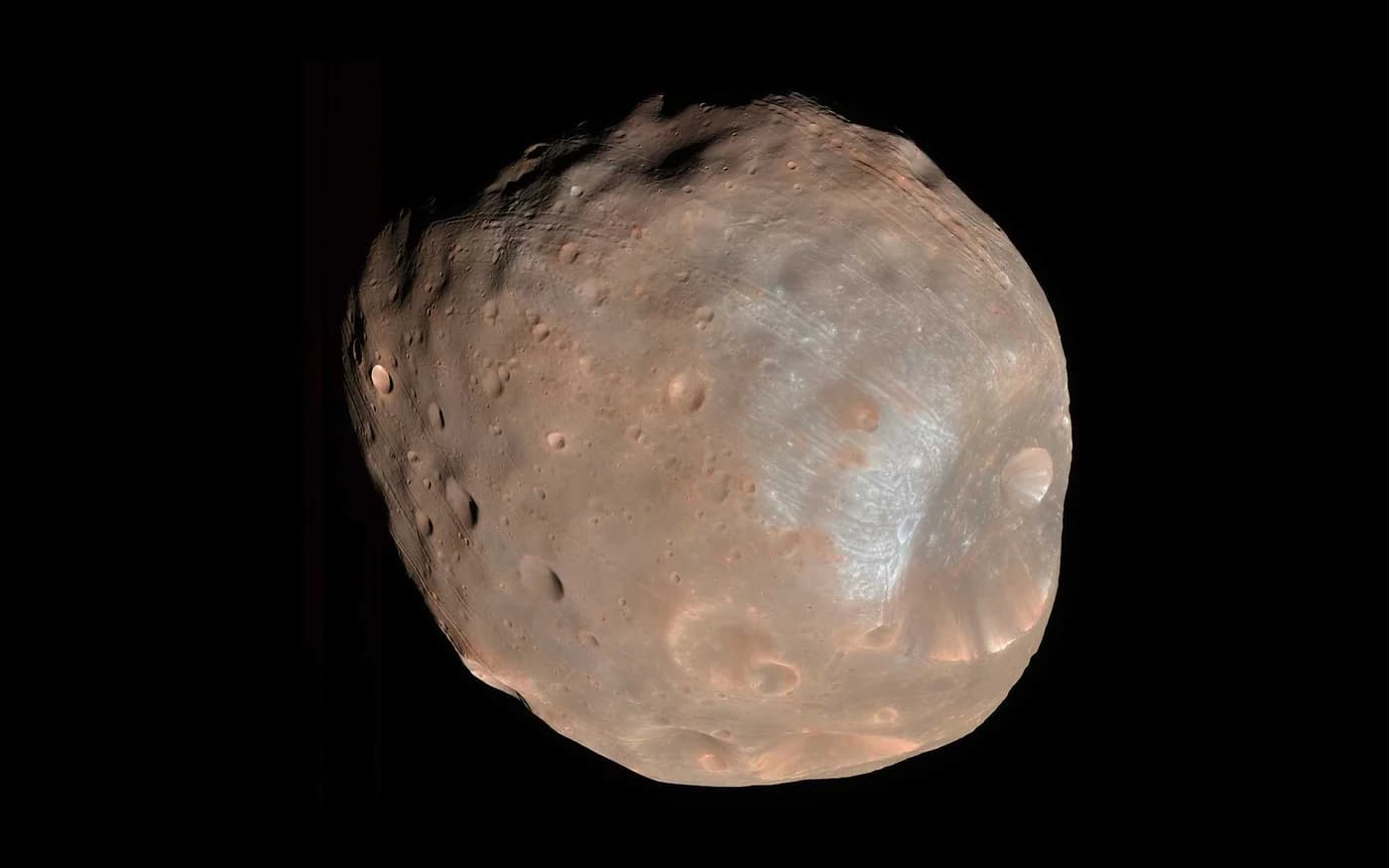
Phobos resembles a small asteroid, yet orbits close to Mars’ equatorial plane. How it ended up beside Mars is one question Japan’s MMX mission aims to answer. The mission has begun: the spacecraft launched on 20 October 2026, Japan time. Ahead lie observations of both moons, rover operations and an attempt to deliver Phobos material to laboratories on Earth. Launch is confirmed; landing and sample return remain future milestones.
- JAXA confirmed MMX’s launch on H3 Flight 10 and the end of initial critical operations on 21 October. The spacecraft has not yet reached Mars or landed on Phobos.
- The main origin scenarios are capture of asteroidal material and formation from debris produced by a major impact on Mars. Visual resemblance alone cannot distinguish them.
- Idefix is a separate DLR/CNES rover. It will investigate the surface before the main spacecraft lands; MMX itself will collect the material for return.
- The target is at least 10 grams from Phobos. Investigations in the Mars system are planned from 2027, with return targeted for 2031; JAXA’s roadmap specifies fiscal year FY2031.
What has happened: launch and initial checks
According to JAXA, H3 Flight 10 lifted off from Tanegashima on 20 October 2026 at 04:41:03 Japan Standard Time. The spacecraft separated as planned roughly one hour and 11 minutes after liftoff. DLR gives 19 October at 21:41 CEST, which is the same moment as 20 October at 04:41 JST. The different calendar dates reflect the time zones.
On 21 October, JAXA confirmed that key initial operations had been performed successfully and ended the critical phase. These included solar-array deployment, attitude establishment and antenna release. Onboard-system checks and preparation for routine cruise operations follow. As of 29 October, this is the early phase that has been confirmed: Phobos images accompanying mission explainers should not be mistaken for images already acquired by MMX.
How Phobos differs from our Moon and from Mars
Mars has two small moons, Phobos and Deimos. Phobos is larger, with principal dimensions of about 27 × 22 × 18 kilometres. It is an irregular body covered with craters, grooves and a layer of fragmented material called regolith. Its dark surface and reflected-light characteristics resemble some carbonaceous asteroids. Appearance does not, however, establish a unique formation history.
Phobos lies only a few thousand kilometres above Mars and has no atmosphere. Earth’s Moon is much larger, while landing on Mars involves an atmosphere and a stronger gravity field. MMX tackles another problem: prolonged observations near a small moon and careful contact with its surface. For an object this small, terrain and gravitational conditions cannot be assumed identical everywhere.
Two main scenarios: captured asteroid or impact debris
In the capture scenario, the original body formed elsewhere in the Solar System and became bound to Mars. The moons’ spectral resemblance to dark asteroids makes this attractive. Orbital dynamics pose a challenge: their nearly circular, low-inclination orbits must result from an initial planetary encounter. The capture mechanism and subsequent orbital evolution therefore need an explanation.
In an impact scenario, a large body struck young Mars, ejecting material into orbit that subsequently formed moons. This more readily connects orbital geometry to the planet, but debris composition and later evolution still need testing. These descriptions represent families of models, rather than two complete, settled pictures. Assigning an origin from shape, colour or density alone would be premature.
What a sample can reveal about these scenarios
Researchers need several lines of evidence: mineral composition, isotope ratios, ages of individual components and signs of heating or impact processing. Material retaining primitive small-body characteristics and material processed by a major collision with Mars may preserve different combinations. The test concerns a consistent picture, rather than a single mineral labelled asteroid or Mars.
Heterogeneity matters too. Repeated impacts have broken and mixed the surface, while exposure and space weathering have altered its upper layers. Different grains can record different events. MMX must first connect sampling locations to surface maps, then let laboratories investigate individual mixture components. Returning material and correctly interpreting its origins are successive tasks.
Why Phobos regolith may contain grains from Mars
A powerful impact on Mars can eject some material into space. Nearby Phobos may intercept part of it. JAXA regards potential Martian admixture as an additional record of the planet’s history. This remains a prediction for future samples, rather than a piece of Mars already identified in an MMX container.
Such admixture must be distinguished from the moon’s own material. Even a securely identified Martian grain would not prove that all of Phobos formed from Mars: it could have arrived much later. Conversely, failure to identify such grains in a small portion would not rule out transport. MMX is sampling Phobos, so any record of Mars must be interpreted through the origins and mixing of individual grains.
Why weak gravity does not make landing simple
JAXA’s overview gives surface gravity roughly 1,700 times weaker than Earth’s. A 25-kilogram Idefix would therefore press on the ground with a force comparable to the weight of about 15 grams on Earth. Its mass and inertia remain unchanged. A small push or poorly controlled wheel motion could produce a bounce instead of steady travel.
Operating near the moon also differs from orbiting a large planet. MMX will use quasi-satellite trajectories, or QSOs, to remain near Phobos while accounting for Mars’ strong influence. This involves more than shrinking a circular orbit to a convenient altitude. Observations must refine the shape, gravity field, obstacles and properties of candidate sites before surface contact.
Why the mission carries the Idefix rover
Idefix was developed by France’s CNES and Germany’s DLR. DLR’s post-launch plan targets landing around the turn of 2028–2029 and approximately 100 days of surface work. The rover will be released above Phobos; after impact and bouncing, it must autonomously right itself and deploy solar panels. None of these steps has taken place as of 29 October 2026.
Its science role concerns the surface’s local properties. The RAX Raman spectrometer and miniRAD radiometer will investigate mineralogy and thermal characteristics, while wheel motion will reveal mechanical behaviour of the regolith. These measurements serve science and help reduce the risk of MMX’s later landing. Idefix is a scout, rather than the return container: the main spacecraft will collect the Earth-bound samples.
How MMX intends to collect at least ten grams
The mission carries two sampling approaches. Japan’s C-Sampler uses a mechanical corer to collect subsurface material. NASA’s P-Sampler directs short bursts of pressurised nitrogen to loft surface particles into a receiver. The devices address different parts of the upper layer and complement each other.
The target returned mass is at least 10 grams. Modern microanalytical methods can extract substantial science from that amount, but it will not automatically represent an average of the whole moon. Grains may differ in composition, size and history. Collection, packaging and preservation of site information must connect future measurements to Phobos’ actual surface.
Why instruments are needed before samples return
TENGOO and OROCHI cameras will connect large landforms with local details and colour, while lidar measures distance and geometry. The MIRS infrared spectrometer will examine reflected light to add compositional information. Together, these observations help select scientifically useful and safe contact sites, rather than a convenient point on a schematic sphere.
The US-provided MEGANE determines elemental composition from neutrons and gamma rays emitted by the surface. That is different information from an image or a reflectance spectrum. Combining measurements will help assess how representative a selected site is and which features merit investigation in samples. Observations of Deimos will broaden the comparison, although the mission does not plan to return material from it.
Which questions require laboratories on Earth
A gram of heterogeneous dust can be investigated as a collection of individual histories. Microscopy reveals mineral relationships and traces of processing; mass-spectrometric methods measure isotope ratios; radiometric approaches help date events. Combining results should distinguish original components, later alteration and transported admixtures. None of these signatures should automatically be treated as the formation age of all of Phobos.
As with Bennu sample research, return enables material to be shared between methods and new questions to be tested after the flight. MMX has its own objective: connecting a small moon’s origins with the history of Mars. Radio links transmit instrument readings, but cannot replace access to an actual grain that can be remeasured or examined using a technique not yet available at launch.
When to expect landing and return, and what success will mean
The plan calls for arrival in the Mars system in 2027: ESA’s October infographic gives August for Mars and September for the start of operations near Phobos. Detailed reconnaissance, Idefix and main-spacecraft sampling follow. Departure from Mars is targeted for 2030. JAXA’s roadmap labels capsule return FY2031, a fiscal year; a specific future landing date has not been established.
The capsule is intended to be recovered in Australia, with the material then transferred for controlled opening and study. Successful launch has only begun this sequence. Even after delivery, the scientific outcome will emerge from comparisons of minerals, isotopes, ages and surface maps. MMX should strongly constrain Phobos origin scenarios; there is no basis to promise that any first grain will instantly settle the history of both Martian moons.
Sources
- JAXA — MMX launch result, 20 October 2026
- JAXA — completion of initial critical operations, 21 October 2026
- ISAS/JAXA — MMX listed among operating spacecraft
- NASA — Phobos dimensions and properties
- JAXA — science goals, moon origins and material ejected from Mars
- ESA — MMX spacecraft, sampling and return
- Earth, Planets and Space — MMX scientific mission architecture, 2022
- DLR — MMX launch and Idefix operations plan, October 2026
- JAXA — IDEFIX rover role and handover, 2024
- NASA — MEGANE and the pneumatic sampler, 15 October 2026
- JAXA — mission sequence and FY2031 plan
- ESA — planned arrival at Mars and Phobos, October 2026
- NASA — current MMX mission page
- NASA — Phobos colour image PIA10368
Questions and answers
Has MMX launched, or is it still on Earth?
JAXA confirmed launch on 20 October 2026 at 04:41:03 JST. Initial critical operations ended on 21 October. The spacecraft is at the beginning of its flight; arrival at Mars and operations on Phobos are still ahead.
Will MMX return material from Mars or Phobos?
Sampling is planned on Phobos. Its surface may contain particles ejected from Mars by ancient impacts, but their presence and origin must be established analytically. This is not direct sampling of the Martian surface.
Will the Idefix rover return the samples itself?
No. It will investigate the surface and help prepare the main spacecraft’s operations. MMX’s samplers will collect material, and a separate return capsule will deliver it to Earth.
Is the origin of Phobos already known?
There is no definitively established explanation. The main scenarios involve captured asteroidal material or debris from a major collision with Mars. MMX will compare remote observations with future laboratory analysis.
When will Phobos samples reach Earth?
The current target is 2031, labelled FY2031 in JAXA’s roadmap. This is a plan: the spacecraft must first reach Mars, investigate sites, collect and preserve material, then complete the return journey.