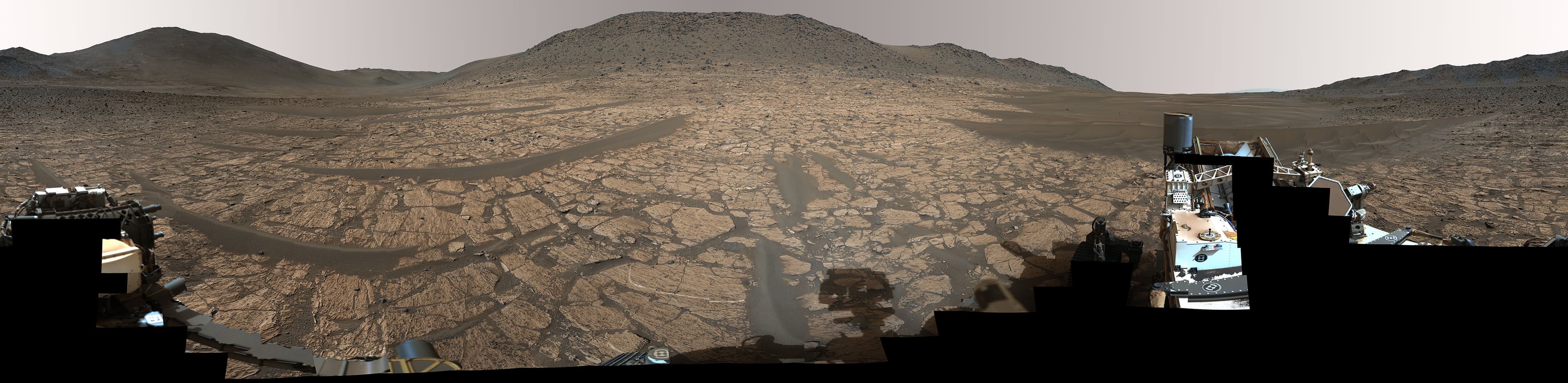
A world that preserves traces of ancient water
Mars preserves terrain shaped by impacts, volcanoes, wind and ancient flowing water. Its thin atmosphere does not create Earth-like conditions today. Researchers reconstruct past environments from individual rock layers and minerals rather than simply seeking landscapes resembling Earth.
Mars: key facts
- Type
- Rocky planet
- Mean radius
- 3,389.5 km
- Mean distance from the Sun
- ≈ 1.52 AU · 228 million km
- Orbital period
- ≈ 687 Earth days
- Rotation
- 24 h 37 min · sidereal
- Temperature
- −153…+20 °C
- Mass
- 6,42 × 10²³ kg
- Mean density
- 3 934 kg/m³
Values are rounded. The distance describes the orbit, not the current distance from Earth. For giant planets, temperature refers to a reference atmospheric level: they have no solid ground. Mean radius differs from equatorial radius.
Atmosphere and appearance
Very thin and mostly CO₂, with nitrogen and argon. Dust colors the sky and can envelop the entire planet.
Valles Marineris
A canyon system about 3,870 km long.
Polar caps
Water ice and seasonal deposits of frozen CO₂.
Jezero
In this crater, Perseverance explores an ancient delta and collects samples.
What is inside?
Scientific model. Layer colors are illustrative; the thin crust is enlarged for clarity.
Crust
Basaltic crust covered in dust and iron oxides.
Mantle
A rocky silicate shell around the core.
Core
An iron-rich core containing lighter elements. Seismic data continue to refine our understanding of its properties.
The cutaway is based on physical models and indirect measurements. It is not a photograph of the interior; in 3D, you can select each layer separately.
Natural satellites
Mars has two small natural satellites, Phobos and Deimos. Their irregular shapes differ from Earth's nearly spherical Moon.
History of discovery and exploration
Known since ancient times
Reddish Mars was observed long before telescopes. Space missions replaced speculation about 'canals' with data on craters, volcanoes, ice and ancient river systems.
- 1965
The first close-up images
Mariner 4 returned close-up images of Mars: instead of imagined canals, its camera revealed craters.
- November 13, 1971
The first orbital explorer
Mariner 9 became the first spacecraft to orbit another planet and began global observations of Mars.
- July 20, 1976
Long-term work on the ground
Viking 1 began successful surface investigations. The two Viking landers returned thousands of photographs and performed biological experiments.
- 1997
A small wheeled explorer
Mars Pathfinder delivered Sojourner. The first successful Mars rover studied rocks near its landing station.
- 2012
A laboratory in Gale crater
Curiosity began studying rocks and conditions in which the ancient Martian environment might have supported life.
- 2021
Jezero and its samples
Perseverance arrived in Jezero crater to explore an ancient delta and collect rock samples. Any possible signs of life require further verification.
Curiosity explores Gale crater; Perseverance explores Jezero. InSight measured marsquakes.
Rocks as a record of the Martian environment
A layered outcrop matters for more than its resemblance to an earthly desert. Rock sequences can preserve evidence of sediment transport, changing water conditions and later alteration. Researchers examine grain sizes, minerals and layer relationships to distinguish possible processes. A horizontal stripe in a photograph alone does not demonstrate an ancient lake: similar shapes require testing against several independent clues.
Orbital imaging identifies a wider region, while a rover examines particular sites nearby. The scales complement each other. Detailed analysis of one rock cannot automatically describe all of Mars; a valley overview does not reveal exact chemical composition. When connecting a panorama with a terrain map, locate major landmarks and the route direction before moving to individual analysed samples.
Organic material and evidence of life
Organic compounds have been detected in Martian rocks, but organic in chemistry does not mean produced by an organism. Carbon-bearing molecules can form without biology. The scientific question is which processes could produce and preserve particular material. Read a discovery report alongside its measurement method, rock type and considered alternatives rather than reducing it to a claim that Martian life has been found.
Ancient habitability and actual habitation are different conclusions. Liquid water and suitable chemistry explain interest in a location but do not establish that organisms existed there. A potential biological signature requires especially careful checks of nonbiological mechanisms and contamination. Separate an observed feature, its interpretation and the confidence level: this preserves the discovery’s interest without turning a hypothesis into an established fact.
Why Martian panoramas have different colours
Rover cameras record light under local illumination, while published versions may use different colour processing. An approximately natural view and a white-balanced view for comparing rocks under Earth-like light answer different questions. A different sky tint alone does not make one version fake. Read the caption to determine whether the image aims to convey Martian illumination or make geological distinctions easier to analyse.
A panorama may also combine many frames taken at different moments. Empty black regions can mark missing image coverage rather than dark holes in the landscape. Establish scale using the horizon, nearby rocks and any visible rover parts. Then check location and date: two similar reddish scenes can belong to different craters and entirely different stages of exploration.
Comparing Mars in Earth’s sky
Mars changes apparent size as the planets move relative to each other. A small bright object on one date and a more conspicuous disk on another do not mean its physical diameter changed. Compare distance, date and image scale. Through a telescope, large-feature visibility also depends on atmospheric steadiness; higher magnification cannot compensate for turbulent air or turn the view into an orbital photograph.
Dust and seasonal changes can affect the Martian disk, making dated notes more useful than unrelated search images. Record what is confidently distinguishable: overall colour, a polar region or a broad dark marking. Do not present an expected feature as observed if it is only suspected. Returning when Mars is higher provides a more honest comparison than aggressively increasing contrast in one unclear frame.
Questions and answers
Why is Mars red?
Iron oxides in surface rocks and dust give many areas a reddish hue. The ground is not all the same color, however, and image processing alters apparent contrast and color.
Is there water on Mars today?
Water is preserved mainly as ice in polar regions and beneath the surface. Ancient river features do not mean rivers flow through them today.
Has life been found on Mars?
There has been no confirmed detection of Martian life. Evidence of ancient habitable conditions and organic compounds requires further study and does not amount to proof of organisms.
Continue exploring
The model offers a cutaway, rotation, images and a walk across reconstructed terrain. You can read the information on this page without loading 3D.
Open in the journeyAll planets and the SunSources and image
- NASA: object overview
- Exploration history · ssd.jpl.nasa.gov
- Exploration history · www.nasa.gov
- Exploration history · science.nasa.gov
- Exploration history · science.nasa.gov
- Exploration history · www.nasa.gov
- Exploration history · science.nasa.gov
- Exploration history · www.nasa.gov
- NASA: physical parameters
- NASA: original image
- Exploration history · www.jpl.nasa.gov