Where the subsurface-ocean hypothesis came from
Galileo recorded changes in the magnetic field around Europa. These are explained by a conducting layer beneath the surface; for an icy moon, salty water is the most likely candidate. This is among the strongest lines of evidence for an ocean, but it is not a photograph of liquid beneath the crust. Surface data and magnetic measurements address the question in different ways.
Jupiter's gravity and the characteristics of Europa's orbit cause tidal deformation and the release of heat. Fractures and complex icy terrain show that the crust has undergone changes. Potential water, an energy source, and chemicals make Europa interesting for astrobiology. A suitable environment is not the same as a discovery of organisms, however, and details of the interior are still being refined.
Where Europa Clipper is heading
Europa Clipper launched on October 14, 2024. Its arrival at Jupiter is planned for April 2030. This is a scheduled mission milestone, rather than an event that has already happened. The spacecraft is intended to make 49 close flybys of Europa, gathering data with nine scientific instruments. Each flyby adds to our picture of a particular region of the moon.
The main question is whether conditions there could support life. The mission is not presented as a landing on the ice or a direct search for living organisms in the ocean. Its objectives first allow a better understanding of the world itself: the shell's thickness, the properties of internal water, and the connection between deep processes and the surface. Future investigations can then be defined more precisely.
How to study an ocean without drilling through ice
Radar investigates the icy shell, magnetic measurements help constrain conducting layers, and composition instruments study the surface and particles around the moon. Terrain imaging connects these data with cracks, bands, and other geological structures. No single instrument will provide the complete answer: consistency between measurements and their physical interpretation are essential.
Clipper orbits Jupiter and encounters Europa during flybys. This reduces continuous exposure to the severe radiation environment near the moon; sensitive electronics are also shielded. Rather than producing one spectacular image, the mission builds a layered portrait. A useful guide for readers is to distinguish the measured signal, the model of the interior, and the next question that remains unanswered.
Why doesn't the ocean necessarily freeze solid?
Europa moves through Jupiter's powerful gravitational field. Tidal deformation can release heat within it; this is one of the mechanisms discussed for sustaining a liquid ocean beneath the icy shell.
Magnetic-field measurements, surface features, and physical models together provide grounds for discussing an ocean. It cannot be seen directly beneath the ice in an ordinary photograph of the moon.
An ocean does not necessarily mean life
Water alone is not enough to assess habitability. Chemicals, energy sources, and opportunities for exchange between the ocean, rocks, and icy shell all matter. Researchers seek to understand these conditions through combined measurements.
Europa Clipper investigates the environment's suitability for life. It is inaccurate to present it as a spacecraft that will definitely find an organism: its scientific objectives are broader and more cautious than that promise.
Comparing the search for water on Mars with studies of exoplanets helps separate a suitable environment from evidence of life: these are different levels of inference.
Among distant worlds, K2-18 b calls for similar caution: even proposed atmospheric molecules must first be identified reliably and explained. Exploring Europa’s ocean and interpreting an exoplanet’s spectrum use different methods, but both examine conditions and possible chemical alternatives before drawing conclusions about life.
Enceladus at Saturn offers a useful comparison: Cassini studied the water and ice particles it ejects. There, an ocean beneath the icy crust is connected to material escaping into space, providing a way to study its chemistry without drilling through the entire shell. Yet neither that access nor organic compounds alone confirm life. Comparing the two moons helps distinguish habitable conditions from the detection of an organism.
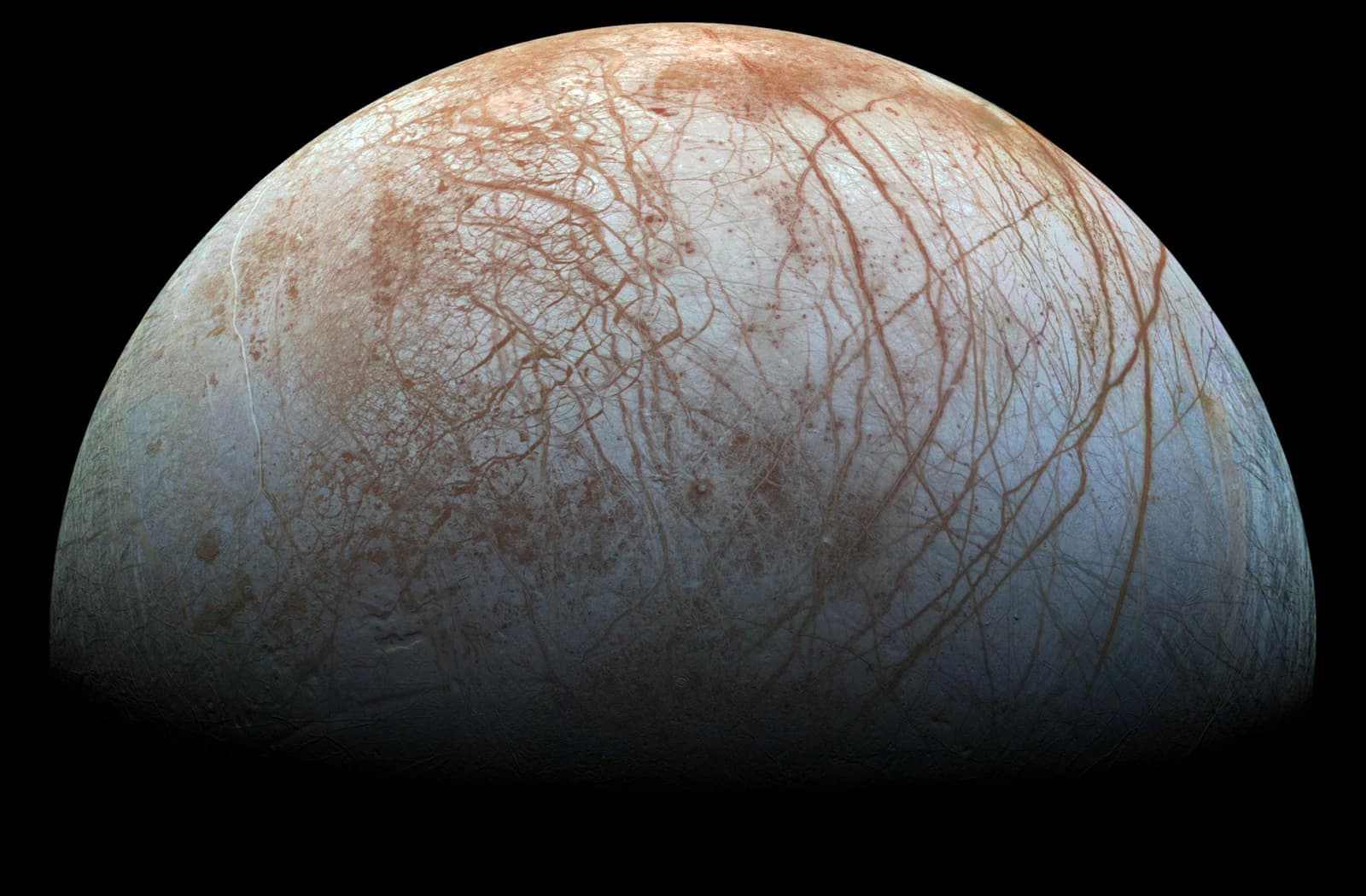
Why Europa’s fractures matter for ocean research
The ice shell does not resemble a motionless, smooth casing. Bands and fractures cross one another, and some regions contain blocks arranged in complicated patterns. Researchers want to establish which structures are older, where ice has moved, and how the surface connects to internal processes. An individual crack is not automatically an open passage to the ocean; its depth and history have to be investigated through several kinds of measurement.
Io, Europa, and Ganymede have resonant orbits: Europa circles Jupiter twice and Io four times during one Ganymede orbit. Their recurring gravitational interactions help maintain a slight eccentricity in Europa’s path. As a result, the strength of tidal deformation changes along its orbit. Orbital geometry, mechanical stretching of ice, and a possible source of internal heat can therefore be connected within one physical explanation.
Surface chemistry also needs careful interpretation. Radiation changes material exposed at the surface, so a measured substance may no longer retain the original properties of a possible ocean source. A camera records terrain, spectral instruments probe composition, and other measurements investigate the shell’s structure. The most informative results will come from comparing these observations for the same region.
Sources
Questions and answers
Has life already been found on Europa?
No. The ocean and possible habitable conditions are being investigated, but a biological presence has not been confirmed.
Will Europa Clipper land on the moon?
No. The spacecraft will operate in orbit around Jupiter and make close flybys of Europa. Arrival is planned for 2030.