Enceladus sprays water from an ocean hidden beneath ice into space, carrying salts and organic material with it. Two important advances emerged in 2026: ocean constituents may be distributed unevenly among ice grains, and an Earth archaeon produced methane in a laboratory analogue of this environment. Neither discovery means life has been found on Saturn’s moon. Both change which samples scientists should collect and how to interpret their chemistry.
- Different Cassini measurements support a liquid saltwater ocean, organic compounds and phosphates. No cells, DNA or other unambiguous evidence of organisms have been detected.
- A 2025 study examined freshly ejected grains. It linked complex organic chemistry to the subsurface environment, rather than solely to ice ageing in Saturn’s ring.
- A 2026 study explains salt diversity through slowly freezing droplets that later fragment. An individual grain can differ from the ocean’s average composition.
- The Earth archaeon experiment tests whether a particular metabolism can operate under selected conditions. It does not establish whether life arose on Enceladus.
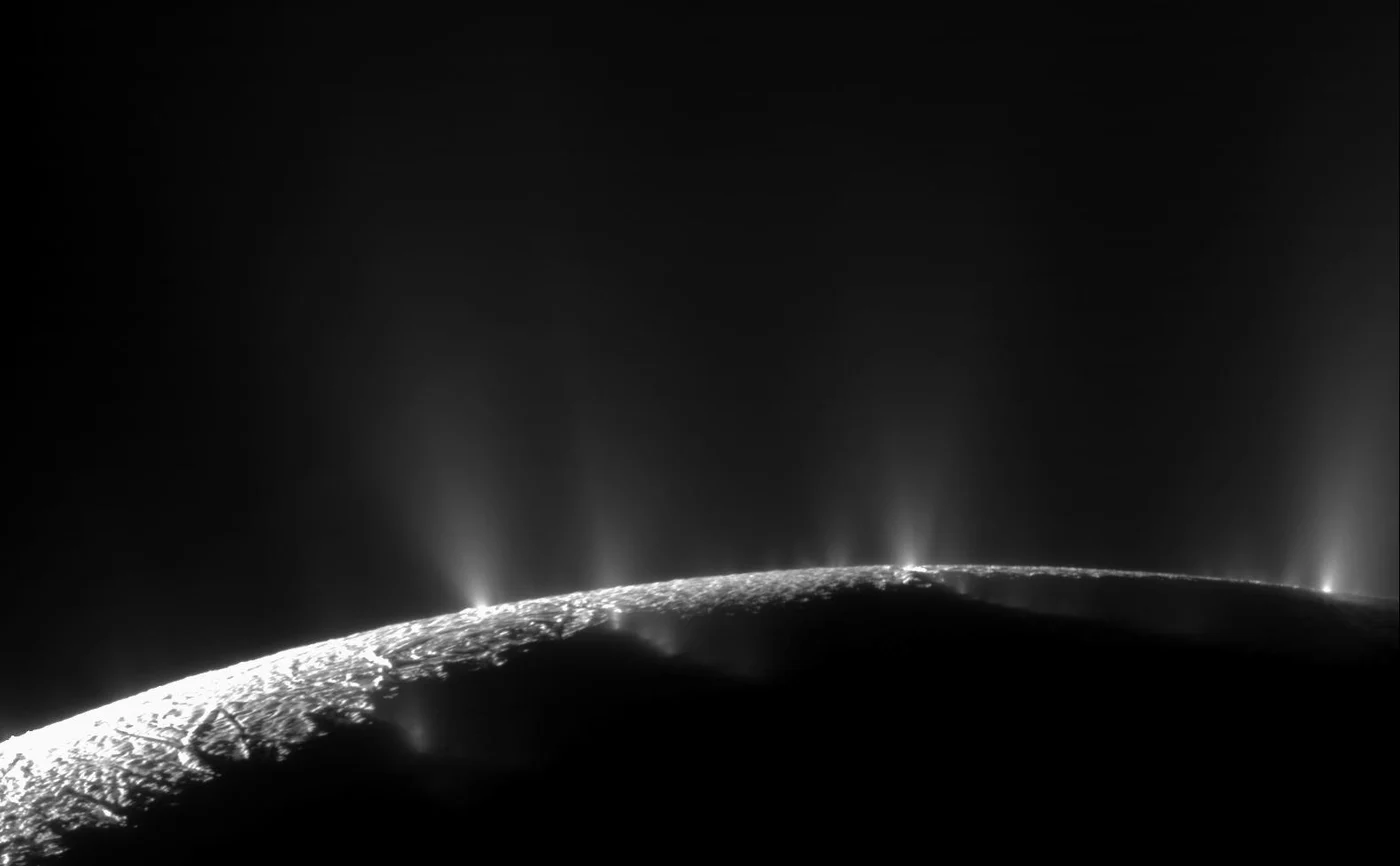
Why Enceladus is back in the news in autumn 2026
Two papers addressing different aspects of the search for life appeared in Science Advances on 25 September. One compared ice-grain composition with experiments freezing saltwater. The other tested whether an Earth microorganism could obtain energy in a chemical environment designed using Enceladus data. These are separate studies: analysis of material naturally delivered into space, and a biological experiment on Earth.
On 22 October, co-authors at Science Tokyo explained the first result in detail: the study included 961 mass spectra of salt-rich grains from the E ring. The diversity was linked not only to the original chemistry but also to the droplets’ possible journey through the ice shell. The advance goes beyond identifying another ingredient for life: it shows how the moon itself may alter a sample before a spacecraft encounters it.
How we know there is an ocean beneath the ice
Enceladus is a small moon of Saturn, roughly 500 kilometres across. Cassini discovered its active jets in 2005: water vapour and ice grains escape from fractures near the south pole. Spectacular fountains alone cannot establish the size of the reservoir below. A global ocean was inferred from several lines of evidence, including the gravity field and the moon’s slight wobble as it travels around Saturn.
Salts in the grains added chemical evidence that the water had interacted with rocky material. Astronomers could therefore investigate an extraterrestrial ocean without drilling through kilometres of ice. There are still no images of its seafloor, and ice thickness, ocean depth and heat distribution are estimated through models. Flying through a plume yields material originating from the ocean, rather than a direct view of the entire water column.
What keeps water warm so far from the Sun
Almost no sunlight reaches beneath the ice shell. Internal heating matters: Saturn’s changing tidal pull deforms the moon, converting some mechanical energy into heat. Orbital interaction with Dione maintains the departure of Enceladus’ orbit from a circle. The structure and longevity of this thermal system remain under investigation; having an ocean today does not by itself reveal how long conditions have favoured complex chemistry.
During a 2015 flyby, Cassini detected molecular hydrogen in the plume; the result was presented in 2017. Together with silica nanoparticles, it supports a picture of warm water interacting with rock. Hydrogen can provide chemical energy for certain microorganisms. Hydrothermal vents on this seafloor are inferred from material composition and calculations; no camera has photographed underwater chimneys there.
Which organics were found in fresh grains
An important advance appeared in Nature Astronomy on 1 October 2025. The authors revisited the 2008 E5 flyby, when Cassini’s dust analyser encountered grains directly within the plume. These grains had left the subsurface environment only minutes before detection. That differs from studying E-ring grains, which can spend a long time in space and be altered by radiation.
Impacts at roughly 18 kilometres per second broke molecules apart and produced charged fragments. Their masses revealed signatures of several classes of organic compounds, including oxygen-bearing groups; some interpretations remain tentative. Few spectra and weak signals prevented quantitative abundance analysis. The main conclusion is that complex organic chemistry is associated with the subsurface source, rather than necessarily arising only as ice ages in the ring.
Why organic compounds do not equal organisms
In chemistry, organic primarily refers to a class of carbon compounds. They can form without cells, through water–mineral reactions, transformation of starting material or other abiotic processes. Detecting organics is therefore important for understanding the available chemical ingredients, but is not by itself a diagnosis of life. A biomolecule precursor, an actual biomolecule and a living organism represent three different levels of claim.
A mass spectrum of fragments is not an image of a whole molecule. Different parent compounds can yield similar peaks, and impact conditions affect what an instrument records. The fresh-ice study did not report DNA, cells or a specific extraterrestrial biochemistry. A careful description still conveys a substantial result: a more diverse chemical inventory has been detected, which future instruments can investigate in greater detail.
Phosphorus: an essential element, not detected DNA
In 2023, Nature published the detection of sodium phosphates in E-ring ice grains. Characteristic signals appeared in nine of 345 salt-rich grains examined. Comparison with laboratory spectra and geochemical calculations linked them to dissolved phosphates in the ocean. This was a concrete measurement of material that had previously been an important gap in the inventory of available nutrients.
Earth life uses phosphorus in DNA, RNA and energy metabolism, among other functions. Detecting phosphate does not mean detecting genetic molecules. Even an estimate of its ocean concentration depends on models of grain formation and sampling. The 2026 study makes one caution especially relevant: a chemically enriched fragment need not match an average water droplet. The element’s presence is much better established than a detailed map of its distribution.
How a freezing droplet can separate salts
The 2026 study found unexpectedly large differences among grains containing different salts. Chlorides stood out in some, carbonates, phosphates or other components in others. Laboratory droplets designed to reproduce the major ocean salts suggested an explanation: slow freezing separates substances among different regions of ice and residual brine. Faster cooling produced a much more uniform distribution.
The proposed reconstruction has several stages. Bursting bubbles loft ocean droplets; vapour carries them through fractures, where they gradually freeze. Nearer the surface, accelerating flow and impacts against the walls may break them into small fragments. An instrument encounters these fragments, each with its own chemical enrichment. This is an explanation combining observations, experiments and modelling, rather than direct footage of the process inside the ice shell.
An Earth archaeon in an ocean analogue: what the experiment showed
The second September study investigated Methanothermococcus okinawensis, an Earth methane-producing archaeon from a deep-sea hydrothermal environment. Archaea are a distinct group of microorganisms, so calling this culture a bacterium is inaccurate. It can use hydrogen and carbon dioxide, releasing methane, without oxygen. This metabolism is relevant because its reactants are associated with the chemistry under discussion for Enceladus.
The authors created a highly alkaline, carbonate-rich model environment with limited available CO₂ and water–rock interaction. Under those constraints, a conventional laboratory medium did not support growth, whereas the ocean analogue allowed the culture to grow and produce methane. This tests one organism and one set of conditions. The real ocean cannot be regarded as fully reproduced, and an ability to survive does not explain how, or whether, life arose there.
Why a sample may not represent the entire ocean
A future spacecraft will face several filters between any hypothetical life and its detector. Material must rise from depth, enter the plume, survive freezing and fragmentation, and be recorded. A 2025 model in Communications Earth & Environment showed that, under the authors’ assumptions, stable ocean stratification can greatly slow the transport of particles from the seafloor. The result depends on assumptions about salinity, mixing and the state of the ice shell.
This does not refute the ocean or prove that its seafloor is inaccessible to every instrument. It is a reason to interpret a missing signal cautiously. Conversely, freezing-induced separation may concentrate rare constituents in a small fraction of grains. If potential biosignatures are concentrated similarly, analysing many individual grains could be more informative than one averaged sample. The salt study did not detect such biosignatures.
Which findings would strengthen the case for life
Methane alone, one organic group or phosphate cannot distinguish biology from geochemistry. A consistent combination of evidence matters: the composition of different grains, the structures of complex compounds, their distribution and their relationship to an energy source. Scientists must test whether non-living reactions could produce the same pattern, while excluding terrestrial contamination and instrumental effects. This is a task for future investigation, rather than a set of tests Cassini has already completed.
The search for life on Enceladus therefore goes beyond counting ingredients. Water, energy and chemical starting material make an environment worth investigating for habitability. Establishing habitability, in turn, is different from establishing that it is inhabited. Studies in 2025–2026 both strengthened and complicated the chemical picture: there is more material to investigate, but its origin and journey to the instrument require closer attention.
Europa’s ocean is also being investigated for conditions that could support life: water, energy and chemical ingredients. At Venus, the initial challenge is different: reliably identifying an atmospheric molecule from its spectrum; whether there is life on Venus remains an open question. Enceladus offers access to individual grains, but here too an inventory of ingredients cannot be presented as detected organisms.
Who could return to Enceladus
Cassini ended its mission in 2017, so the new papers use archived measurements and new ways of testing them. The spacecraft did not collect another batch of ice at Saturn in 2026. A successor will need instruments suited to individual-grain analysis and more detailed identification of molecular composition. Sampling location and method also matter: a fresh plume, aged ring material and ice deposited on the surface have different sample histories.
ESA is studying an L4 mission to Enceladus with plume sampling and a lander. The programme timeline gives a launch target around 2042; this is a provisional schedule for a project in definition, with mission adoption at a later stage. It does not imply an imminent answer about life. For now, the practical outcome of the new studies is a clearer understanding of which chemical differences instrument design and sample collection must preserve.
Other chemical environments are also being explored in the Saturn system. The Dragonfly mission is intended to study organic compounds on Titan’s surface, where conditions differ from Enceladus’s subsurface ocean. Sampling grains from a plume and flying between land sites therefore address different questions about prebiotic chemistry. Their results are best compared with attention to the location and origin of each sample, rather than simply the shared label “organic”.
Sources
- NASA — Enceladus: ocean, plumes and internal heating
- ESA — organics in fresh ice, 1 October 2025
- Nature Astronomy — composition of freshly ejected grains, 2025
- Nature — detection of phosphates, 14 June 2023
- NASA — what the phosphorus discovery means, 2023
- Science Advances — compositional segregation of ice grains, 25 September 2026
- Science Tokyo — explanation of freezing-droplet experiments, 22 October 2026
- Science Advances — methanogenesis in an ocean analogue, 25 September 2026
- Freie Universität Berlin — two Enceladus studies, 2026
- University of California, Riverside — diversity of salt-rich grains, 2026
- Communications Earth & Environment — modelling transport through the ocean, 2025
- NASA/JPL — hydrogen detection and chemical energy, 2017
- ESA — objectives of the L4 mission to Enceladus under study
- ESA — L4 phases and provisional timeline
- NASA — Europa Clipper: habitable conditions versus detecting organisms
- Nature Astronomy — searching for phosphine in Venus spectra, 2020
- NASA — Dragonfly and chemical investigations of Titan
Questions and answers
Has life already been found on Enceladus?
No. Ocean-derived material, organic compounds, phosphates and evidence of chemical energy sources have been detected. The 2026 studies examine ice composition and an Earth archaeon in the laboratory; they did not detect organisms on the moon.
Does phosphorus in the plume mean DNA is present?
No. Phosphate salts were found, rather than DNA. Phosphorus is important for Earth life, but also occurs in non-living minerals and solutions. A biological origin for the detection has not been established.
Why discuss methane if it does not prove life?
Methane is associated both with some microbial metabolisms and with non-living processes. It must be considered alongside other compounds, energy sources and ocean models. The archaeon experiment demonstrates a possible mechanism, rather than the origin of methane on Enceladus.
Can Enceladus’ ocean be seen in images?
The ocean itself is hidden by the ice shell. Cameras see the surface and the plumes above it; information about the ocean comes from the moon’s motion, gravity and ejected material. Cutaway images showing water and vents are diagrams.
When will a new spacecraft investigate Enceladus?
ESA is developing the L4 mission concept. The published provisional timeline targets launch around 2042, with subsequent phases dependent on development and mission adoption. These plans do not mean a dedicated life-search spacecraft is already on its way to Enceladus.