Titan has rain, rivers and lakes, but liquid hydrocarbons take the role normally played by water. In October 2026, NASA reported a comprehensive simulation of Dragonfly’s initial flight: a future flying laboratory for this moon of Saturn. The spacecraft is still on Earth. Its task is to investigate how far natural organic chemistry has progressed, rather than deliver a promised discovery of extraterrestrial life.
- On October 23, 2026, NASA described a computer testbed run using flight-like electronics. Dragonfly has not flown on Titan.
- The current plan targets launch no earlier than July 2028, arrival in late 2034 and a 3.3-year primary science mission.
- The methane seas and lakes are real observed features. Organic molecules in the atmosphere and surface material can form without living organisms.
- Dragonfly will investigate equatorial dunes and deposits near Selk Crater. Its route links land sites by air, rather than taking it to the polar seas.
What Is Titan, and Why Compare It with Earth?
Titan is Saturn’s largest moon and the Solar System’s second-largest moon after Ganymede. Its solid surface is about 5,150 kilometres across. Its diameter exceeds Mercury’s, but that does not make it a planet: Titan orbits Saturn. A thick nitrogen atmosphere sets it apart from most other moons, while orange haze hides the surface at visible wavelengths.
The surface temperature is roughly −179 °C, and atmospheric pressure is about one and a half times Earth’s. The atmosphere is not breathable: sharing Earth’s main atmospheric gas does not supply oxygen suitable for humans. Comparisons with early Earth chiefly concern chemical processes and interactions between atmosphere and landscape. Titan is not a preserved copy of our planet, and its cold environment must be studied on its own terms.
What Fills the Methane Lakes, and How Does It Rain?
On Titan, methane evaporates, forms clouds, falls as rain and feeds channels, lakes and seas. Ethane is another component of the surface liquids, with proportions varying between bodies of liquid. This seems unfamiliar from Earth, where methane is a gas under everyday conditions. In Titan’s cold environment it participates in a liquid cycle, while water ice largely takes the role of solid bedrock.
Cassini investigated these bodies using radar and infrared instruments, rather than ordinary photography alone. An analysis published in 2019 found that some small northern lakes were more than 100 metres deep and consisted mainly of methane. Other observations indicated changing liquid levels. The surface is not one shallow ocean: large seas, separate lakes, dry depressions and equatorial dunes represent different geological settings.
Why Organic Chemistry Does Not Yet Mean Life
High in the atmosphere, sunlight and energetic particles break apart nitrogen and methane molecules. Their fragments undergo further reactions, producing a range of carbon-containing compounds. Some products contribute to the haze, while others settle onto the surface. The term “organic” describes a class of chemicals and does not by itself reveal whether living organisms made them.
The chance to study rich chemistry without assuming biology makes Titan valuable. Researchers want to learn which complex molecules arise naturally and what happens when they encounter liquid water. Finding an interesting compound, establishing suitable reaction conditions and demonstrating an organism are different results. Even a striking headline cannot make them equivalent.
What Cassini and Huygens Have Already Achieved
Dragonfly will not be the first spacecraft on Titan’s surface. ESA’s Huygens probe, delivered by the Cassini–Huygens mission, landed on January 14, 2005. It measured the atmosphere and imaged the landscape during descent, then transmitted images from the ground. Those data showed how familiar landforms can appear in a very different chemical and thermal environment.
Cassini continued studying the Saturn system until its mission ended in 2017. Repeated flybys supplied surface maps and observations of the atmosphere and liquid bodies. An orbital map and the analysis of an individual grain answer different questions, however. Dragonfly will add the ability to choose multiple sites, collect local material and compare composition with geological surroundings.
Why Choose a Flying Laboratory for Titan?
Near-surface atmospheric density is about four times Earth’s, while gravity is roughly one seventh as strong. This makes lift easier to generate. Pressure at about one and a half times Earth’s and density at four times Earth’s are compatible: they are different physical quantities, related partly through gas temperature. Dense air and low gravity are particularly useful for flying between dunes and other sites.
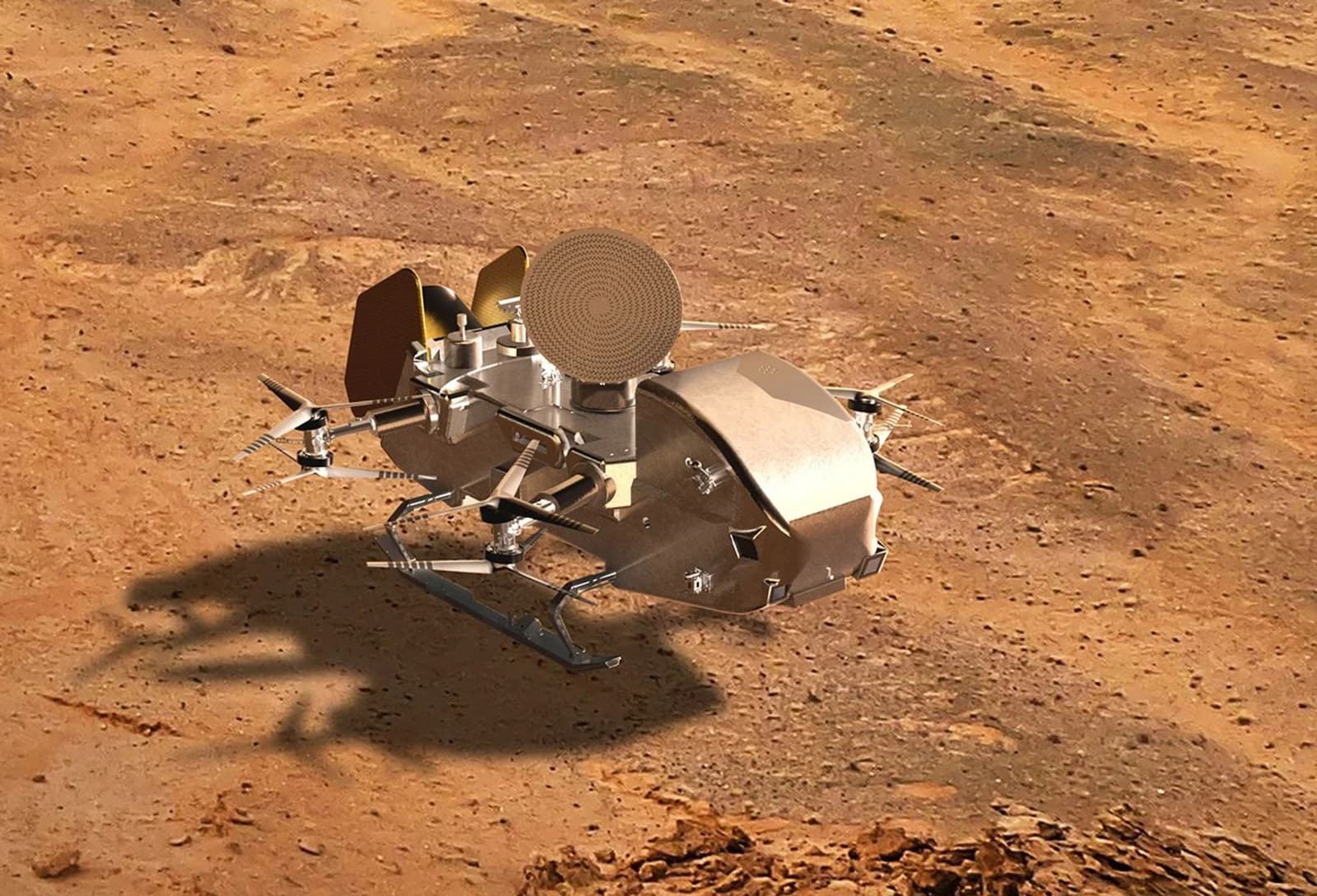
Eight rotors are intended to carry scientific equipment across terrain where sand and rough ground could hinder a wheeled rover. Ingenuity already achieved the first powered, controlled flight on another planet on Mars in April 2021. Dragonfly’s distinctive goal is a substantial science mission combining sample analysis and repeated travel on Saturn’s moon. A successful Martian helicopter does not replace testing a vehicle for a different atmosphere.
How the First Flight Was Tested in a Simulation
NASA’s October 23 report described the most comprehensive simulation to date of Dragonfly’s first flight, run on an APL testbed in Maryland. Software operated in real time on flight-like electronics, receiving simulated navigation-camera, inertial-sensor and lidar inputs. In the virtual scenario, the vehicle searched for a safe landing site, passed over it, turned back and descended to land.
This kind of test checks how terrain sensing, computation and control work together, including timely data transfer. It goes beyond a visually appealing trajectory animation, while remaining a ground simulation with synthetic inputs. NASA separately listed the next steps: repeating the scenario on the actual flight system, testing other flight profiles and deliberately introducing faults. The news publication date is not an announced date for the test itself.
When Will Dragonfly Launch, and How Will It Land?
NASA’s mission page, checked on October 28, 2026, lists launch no earlier than July 2028 and arrival at Titan in late 2034. The primary science programme is planned to last 3.3 years. This is a future mission plan, dependent on spacecraft and launch readiness. Older explainers give different years and shorter operating periods; those figures require checking before reuse.
An entry capsule and heat shield will protect the spacecraft, after which parachutes will slow its descent. Before separation, the rotorcraft must be lowered from its stowed position beneath the backshell so its rotors can spin safely. Once released, Dragonfly is intended to complete the descent under its own power. Deployment-mechanism tests and navigation-scenario tests address different parts of that sequence.
Where Will It Go? Ahmakiq Undae Dunes and Selk Crater
In September 2026, NASA announced the approved name of the landing dune field: Ahmakiq Undae. It lies in the equatorial region south of Selk Crater. Dunes and interdune areas allow comparisons of material accumulated and altered by different processes. The famous polar methane seas should not automatically be added to the route: Dragonfly is designed to study other regions.
Selk is interesting as an ancient impact site where water ice could have melted and mixed with organic material. Researchers view the surviving deposits as possible records of a long natural chemical experiment. How much water formed, how long it stayed liquid and which reactions occurred are questions for models and measurements. This does not establish a warm lake there today, or that a cell ever lived in it.
Which Instruments Will Examine Titan’s Composition?
The DrACO system is intended to drill the surface, collect material and pneumatically deliver particles to the DraMS mass spectrometer. Mass spectrometry investigates molecular composition, while sample preparation and separation help distinguish compounds in a complex mixture. Heritage from instruments developed for Mars is useful, but sampling is designed for Titan’s own conditions. Material will be analysed inside the spacecraft, rather than returned to a laboratory on Earth.
DraGNS will measure surface elemental composition, complementing molecular information. The DragonCam cameras will provide context: landforms, conditions around landing sites and images at multiple scales. DraGMet is designed for meteorology, surface-material properties and seismic observations. A chemical measurement is easier to interpret when its environment and location are known.
Comparisons between sites are especially valuable. A compound found everywhere suggests a different history from one associated with impact deposits. The ability to fly is therefore part of the scientific method. The rotorcraft does not need to remain airborne continuously: observations and analysis on the ground matter as much as travelling to the next site.
Where Will Its Power Come From, and Why Fly Autonomously?
Far from the Sun and beneath atmospheric haze, solar illumination is weak. Dragonfly uses an MMRTG radioisotope thermoelectric generator and a battery: a steady power source allows charge to build between energy-intensive operations. The generator also produces heat needed in the extreme cold. It is not a small nuclear reactor with a controlled chain reaction; it converts part of the heat from radioactive decay into electricity.
The long radio travel time prevents real-time steering from Earth. Dragonfly must combine camera, motion-sensor and lidar readings, assess terrain and choose safe actions for itself. People will set scientific goals and plans, while the onboard system handles the immediate flight task. Tests with deliberate failures are therefore as important as a flawlessly completed nominal scenario.
Does Titan Have an Underground Water Ocean?
For years, the idea of a global ocean beneath an ice shell rested on interpretations of Cassini data. A Nature paper published in December 2025 proposed a different picture. Reanalysis of radio-tracking measurements revealed strong tidal energy dissipation, which the authors explained through near-melting ice layers, slush and isolated pockets of liquid water. In their model, a global ocean is unnecessary and inconsistent with the resulting constraints.
This is a research inference about the interior, rather than a photograph of an underground environment or the disappearance of all water on the moon. The surface methane lakes are a separate matter. Dragonfly’s seismic measurements could add constraints on the interior if suitable events occur during operations. It is too early to promise that an instrument will necessarily detect a particular layer or immediately settle the debate.
Which results could change the picture
Dragonfly can connect molecular composition with specific geological settings by comparing ordinary organic deposits, sites altered by liquids and material associated with an impact. Both complex products and the absence of expected compounds can inform origin-of-life chemistry. Any conclusion must account for instrument limitations, sample condition and site selection. A negative result at one location does not test all of Titan.
Enceladus provides access to material ejected from beneath its ice, while Europa draws interest through its inferred water ocean below an icy shell. Titan adds an observed hydrocarbon cycle and rich surface organic deposits to this collection of worlds. Each requires its own observing strategy. Dragonfly’s value lies in testing specific chemical and geological questions; a claim of life would require a separate, rigorous assessment of the complete evidence.
Sources
- NASA — Dragonfly’s first simulated flight, October 23, 2026
- NASA — current Dragonfly mission overview
- ESA — physical facts about Titan
- NASA — Titan’s atmosphere and surface
- NASA — composition, depth and seasonal changes of Titan’s lakes
- ESA — Cassini–Huygens and the January 14, 2005 landing
- NASA — Dragonfly’s chemistry questions and Selk Crater
- NASA — atmospheric density, gravity and organic chemistry
- NASA — Dragonfly’s design, power and scientific instruments
- NASA Goddard — the DraMS mass spectrometer
- NASA — the Ahmakiq Undae landing region, September 2, 2026
- NASA JPL — a new model of Titan’s interior, December 2025
- Nature — tidal dissipation and a Titan model without a global ocean
- NASA — ground testing of Dragonfly’s rotors, January 2026
- NASA — Ingenuity’s first powered, controlled flight on Mars
- NASA — Enceladus’s ocean and plumes
- NASA — Europa’s icy surface and inferred ocean
- NASA — Dragonfly’s power, battery charging and heating
- NASA — how a radioisotope generator produces electricity
Questions and answers
Has Dragonfly Already Flown on Titan?
No. NASA’s October 23, 2026 report concerns a simulation on an APL computer testbed. The spacecraft was being prepared and tested on Earth; arrival at Titan is planned for late 2034.
Do Titan’s Lakes Contain Water or Methane?
The observed surface lakes and seas contain liquid hydrocarbons, primarily methane and ethane. Their proportions can vary. At the extremely cold surface, water is mainly solid.
Why Not Send the Drone Directly to the Methane Seas?
Dragonfly’s described route concerns an equatorial dune field and Selk Crater, allowing comparisons of organic deposits and possible traces of interaction with water after an impact. The polar seas lie outside that study region.
Do Organic Molecules Prove There Is Life on Titan?
No. These molecules can arise through natural nonbiological reactions. The mission studies composition, conditions and the development of chemical complexity; even a potentially interesting finding would require alternative explanations to be tested.
When Will Dragonfly Launch and Land?
Under NASA’s current plan as of October 28, 2026, launch is targeted no earlier than July 2028 and arrival for late 2034. The planned primary mission lasts 3.3 years. These future dates remain subject to revision.