As of 27 October 2026, life on Venus has not been confirmed. Even the presence of phosphine, the gas behind many dramatic headlines, remains scientifically disputed. New publications discuss cloud observations and possible chemistry, rather than showing organisms found on Venus. Understanding the news requires three separate checks: is the signal reliable, which molecule produces it, and where could that molecule come from?
- Phosphine, PH3, is a possible chemical clue, not automatic evidence of life.
- Independent analyses and observations give conflicting results. Altitude, observation time and data reduction matter.
- The JCMT-Venus paper published online in January 2026 is a symposium contribution, not independent confirmation of biology.
- A molecule surviving in acid, or an Earth fungus sharing part of Venus's spectrum, is not a detection of an organism.
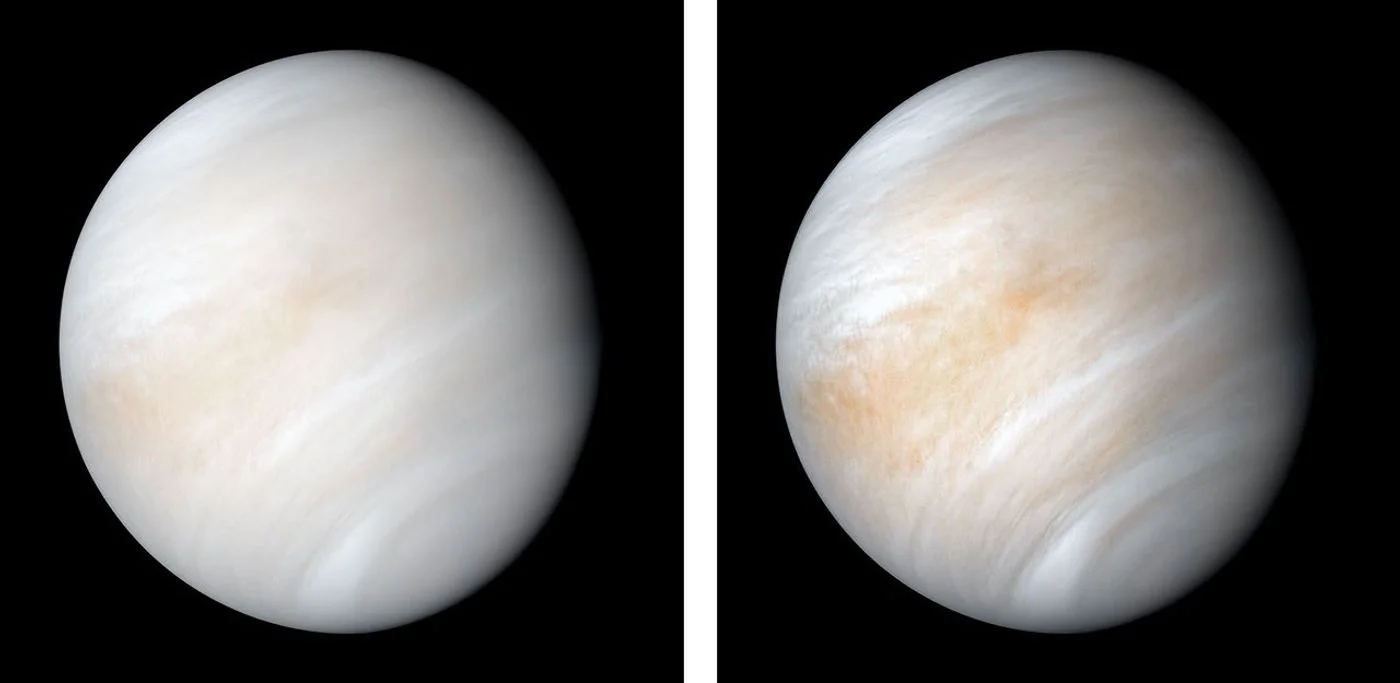
Has life been found on Venus?
There has been no confirmed detection of microbes or other life. The story began with an attempt to identify a gas from its spectral signature. Even an impeccable detection of an unusual molecule does not establish its source: the same substance can arise under different chemical conditions. At Venus, the dispute persists at an earlier stage: how confidently can the feature itself be attributed to phosphine?
It helps to distinguish an observed signal, an identified substance and established biology. Headlines about signs of life often merge these stages, although they require different tests. A reliable conclusion about organisms would need consistent measurements and an explanation of why viable non-biological processes cannot produce the same result.
Why look in the clouds rather than on the surface?
Researchers are interested in parts of the cloud layer where temperature and pressure are much milder than at the scorching surface. Around 50–60 kilometres above it, some physical conditions can resemble those on Earth. Comparing temperatures alone is misleading, however: Venusian cloud particles contain concentrated sulfuric acid rather than ordinary raindrops.
A possible aerial inhabitant would have to meet requirements for chemical stability, available water, nutrients and sustained suitable conditions simultaneously. Comfortable pressure does not compensate for a destructive environment. A habitable layer should therefore be understood as a hypothesis being tested, not an ecosystem already discovered and waiting to be viewed through a telescope.
What was announced about phosphine in 2020?
Phosphine is a phosphorus–hydrogen compound with the formula PH3. In September 2020, Jane Greaves's team reported its apparent presence in Venus's atmosphere using JCMT and ALMA observations. The analysis concerned absorption in the millimetre band, around 267 gigahertz. This is not a photograph of molecules: a faint feature is extracted from a spectrum and compared with calculations.
The initial inferred abundance was about 20 parts per billion. The authors discussed why that concentration would be unexpected in Venus's oxidising atmosphere and considered possible sources, including unknown chemistry. They did not announce observations of organisms. The original number should not be reproduced as an uncontested present-day measurement: recalibration, an addendum and criticisms followed.
Why do different teams reach different answers?
The dispute involves several separate difficulties. Very bright Venus produces a challenging background, and instrumental effects or the way that background is removed can influence a weak line. A transition of sulfur dioxide, SO2, a familiar component of Venus's atmosphere, lies nearby. Researchers must test which gas best explains the feature's frequency and shape, and whether the result survives reasonable reduction choices.
A 2021 independent analysis by Villanueva and colleagues obtained PH3 upper limits inconsistent with the original interpretation. The original Nature Astronomy paper carries an editorial warning about ALMA processing and links to an addendum and a Matters Arising discussion. These are reasons for caution. Calling the paper retracted without a corresponding journal notice would be incorrect: an addendum and criticism are different editorial events.
What did SOFIA and its reanalysis show?
Cordiner and colleagues found no convincing PH3 signal in SOFIA observations made in November 2021. Their modelling gave a disk-averaged upper limit of 0.8 parts per billion for altitudes of 75–110 kilometres. That is an important constraint, but it cannot be translated into a claim that phosphine is absent everywhere at all times: the measurement concerns a particular atmospheric region and epoch.
In a published 2023 comment, Greaves and colleagues proposed a different reduction of the same data and reported a candidate phosphine signal. They also discussed a possible dependence of gas abundance on illumination. These are not two new missions making opposite discoveries; they reflect a dispute over extracting information from a challenging dataset. Resolving it requires testing the methods and obtaining independent data.
What new JCMT work was published in 2026?
On 20 January 2026, Cambridge University Press published David Clements's Venus Phosphine: Updates and lessons learned online. The publisher identifies it as a Contributed Paper in Proceedings of the International Astronomical Union, associated with Symposium S387. It is a published contribution discussing JCMT-Venus and the authors' interpretation; it should not automatically be treated as separate, independent confirmation of the detection.
JCMT-Venus is designed to monitor PH3 over time alongside other species, including sulfur compounds and HDO, a form of water containing deuterium. Comparing variations may help establish whether the proposed signal changes with atmospheric composition or illumination. A 2026 publication date does not itself mean new organisms were found that year or that the phosphine dispute has been settled.
Why is a suitable temperature not enough? The water problem
A cell needs more than H2O molecules somewhere nearby: water must be available for its processes. Water activity describes this availability. Hallsworth and colleagues calculated values no higher than 0.004 for Venus's sulfuric-acid droplets. Comparing that with the known lower limit of about 0.585 for terrestrial extremophiles shows the scale of the obstacle for familiar cellular life.
This argues against simply placing an Earth microbe inside a typical Venusian droplet. It is not a mathematical proof against every conceivable biochemistry. But if a hypothesis requires an unfamiliar solvent, protective mechanism or different droplet composition, those assumptions must be measured and tested separately. Calling something an extremophile does not remove physical constraints.
Amino acids and fungi: what is being tested in the laboratory?
In 2024, researchers reported that the molecular backbones of 19 amino acids remained intact for up to four weeks in 81–98% sulfuric-acid solutions. This was an experiment on individual compounds. It shows that concentrated acid does not necessarily destroy every organic molecule immediately, but does not demonstrate a functioning cell, metabolism or reproduction in Venus's clouds.
A Scientific Reports paper published on 11 June 2026 examined the spectra of spores from three terrestrial acidophilic fungi. Some absorption bands partly overlapped the region of Venus's unidentified ultraviolet absorber. That similarity makes the hypothesis testable; it does not establish that fungi are present on the planet. Measuring an Earth sample's spectrum is not a detection of its Venusian counterpart and does not replace testing the combined effects of acid, dehydration and radiation.
If phosphine is present, what produces it?
Possible sources are tested using chemical reactions, energy requirements and destruction rates. A 2024 review by Bains and colleagues argues that known geological and photochemical pathways cannot explain the abundances being discussed. This is the authors' assessment under model assumptions, not an experimental exclusion of all unknown chemistry. A process that has not yet been understood remains a legitimate scientific possibility.
What measurements are needed, and what can new missions do?
A convincing PH3 test should connect multiple spectral features, observations with different instruments and information about altitude. A biological interpretation also needs droplet composition, water availability and other evidence of chemical processes. Direct atmospheric measurements could remove some uncertainties of remote spectroscopy, although they too require calibration and error checks.
NASA's developing DAVINCI mission includes a descent probe to study atmospheric composition and conditions. The VERITAS and European Envision orbiters will investigate geology, the surface and connections between the interior and atmosphere. Their data will also help assess non-biological explanations. These are different science tasks: surface mapping is not a promise to capture microbes.
What does Venus teach us about searching for life elsewhere?
The same caution is useful when discussing Mars, exoplanets and possible biosignatures on K2-18 b. Researchers must test not only the appeal of a biological explanation but also the reliability of the original signal, environmental conditions and alternative processes. That is what makes the Venus debate valuable: improved instruments and methods can uncover unfamiliar chemistry even if the biological hypothesis is not confirmed.
Sources
- Greaves et al. — the original phosphine paper and its Nature Astronomy editorial record
- Villanueva et al. — independent analysis and phosphine upper limits, 2021
- Cordiner et al. — the SOFIA upper limit, peer-reviewed study, 2022
- Greaves et al. — comment using a different SOFIA reduction, 2023
- Clements — Venus Phosphine: Updates and lessons learned, published 20 January 2026
- JCMT — the programme monitoring phosphine and other Venusian molecules
- Hallsworth et al. — water activity in Venus's clouds, 2021
- MIT — amino-acid stability in concentrated sulfuric acid, 2024
- Olewicz et al. — spectra of terrestrial acidophilic fungi, Scientific Reports, 2026
- Bains et al. — review of possible phosphine sources, 2024
- NASA — objectives of the future DAVINCI mission
- NASA — current information on Venus exploration projects
- ESA — objectives of the Envision orbiter
- NASA — Venusian clouds in Mariner 10 images
Questions and answers
Have bacteria been found on Venus?
No. As of 27 October 2026, organisms have not been confirmed. The research concerns chemical signals, cloud conditions and laboratory hypotheses.
Is phosphine definitely present in the atmosphere?
There is no secure consensus. Some studies support the signal, while others challenge it or give upper limits. Altitude, epoch and data reduction affect the result.
Was the original phosphine paper retracted?
The Nature Astronomy page checked here lists an editorial warning, an addendum and scientific discussion. These are not a retraction notice and do not justify describing the paper as retracted.
Did JCMT confirm life in 2026?
No. The January publication is a symposium contribution about phosphine research. Its publication alone establishes neither independent validation of the gas nor a discovery of life.
Why might clouds with suitable temperatures be uninhabitable?
Temperature is only one requirement. Concentrated acid, extremely low water activity and other stresses can prevent known cells from functioning.
Have Venusian fungi actually been detected?
No. The 2026 study compared spectra of Earth fungal spores with a Venusian absorption region. Partial spectral similarity does not identify a biological source or reveal organisms.