As of 25 October 2026, life on K2-18 b has not been confirmed. The James Webb Space Telescope measured the spectrum of a distant exoplanet's atmosphere, and researchers disagree about which molecules left their signatures in it. The headline claim of possible biological activity relied on tentative signs of sulfur-bearing gases, but independent checks have not established a robust detection.
- Methane in the atmosphere is the most robust result across the independent analyses considered here.
- The presence of DMS and DMDS remains disputed and does not establish the existence of organisms.
- An ocean beneath a hydrogen atmosphere is a possible model of the planet, not an observed surface.
- Studies published in 2026 consider both mini-Neptune and ocean-world scenarios without requiring life.
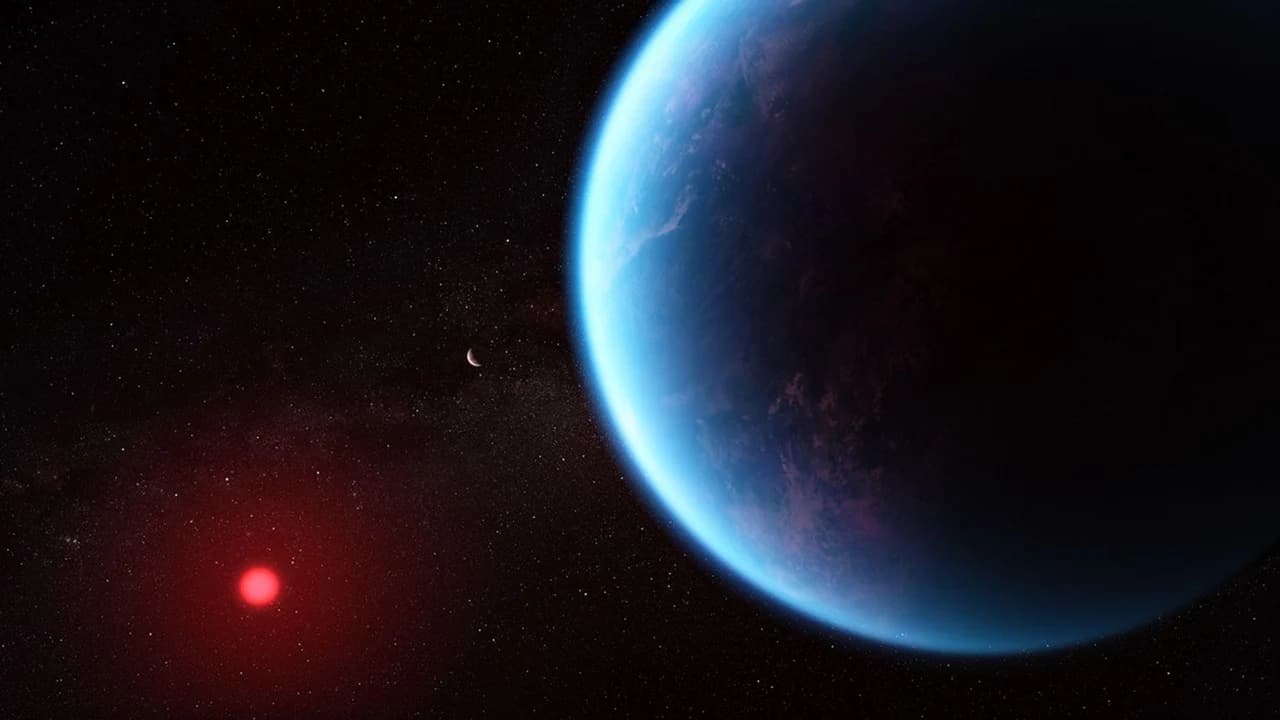
What kind of planet is K2-18 b?
K2-18 b lies about 120 light-years from Earth, in the direction of the constellation Leo. It orbits a relatively cool red dwarf. The letter b identifies a planet in the system, while K2 refers to the extended Kepler mission whose observations led to its discovery in 2015. The planet itself has been known for years; the news concerns attempts to understand its atmosphere.
Its radius is about 2.6 times Earth's and its mass about 8.6 times Earth's. Objects of this size are called sub-Neptunes: larger than Earth but smaller than Neptune. Our Solar System has no close equivalent, so the familiar picture of a rocky Earth with seas can be misleading. Mass and size alone do not reveal whether the planet has an accessible solid surface.
What exactly did James Webb measure?
When K2-18 b crosses in front of its star, some starlight passes through its atmosphere. Molecules absorb particular wavelengths, making the transit slightly deeper in some parts of the infrared spectrum than in others. Astronomers compare those variations with calculated atmospheric compositions. This is transmission spectroscopy: the telescope collects light, not a gas sample from the planet.
NASA's 2023 announcement described methane, carbon dioxide and a less robust hint of dimethyl sulfide. A later independent analysis confirmed methane but found weaker support for carbon dioxide and DMS. These molecules should therefore not all be presented as equally established facts. Much of this planet's scientific story concerns changing interpretations of faint spectral features.
Where did the reports of signs of life come from?
In April 2025, Nikku Madhusudhan's team presented observations made with MIRI in the mid-infrared. The authors argued that some spectral features were best explained by dimethyl sulfide, DMS, and/or dimethyl disulfide, DMDS. They reported evidence at approximately the three-sigma level and explicitly called for more observations and investigation of non-biological sources.
These compounds attracted attention because their production on Earth is associated with organisms, including marine microorganisms. The telescope did not see phytoplankton, cells or ocean water. It recorded features in light for which a chemical explanation was proposed. Two separate questions stand between that interpretation and evidence of extraterrestrial life: have the molecules been identified correctly, and what process produced them?
Why does three sigma not mean a 99.7% probability of life?
Statistical significance describes a result within a chosen analysis procedure and its assumptions. It does not directly give the probability that organisms inhabit a distant world. Even a strong departure from a model without a molecule must be tested against other molecules, instrumental effects and alternative atmospheric scenarios. An overly restricted comparison can produce too much confidence.
The debate cannot therefore be reduced to waiting for one decisive number. More measurements matter, but so do the reduction of the raw signals, laboratory knowledge of molecular absorption and the range of compositions included in the calculation. Confirming a gas and establishing its biological origin require different evidence.
What did independent checks find?
A study led by Stephen Schmidt used several reductions of the NIRISS and NIRSpec observations and more than 250 atmospheric retrievals. Methane remained robust, but the authors found no statistically convincing evidence for DMS or carbon dioxide. Their calculations allowed the composition to be explained by a mini-Neptune atmosphere without requiring a liquid ocean or life.
Rafael Luque's team examined the near- and mid-infrared observations together, including MIRI. Its analysis likewise found insufficient evidence for DMS or DMDS. Other compounds, such as ethane, could fit the observations comparably well. Marginal preferences depended on data reduction and on how narrowly the list of candidate molecules was restricted.
This does not establish that life is absent. It assesses the strength of a particular piece of evidence: the available spectra do not securely attribute the disputed features to biosignatures. Reprocessing the same observations helps determine which conclusions survive reasonable changes in assumptions.
In the search for an atmosphere on TRAPPIST-1e, a related difficulty arises even before any debate about biological molecules: an uneven stellar surface can leave features in a transit spectrum that resemble planetary absorption. One correction method being tested compares closely spaced transits of e and the likely airless b. It depends on the star remaining stable between observations; a flare can break that condition.
What the 2026 studies added
In a paper submitted in March 2026, Shang-Min Tsai and colleagues compared atmospheric calculations with new laboratory measurements of DMS and DMDS absorption. They favoured a sub-Neptune scenario without DMS and found no strong evidence for a water-rich interior. This is a model-based interpretation, not a photograph of what lies beneath the atmosphere.
A study by Sean Jordan and colleagues, revised in May 2026, tested possible abiotic formation of organosulfur compounds. One modelled pathway can produce observable amounts of DMS and DMDS, but the outcome depends on a reaction energy barrier that has not yet been measured experimentally. The authors also consider hydrocarbons with similar spectral features. A blanket rule that DMS can only come from life therefore cannot be applied to every planetary environment.
A peer-reviewed paper published in Astronomy & Astrophysics on 1 July 2026 compared 12 reductions of the spectrum. Methane persisted in most configurations, hints of carbon dioxide were weak and model-dependent, and DMS disappeared in the most comprehensive retrievals. The authors also showed how correcting for a spot on the star affects the inferred atmosphere: the planet has not changed, but the extraction of its signal has.
Does K2-18 b have an ocean, and could it support life?
A Hycean world is a hypothetical planet with a water ocean beneath a hydrogen-rich atmosphere. The name does not mean that its ocean consists of hydrogen. This scenario is discussed for K2-18 b because some models connect the observed gases with water below. Atmospheric thickness, temperature, pressure and interior structure remain major unknowns. Planetary size alone cannot select one unique structure.
A May 2026 preprint by Takuya Fujisawa and colleagues shows that some self-consistent ocean-world models can also match the near-infrared spectrum without DMS. The authors do not rule out a mini-Neptune. The result keeps several possibilities open rather than confirming a sea. Being in the habitable zone describes stellar irradiation under certain assumptions; it guarantees neither liquid water nor comfortable temperatures.
What would make the conclusion convincing?
First, the proposed gases' spectral features must be reliably distinguished from those of other substances. Independent observations, reductions and laboratory measurements must then test the result. The next step is to understand the climate and chemical sources: a possible biosignature must be assessed in its environmental context. A gas that is persuasive in one atmosphere may be a natural product of non-living chemistry in another.
A useful way to read new headlines is to identify the actual advance: another transit, a molecular identification, an atmospheric model, or the exclusion of alternatives. For K2-18 b, these steps have not yet combined into evidence of life. The observations remain scientifically valuable because they test methods that will be used to study other exoplanets and potentially habitable environments.
Similar questions arise in discussions of life on Venus. First, a proposed molecule must be identified reliably in the data; then chemical explanations for its presence must be tested. Detecting a gas, even if independently confirmed, does not by itself amount to detecting an organism. Our neighbouring planet is therefore also useful for testing how to interpret reports of biosignatures.
Even a convincing biological explanation for an atmosphere’s composition would not answer the question of an advanced civilisation. The Fermi paradox concerns the possibility of noticing intelligent activity on cosmic scales. Radio searches and optical observations test particular bands, directions and time intervals; a null result applies to the conditions surveyed. An absence of detected technosignatures and a debate about an atmospheric molecule’s origin therefore need to be assessed using different datasets.
Sources
- NASA — methane, carbon dioxide and a cautious interpretation of K2-18 b, 2023
- Madhusudhan et al. — constraints on DMS and DMDS from MIRI, 2025
- Schmidt et al. — independent reanalysis of NIRISS and NIRSpec, 2025
- Luque et al. — insufficient evidence for DMS and DMDS in the combined spectrum, 2025
- Tsai et al. — physical questions and new laboratory measurements, 2026 preprint
- Jordan et al. — abiotic organosulfur chemistry, 2026
- Fujisawa et al. — a possible Hycean interpretation, 2026 preprint
- Astronomy & Astrophysics — independent atmospheric composition analysis, July 2026
- Frontiers — review of the Venus phosphine debate
- Nature Astronomy — independent reassessment of the phosphine signal
- Wright and colleagues — limits of the technosignature search space
- The Astronomical Journal — paired e and b transits, 22 January 2026
Questions and answers
Have aliens been found on K2-18 b?
No. As of 25 October 2026, life has not been confirmed. The debate concerns atmospheric spectra and their chemical interpretation, not observations of organisms.
Have DMS and DMDS definitely been detected?
There is no robust confirmation across analyses. One team reported possible signatures in 2025, but an independent combined analysis of different wavelength ranges found insufficient evidence for these gases.
How far away is K2-18 b?
About 120 light-years from Earth, in the direction of Leo. This is a distance, not the travel time of a present-day spacecraft.
Can we see a photograph of its surface?
No. Popular images of K2-18 b are artists' impressions. Atmospheric studies rely on changes in the spectrum of starlight during a transit.
Why does methane not prove life?
The same compound can form through different pathways. Establishing a biological source requires environmental evidence and the exclusion of viable non-biological explanations.
Has the ocean hypothesis been disproved?
The planet's structure has not been uniquely established. Some models favour a mini-Neptune, while others allow an ocean beneath a hydrogen envelope. Compatibility with observations does not by itself confirm an ocean.