Seven rocky planets around a small star look like a convenient place to search for another Earth-like world. Yet an Earth-like atmosphere has not been confirmed in TRAPPIST-1. We examine the 2025–2026 results: which envelopes Webb rules out, why planet e cannot be declared either habitable or airless, and how the star itself complicates measurements.
- An analysis of the phase curves of b and c was published in April 2026: thick atmospheres are strongly disfavored by those data. A thin oxygen atmosphere remains possible for c; the conclusion does not automatically apply to the other five planets.
- Some hydrogen-rich scenarios are ruled out for TRAPPIST-1e, but a heavy secondary atmosphere is neither confirmed nor ruled out. Compatibility of a nitrogen-rich scenario with the data is not a detection of nitrogen.
- Spots and flares change the starlight and can mimic a planetary spectral signal. Additional transits are therefore useful alongside checks of how the stellar contribution has been removed.
- The habitable zone, an atmosphere, liquid water and life require different kinds of evidence. Webb has no photographs of oceans or the surfaces of the TRAPPIST-1 planets.
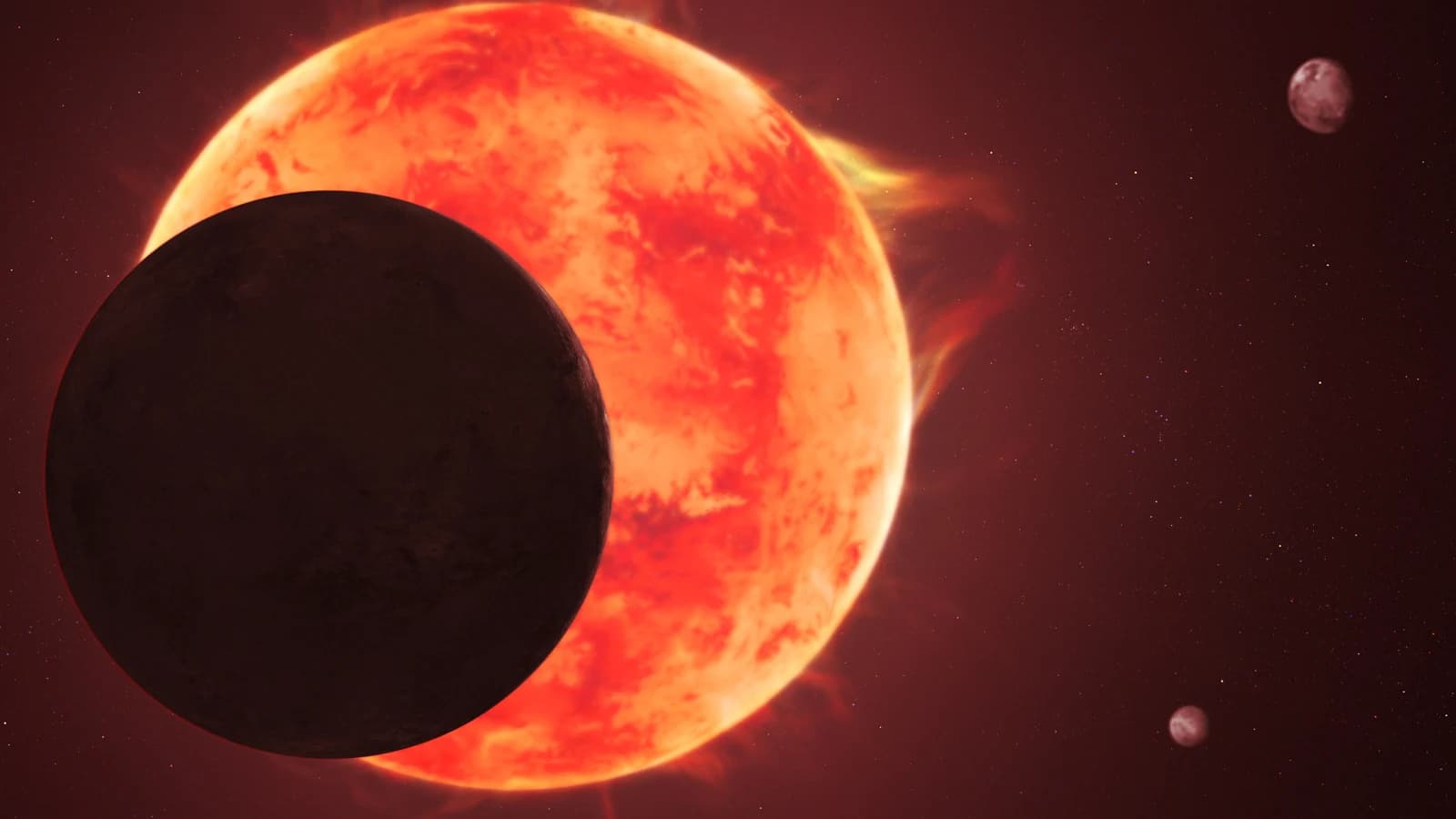
What changed in 2026
On 3 April 2026, Nature Astronomy published Michaël Gillon and colleagues’ study of thermal emission from the two inner planets, b and c. It strengthened constraints on thick atmospheres. The result did not appear out of nowhere: the original preprint had been available since September 2025. It is therefore more accurate to describe a peer-reviewed publication and an advancing investigation than a new October discovery.
Another study, published in The Astronomical Journal on 22 January 2026, tested a way to separate the star’s influence using closely spaced transits of b and e. It presents the program’s first three observations, taken in 2024. Neither this methodological test nor the April analysis of b and c confirmed an atmosphere on e. As of 31 October, the main question of a heavy atmosphere on that planet remains open.
Why this system became a laboratory
TRAPPIST-1 lies about 40 light-years away and has seven known planets close to Earth in size. They are labeled b through h. All their orbits are smaller than Mercury’s, and their years last roughly one and a half to nineteen Earth days. The star, however, is much smaller and cooler than the Sun. Planets e, f and g are therefore considered habitable-zone worlds despite their short distances from the star.
A small star is convenient for observations: an Earth-sized planet covers a relatively large fraction of its disk, and frequent transits provide repeat measurements. These exoplanets therefore allow methods of searching for atmospheres on rocky worlds to be tested. Similar radii are the starting point of the investigation. They do not yet reveal comfortable surface pressure, an ocean or Earth-like weather.
How to search for air without seeing the surface
During a transit, a planet crosses in front of its star. If it has an atmosphere, a small fraction of the light passes through gas, and transit depth can depend on wavelength. The spectrum is compared with absorption calculations. But the observed light also comes from an uneven stellar surface, so not every feature can be assigned to an atmosphere. These measurements do not produce a separate direct image of a TRAPPIST-1 planet.
Another approach measures the loss of planetary thermal emission when a world goes behind its star. A phase curve tracks changes in total brightness over an orbit. This can constrain day–night contrast and test heat transport. A thermal map in a scientific paper is usually a model inferred from the data: the telescope does not resolve continents, cloud vortices or cities on it.
What phase curves revealed about b and c
The 2026 study used MIRI at a wavelength of 15 micrometers. It obtained dayside brightness temperatures of 490 ± 17 K for b and 369 ± 23 K for c. These are temperatures corresponding to the measured emission in the selected band, not thermometer readings across the entire surface. No significant nightside emission was detected; b also showed no significant displacement of maximum emission from the substellar region.
The strong contrast supports inefficient heat transport. The examined thick-atmosphere models with surface pressures around a bar and higher are strongly disfavored by the data. For b, a dark airless surface is the most natural interpretation. For c, both more reflective bare rock and a thin oxygen-rich envelope with little greenhouse warming remain possible. Oxygen here is also an allowed model scenario, not a detected biosignature.
Why d needs a separate conclusion
In August 2025, researchers reported that TRAPPIST-1 d’s spectrum lacked the expected signs of an Earth-like atmosphere. NIRSpec did not reveal convincing planetary signals of water, methane or carbon dioxide. The study constrained a range of possible atmospheres; it did not measure the absolute absence of every amount of gas across the planet.
The authors left several explanations open: a very thin atmosphere, high clouds obscuring gas signatures, or an airless world. These are different physical states, not three names for a single established result. Nor should d be confused with e: the planets receive different irradiation, and constraints on one do not automatically become constraints on its neighbor.
What was actually measured for TRAPPIST-1e
The first published spectra of e are based on four transits observed in 2023. In September 2025, teams led by Néstor Espinoza and Ana Glidden presented analyses of those data. The signal contained strong stellar contamination that varied between visits. Using statistical methods, the researchers ruled out some extended hydrogen-dominated atmospheres but did not obtain unambiguous evidence for a heavy secondary envelope.
A secondary atmosphere is one formed or substantially reworked after a planet’s initial envelope. The term does not imply biology: geological processes can supply gases. For e, the data permit both bare rock and a heavier atmosphere. Residual spectral features may come from the planet or from stellar effects that have not been fully removed.
A nitrogen atmosphere: allowed does not mean detected
Glidden’s team tested different compositions. Models dominated by nitrogen with small amounts of CO₂ and methane are compatible with the observations, but an airless model also fits adequately. This cannot be turned into “Webb saw Earth-like air.” Agreement of one scenario with the data becomes evidence only when alternatives can be reliably distinguished.
For the selected pressures, CO₂-rich scenarios in that study were only weakly disfavored, at about two sigma. This is not a universal exclusion of all carbon dioxide. Even a small fraction in a nitrogen atmosphere could affect climate, but the climate is still calculated conditionally. A possible ocean, an icy surface or open water on the illuminated side remain scenarios under particular compositions and pressures.
How the star can imitate an atmospheric signal
The visible surface of a red dwarf is uneven. Cool spots and hotter regions have different spectra, while a planet covers only a narrow strip of the disk. If that strip differs from the average star, the difference changes the observed transit depth with wavelength. The resulting spectral feature can resemble atmospheric absorption even though it originated on the star itself.
Flares additionally change the light during observations. Simply increasing the number of transits is therefore insufficient: a systematic error need not disappear like random noise. The January 2026 paper shows how small data-analysis assumptions affect the weak signal being sought. Studying stellar activity and stellar lifetimes becomes part of investigating the planet rather than a separate background issue.
Why observe e alongside the likely airless b
Allen and colleagues’ program includes 15 closely spaced observations of transits of b and e. If b truly lacks a substantial atmosphere, its spectrum can serve as a reference for the star’s influence. Comparing it with a nearby transit of e should reduce dependence on a complex starspot model. This requires the star’s state not to change substantially between the two events.
The first three observations showed both the method’s promise and its limits. In the cleanest case, stellar contamination was reduced, while strong flares hindered correction. The simulated ability to detect a particular atmosphere with a CO₂ band depends on successful correction and the required gas being present. The number 15 describes a program and its forecast, not fifteen already published confirmations of air.
Does a red dwarf make all its planets uninhabitable?
High-energy radiation can break apart and remove atmospheric gases, especially on close-in planets. The outcome depends on orbit, composition, replenishment history and stellar evolution. An airless b therefore does not prove that e, f and g are airless. The habitable zone describes a possible energy regime with a suitable atmosphere; it does not settle whether that atmosphere survives.
The system’s planets are thought to keep one side facing the star because of tidal locking. Permanent day and night do not prescribe a single temperature: gas and water, if present, would change the contrast through heat transport. A calculation of a favorable climate, however, is not a measurement of that climate. For e, the environment itself must still be established before discussing stable liquid water and biological processes.
What would count as convincing evidence
A reproducible signal is needed, one that survives independent analysis and checks for stellar contamination. It should be compared with an airless model and different compositions, followed by estimates of pressure and climatic consequences. There is no scheduled discovery date: additional data may confirm an atmosphere, narrow the allowed scenarios or show that an interesting feature belongs to the star.
Unlike the debate over possible biosignatures on K2-18 b, the first unresolved step for TRAPPIST-1e is a convincing detection of the heavy atmosphere itself. Even success would not reveal organisms. NASA considers biosignature detection in this system with Webb unlikely. Establishing which rocky worlds retain gas around red dwarfs would nevertheless be an important result in its own right about planetary diversity.
Sources
- NASA/STScI — what Webb has revealed about TRAPPIST-1
- Nature Astronomy — phase curves of b and c, 3 April 2026
- Gillon et al. — original b and c study, September 2025 preprint
- Espinoza et al. — four spectra of TRAPPIST-1e, 2025
- Glidden et al. — constraints on a secondary atmosphere for e, 2025
- NASA — interpretation of the first TRAPPIST-1e results, September 2025
- The Astronomical Journal — paired e and b transits, 22 January 2026
- ESA/Webb — constraints on the atmosphere of TRAPPIST-1 d, August 2025
- University of Chicago — TRAPPIST-1 d and remaining atmospheric possibilities
- ESA/Webb — illustration of the active star and planet d
Questions and answers
Has Webb detected an atmosphere on TRAPPIST-1e?
There is no convincing confirmation. Analyses permit a heavy atmosphere, but an airless model is also compatible with the data. Thick hydrogen-rich scenarios are more strongly constrained than some nitrogen-rich ones.
Have nitrogen or life been found on TRAPPIST-1e?
No. A nitrogen-rich composition is one allowed model scenario, not a directly established gas. Neither liquid water nor organisms have been detected; attractive views of the alien surface are illustrations.
Why do b and c not settle the fate of the whole system?
They are closer to the star and receive different irradiation. The phase curves strongly constrain thick atmospheres on those two planets specifically. More distant worlds may have different conditions and histories of gas loss.
How many TRAPPIST-1 planets are in the habitable zone?
The usual set is e, f and g. This identifies an irradiation range in which a suitable atmosphere could support liquid water. It does not mean that air, oceans or life are already known on all three.
When will there be a definitive answer about the atmosphere?
There is no exact date. Additional measurements and reliable correction of the stellar contribution are needed. A program’s sensitivity forecast shows what could be detected under selected conditions, not a guaranteed discovery by a deadline.