The Fermi paradox begins with a simple puzzle: if the universe contains so many stars and planets, why have we found no confirmed traces of other technological civilizations? There is no settled answer. That establishes neither our solitude nor the existence of a hostile dark forest. In October 2026, new LaserSETI stations expanded the search. They help test particular kinds of signals rather than pass judgment on all life in the cosmos.
- As of October 30, 2026, no extraterrestrial technological signal has been confirmed. A candidate, an unusual burst and an established discovery are different stages of verification.
- On October 22, the SETI Institute announced that two LaserSETI stations were operating in AlUla. They were installed on August 19; the news date is not the date of a signal detection.
- Radio silence constrains only the combinations of direction, frequency, power and time that have been tested. There is no single reliable percentage of the universe that has been listened to.
- The Great Filter is a conditional framework for rare developmental steps, while the dark forest is a popular literary scenario. Observations have not established that either explanation is correct.
What is the Fermi paradox?
The Milky Way contains an enormous number of stars, and exoplanets are an established observational fact. That makes other civilizations a reasonable subject of inquiry. Yet unknown transitions lie between a planet and technology that we can notice: the emergence of life, complex organisms, intelligence and a means of communication that an instrument on Earth can detect. A large number of possible locations does not by itself determine the probability of each transition.
The apparent contradiction becomes sharper if we also assume that civilizations are common, long-lived and inevitably spread across the Galaxy, leaving visible traces. The absence of visible traces would then need explaining. But those assumptions have not been established. The name Fermi paradox covers a family of arguments; it is neither a physical theorem forbidding extraterrestrial intelligence nor a calculation of our neighbors published by Fermi.
What changed in the search by October 2026?
On October 22, 2026, the SETI Institute announced that two new LaserSETI stations in AlUla, northwestern Saudi Arabia, had been commissioned and were collecting data. They were installed on August 19. AlUla became LaserSETI’s first observing site in Asia and the fifth in its network. This is recent news about expanding the instruments available, rather than a report of a civilization being found.
Rather than using a single telescope’s narrow field, wide-field cameras and diffraction gratings monitor large areas of sky for brief optical flashes. Geographically separated sites can watch different directions for longer and compare events from multiple locations. A flash may turn out to be a natural phenomenon or interference: a program searching for possible laser technosignatures does not make every event it records artificial.
What is SETI, and how does a technosignature differ from life?
SETI is the scientific search for extraterrestrial intelligence, not one radio telescope or a single project. Researchers look for technosignatures: observable consequences of technology. Proposed examples include radio transmissions, brief laser pulses, unusual industrial pollutants and excess infrared radiation from large-scale energy use. These are classes of search targets, not a catalog of alien devices already found.
A biosignature addresses a different question: could an observed feature have been produced by living organisms at all? Even compelling evidence of microbial life would not establish a civilization. Conversely, a technological signal need not reveal its makers’ chemistry. The number of planets with suitable conditions, the fraction of inhabited worlds and the fraction of civilizations visible to our instruments are three different quantities.
How much of space have we actually searched?
A telescope does not listen for every possible transmission at once. An observation has a direction, frequency range, duration, sensitivity and requirements for the signal’s form. An instrument may look at the right star but miss a transmission on another frequency, or cover the right band an hour before a brief pulse. Even a well-studied patch of sky is not an exhaustive survey of every possible means of communication within it.
In a study by Jason Wright and colleagues, the search space is described by an eight-dimensional model, the cosmic haystack. This framework shows why observing hours or the number of stars examined are insufficient measures of completeness. The resulting fraction depends on the model’s chosen boundaries and assumptions about transmitters. It would be misleading to extend one paper’s estimate to all searches in 2026 and announce an exact percentage of the universe surveyed.
Why an existing transmitter could go unnoticed
A powerful signal could be tightly beamed and never cross Earth. A weak one could fall below the sensitivity threshold. A civilization might use technologies that do not leave the signature being sought, or emit in a way we can detect for only a short time. These possibilities explain how a signal could be missed; they do not establish that a hidden transmitter really is operating nearby.
An observation is also not simultaneous with the life of a distant society: light and radio waves take a finite time to reach us. We examine radiation that left its source in the past, and our observations must coincide with its arrival. A civilization’s lifetime and the length of its detectable technological phase are therefore different things. The disappearance of radio transmissions need not mean their makers have physically perished.
Why an unusual radio signal does not establish intelligence
A useful example is blc1, a candidate found in Proxima Centauri observations made with the Parkes telescope on April 29, 2019. It was narrowband, drifted in frequency and initially warranted investigation. However, a detailed analysis published in Nature Astronomy in 2021 found related interference and showed that blc1 could be explained by terrestrial electronics. Observing a signal in a star’s direction does not establish that the star is its source.
Satellites, ground-based transmitters, instrumental effects and processing artifacts must first be excluded. An unusual shape alone is also insufficient: fast radio bursts remind us that nature produces brief, powerful radio pulses. Researchers examine combinations of properties, behavior when pointing changes, other frequencies and independent observations. The more extraordinary a discovery claim, the more important access to the underlying data becomes for verification.
What a null result means: the example of 3I/ATLAS
In June 2026, the SETI Institute reported a technosignature search toward the interstellar object 3I/ATLAS using the Allen Telescope Array. Observations had begun after the object was announced in July 2025. The analysis included more than seven hours of data from 1 to 9 GHz. Following selection and investigation, all remaining candidates turned out to be terrestrial interference, including signals from human technology and satellites.
That result is useful: it rules out particular transmissions that the procedure should have detected under those observing conditions. It does not cover every frequency, every moment or every conceivable technology. Selecting an interstellar object for investigation does not make it artificial; observations of 3I/ATLAS support a cometary origin. The reason for pointing antennas at a target and the evidence obtained after analysis must be kept separate.
The Drake equation: a map of unknowns rather than a ready answer
Frank Drake proposed the famous framework in 1961. It connects the rate of star formation, the prevalence of planets and suitable conditions with the fractions of worlds that develop life, intelligence and detectable technology. A final important factor is the duration of the detectable phase. It is a useful way to divide a large question into separate research problems.
Writing unknown quantities as a formula does not turn their product into a measurement. For the later transitions, we lack a representative sample of independent civilizations. Optimistic and pessimistic inputs can produce very different results, but those results follow from assumptions. No such number can honestly be presented as an established count of intelligent societies in the Milky Way, or used to prove their inevitable self-destruction.
The Great Filter: a rare transition or a future catastrophe?
In Robin Hanson’s formulation, an extremely unlikely transition, or several such steps, may lie between nonliving matter and a long-lived, widely spread civilization. This idea is called the Great Filter. If few advanced societies are observed, it suggests asking where the assumed chain usually breaks. It is a conditional argument that depends on expectations about civilizations spreading and becoming visible.
The filter could lie in the distant past, for example at a transition toward complex life, or concern future obstacles to sustained development. Observations have not located it or confirmed that a single universal barrier exists. The absence of a received signal cannot establish that humanity must perish: all the intermediate assumptions would first need justification, including adequate search completeness.
The dark forest hypothesis: where science fiction meets an untested idea
The dark forest became especially well known through Cixin Liu’s novel of the same name. In this scenario, civilizations hide because they cannot know their neighbors’ intentions and fear a preemptive attack. The idea gives silence a compelling explanation within a fictional world. Literary plausibility does not replace observations: we have measured neither extraterrestrial societies’ motives nor their ability to detect one another and launch interstellar attacks.
Turning this scenario into a scientific model requires explicit assumptions and testable predictions that distinguish it from other explanations. Simply saying that civilizations always hide perfectly shields the idea from any outcome and leaves almost nothing to test. Receiving someone else’s radiation is also different from sending a message: SETI and active contact attempts, often called METI, are different activities. Debates about transmission do not establish that listening itself is dangerous.
Which explanations for silence can be tested?
Other possibilities require no cosmic conspiracy: technological societies might be rare, emit detectably for only a short time or lie too far away for present instruments. Interstellar settlement might be difficult and need not be every society’s inevitable choice. Several causes could operate together. Without quantitative assumptions and an observational model, ranking them by the appeal of their stories would be arbitrary.
Scientific progress begins when an idea specifies an observation: which stars to examine, at what frequency, with what sensitivity and for how long. A null result can then change a particular model’s allowed parameters. Radio searches, optical stations and searches for other technological traces complement one another because they test different possibilities. In this way, the question of where everybody is becomes a set of experiments rather than a contest for the most alarming explanation.
What would a genuine discovery require?
The International Academy of Astronautics’ principles, updated in June 2026, recommend careful investigation of candidates, independent instruments and organizations, and preservation of data and analysis methods. A possible signal may remain ambiguous for a long time, and follow-up work may yield no definitive answer. These principles concern the search for extraterrestrial intelligence; they are scientific guidelines, not evidence that contact has already occurred.
For a confirmed result, the principles call for an open announcement and a verifiable scientific report containing the data, analysis and justification for the conclusion. An unusual peak on a plot or a viral headline cannot replace that foundation. As of October 30, 2026, SETI has no confirmed extraterrestrial signal. The lack of a discovery still leaves substantial work: expanding coverage, investigating interference and explaining more precisely what has actually been ruled out.
Sources
- SETI Institute — no extraterrestrial signal has been confirmed
- SETI Institute — two LaserSETI stations in AlUla, October 22, 2026
- NASA — the search for technosignatures
- Wright and colleagues — the multidimensional SETI search space
- Nature Astronomy — investigating blc1 and terrestrial interference
- SETI Institute — a null result in the 3I/ATLAS search, June 2026
- Robin Hanson — the original Great Filter argument
- Macmillan — Cixin Liu’s The Dark Forest, a science fiction novel
- IAA — principles for verification and announcing a discovery, June 2026 update
- Robert Gray — the historical assumptions behind the Fermi paradox
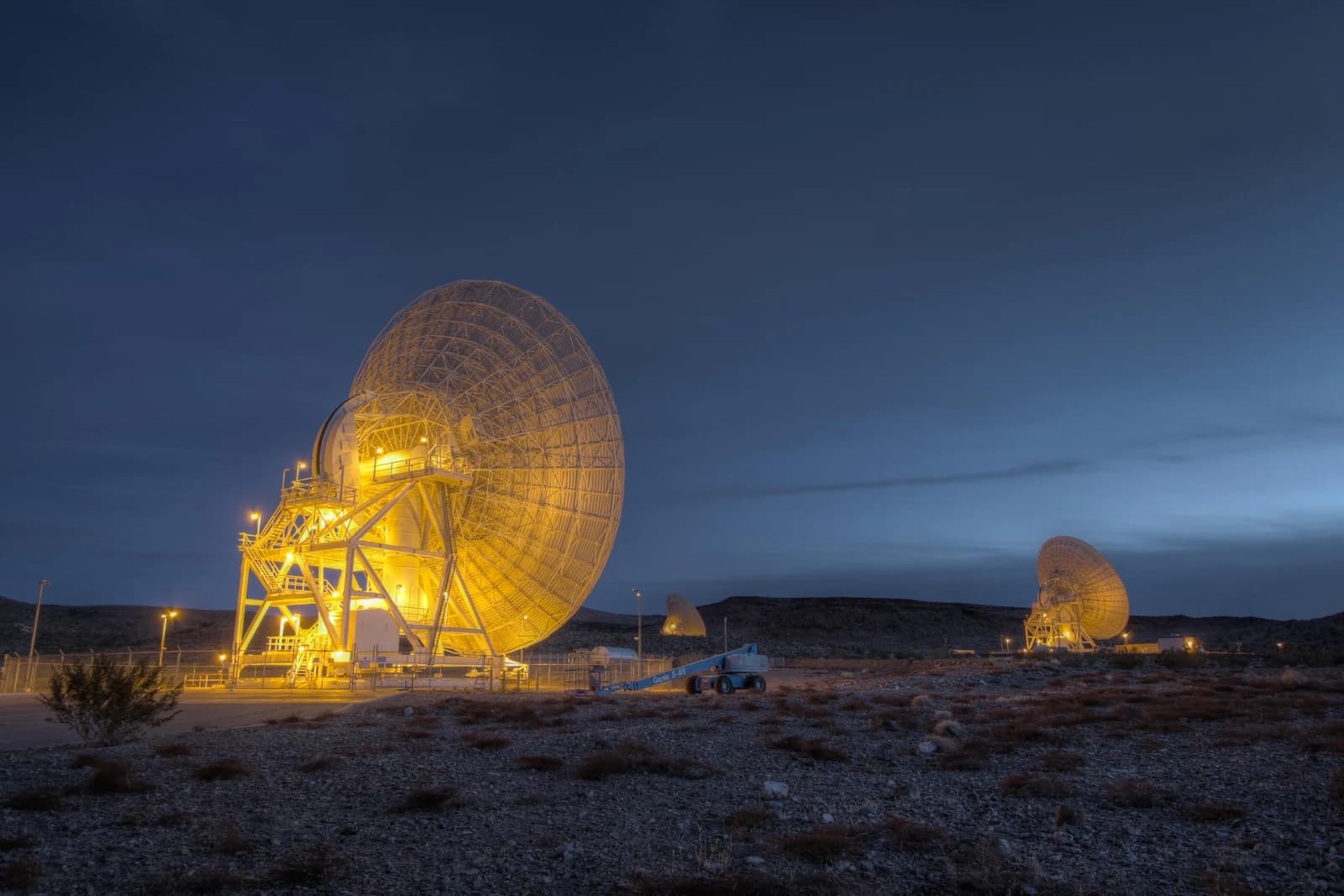
- NASA/JPL-Caltech — a real photograph of the Goldstone antennas
- NASA — natural fast radio bursts and magnetars
Questions and answers
Has any signal from an extraterrestrial civilization been confirmed?
No such result exists as of October 30, 2026. Search programs find candidates, but a signal’s unusual properties do not establish its origin. Terrestrial interference and instrumentation must be investigated, and independent confirmation is needed.
Has the dark forest hypothesis been proven?
No. It is a popular scenario known from Cixin Liu’s novel. It assumes particular motives and capabilities for civilizations that we have not observed. Radio silence alone cannot distinguish it from rare technology, weak signals or an incomplete search.
Must the Great Filter lie ahead of humanity?
No. Even within this conditional framework, rare steps could lie in the past, in the future or across several transitions. No measurement has identified a single unavoidable barrier or demonstrated that civilizations must perish.
Does SETI listen or send messages?
SETI primarily searches for observable signs of other technologies, including by receiving radio and optical radiation. Deliberately sending messages is usually distinguished as METI. The history of active messages and debates about them do not turn every SETI observation into a transmission.
Why does radio silence not prove that we are alone?
Because searches are limited by sensitivity, directions, frequency bands and observing times. A null result rules out certain kinds of sufficiently detectable signals under the conditions tested. It is not a simultaneous examination of every planet and every possible technology in the universe.