A planet can be found even without a star to orbit. Young worlds reveal themselves through their own heat; long-cooled worlds through gravitational magnification of a distant star’s light. In 2026, observations by Gaia and ground-based telescopes allowed the mass of one such candidate to be determined separately from its distance. Meanwhile, Roman is already undergoing science commissioning in space. These developments make rogue planets a population we can measure, but important difficulties remain: an unseen host star does not always mean no host exists.
- Rogue planets do not orbit a host star. Some candidates could nevertheless turn out to be worlds on extremely wide orbits.
- A Science paper published on 1 January 2026 measured a candidate’s mass as 0.219 Jupiter masses, about 70 Earth masses. Whether it has a possible host star is a separate question.
- Webb and the VLT investigated the growth of the young object Cha 1107-7626. Water vapor was found in its surrounding disk; that is not a detection of an ocean or life.
- According to NASA’s 22 October 2026 update, Roman is in the final stage of science commissioning. The hundreds of expected discoveries remain a survey forecast.
What is a rogue planet?
Exoplanets are usually found around other stars, but some planetary-scale bodies move independently through the Galaxy. They are called free-floating, wandering, or rogue planets. “Free-floating” means not bound to a particular star: the object still moves within the Milky Way’s gravitational field. It does not have to hang motionless in empty space or escape the laws of celestial mechanics.
An observational label does not always establish a birth history. A small body may have formed in a planetary system or through the collapse of a gas cloud. For the latter case, researchers often use the cautious term “planetary-mass object.” Brown dwarfs likewise cannot sustain hydrogen fusion as ordinary stars do. An outward resemblance to Jupiter is not enough to establish an origin and choose one universally agreed label.
How a world can end up without a host star
In a young system, several massive bodies can gravitationally scatter one another. Close encounters exchange energy and alter orbits; one participant sometimes gains enough energy to escape the system. A direct collision is not required. A passing star can also disrupt the original arrangement. Researchers study these processes with numerical simulations and compare them with the masses and motions of real objects.
Another route is the formation of an individual low-mass body from gas and dust, much like a star but without accumulating stellar mass. In that case, the “orphan” may never have had a parent star. Young objects with their own disks make this route especially interesting. We cannot yet assume every candidate shares one history: samples may mix objects ejected from systems with bodies born separately.
Why a planet can be visible without starlight
The absence of a nearby bright star does not mean an object emits no radiation. A young massive body retains heat from formation and radiates in the infrared. Webb therefore searches for faint objects in young clusters and obtains their spectra. In NGC 1333, such observations identified bodies with masses comparable to giant planets. This uses the source’s own thermal emission rather than light reflected from an unknown nearby sun.
Colors and brightness help select candidates, while a spectrum provides additional temperature and molecular-composition indicators. Mass is generally inferred through cooling models that account for age. If age or atmospheric properties are uncertain, the mass estimate changes. As an object cools, it fades, so direct infrared samples preferentially reveal young, large worlds rather than providing a complete census of old, small planets.
How gravity reveals an unseen, cooled world
In microlensing, a foreground body passes almost exactly in front of a distant star in our sky. Its gravity bends light paths, temporarily making the background star appear brighter. Observers measure that star’s brightness over time. The lens itself can remain unseen, making the method suitable for a planet without a luminous host. This differs from a transit, in which a planet blocks some of its host star’s light and makes it fainter.
For low-mass lenses, a detectable signal may last only hours or a few days. Telescopes must repeatedly image very many stars and catch a rare alignment. A short brightening does not automatically provide a mass, however: its characteristics also depend on distances and relative motion. Different combinations can produce similar light curves. Weighing a particular object requires additional measurements, rather than just a short event.
What was measured for the first time in 2026
On 1 January 2026, Science published a study of KMT-2024-BLG-0792/OGLE-2024-BLG-0516. The event had been recorded in May 2024 by the ground-based KMTNet and OGLE surveys and by Gaia. The separated viewpoints saw slightly different light curves: from Gaia, the event was shifted by about two hours. This parallax, together with analysis of the signal’s shape, helped separate the effects of mass and distance.
The measured mass is 0.219 Jupiter masses, or about 70 Earth masses, with published uncertainties of −0.046 and +0.075 Jupiter masses. That makes it a Saturn-class object by mass, not an exact Saturn copy. The study provided the first direct mass determination for such a microlensing candidate rather than a statistical estimate alone. Its radius, density, surface, and detailed weather do not follow from that number.
Why a measured mass does not prove there is no host star
The paper itself retains an important alternative: the lens is either unbound or on a very wide orbit. If a possible host is far from the alignment, its separate effect may not appear in the short signal. The absence of a characteristic light-curve feature therefore constrains the possible system, but does not always exclude every star at every separation from the planet.
The authors favor formation in a protoplanetary disk followed by ejection. That inference comes from comparisons with the event population and formation simulations, not from witnessing the ejection itself. The result’s strength is the independent determination of a planetary mass. The full orbital history is less certain. Separating these questions shows precisely what the discovery established.
What Webb and the VLT saw around a growing rogue planet
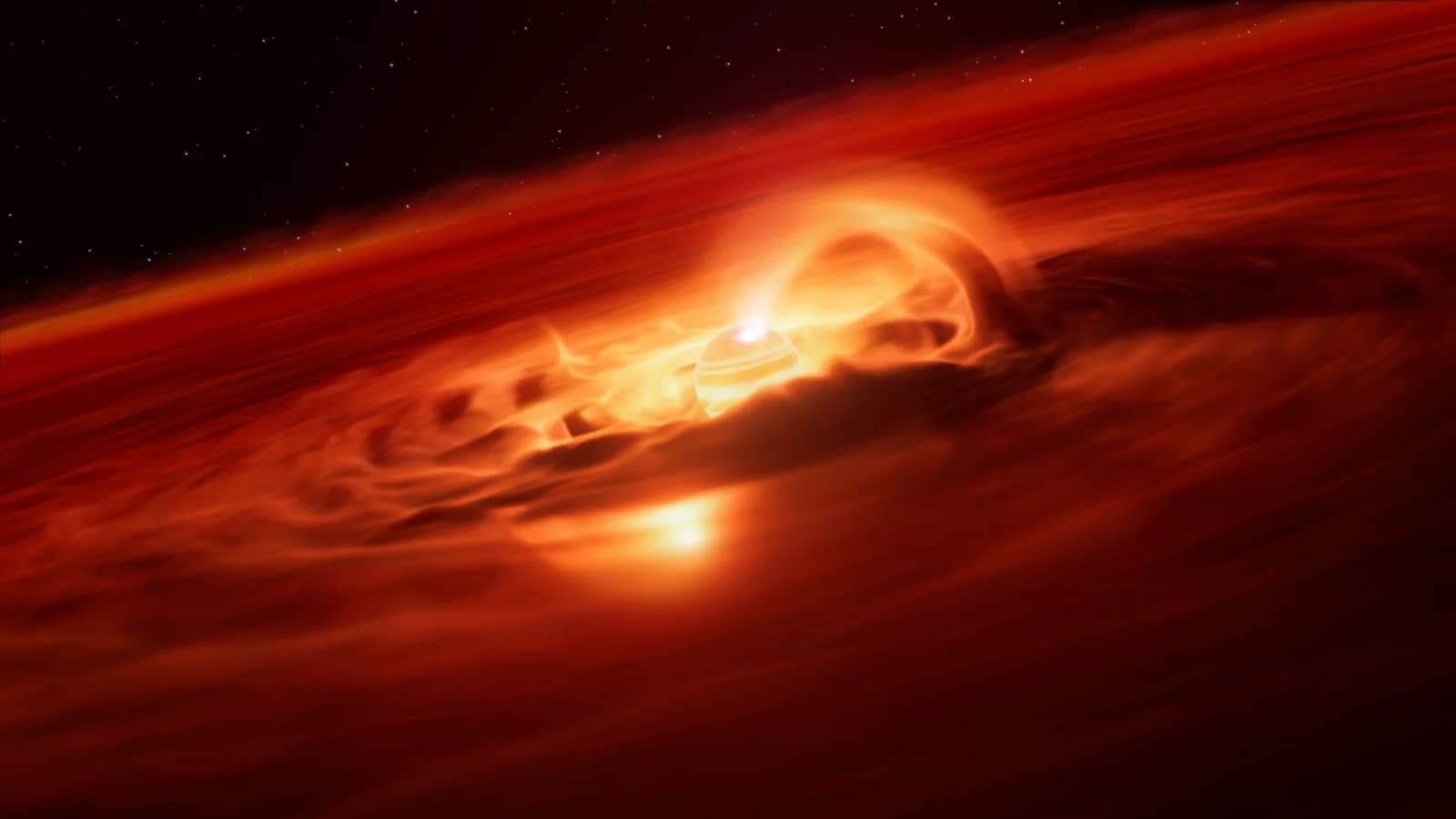
A different example is the very young object Cha 1107-7626 in Chamaeleon, roughly 620 light-years away. Its estimated mass is 5–10 Jupiter masses, and it has a disk of gas and dust. On 2 October 2025, ESO reported a sharp increase in accretion, the flow of material from the disk. VLT spectra indicated a rate of about six billion tonnes per second by August 2025, eight times greater than a few months earlier.
Webb added information about disk chemistry: water vapor was detected during the enhanced growth but had not been seen before. A magnetic field likely channeled the inflow. Similar episodes occur in young stars, connecting their early evolution with that of some planetary-mass bodies. Vapor in hot surrounding material is not a liquid ocean, however, and a similar accretion mechanism does not establish the origin of all rogue planets.
How many rogue planets does the Milky Way hide?
Estimates of a vast galactic population extrapolate from a small observed sample while accounting for survey sensitivity. Researchers must specify a mass range, distance and velocity distributions, alignment probability, and the fraction of missed signals. If abundant low-mass objects lie near the detection threshold, the correction becomes large. The number of detected candidates, an estimate of the total population, and a future telescope’s forecast are therefore different quantities.
Neither a striking headline about trillions nor a simple ratio of rogues to stars is a proven census. The relevant mass range and the authors’ definition of free-floating objects matter. Infrared observations of young clusters and microlensing of an older population select different parts of the distribution. Comparing them tests models, but mechanically adding the samples or applying one cluster’s fraction to the entire Milky Way is inappropriate.
What Roman will change, and where it stands now
As of 28 October 2026, Roman is already in space. NASA’s 22 October update describes its transition to final science commissioning: the team is checking image quality and instrument performance before full science observations. This is beyond the old plan for a 2027 launch, but it is not yet a published catalog of hundreds of rogue planets. Tests in crowded star fields are especially important because that is where faint brightness variations will be sought.
The Galactic Bulge Time-Domain Survey will repeatedly observe a crowded region toward the Galactic center, monitoring brightness changes in enormous numbers of stars. NASA forecasts hundreds of rogue planets, with sensitivity extending to very low masses. Hubble imaged some of the fields in advance to help disentangle overlapping sources later. Combined with ground-based data, observations from another location in space can improve mass measurements. Survey expectations must be distinguished from validated results.
The Roman telescope’s task begins with precise repeated images: small changes in focus or sensitivity can imitate faint variability. That makes current tests of the WFI camera and guidance system as important as the area of the future survey.
Could a world without a sun retain water or life?
Without steady stellar heating, conditions differ substantially from Earth’s, but the absence of a star does not provide a ready-made surface temperature. In David Stevenson’s 1999 theoretical work, a massive hydrogen atmosphere could trap internal radioactive heat on an ejected Earth-scale body and maintain liquid water. This requires particular atmospheric properties and heat flows. It is a calculation of a possible scenario, not a measured climate on a discovered rogue planet.
The 2026 microlensing candidate has a measured mass, but no detailed surface map or biological evidence. Cha 1107-7626 observations concern a young body and its surrounding disk, not an Earth-like habitable landscape. Keeping these distinctions helps when reading headlines: planetary mass, a water molecule, potentially suitable conditions, and detected organisms are successive but separate levels of evidence. Establishing one does not replace testing the others.
Sources
- NASA Roman — rogue planets and how they are detected
- NASA — the boundary between planets and brown dwarfs, 2019
- Science — an object’s mass measured through microlensing, 1 January 2026
- Peking University — joint Gaia and Earth observations, January 2026
- ESO — Cha 1107-7626 growth observed with VLT and Webb, 2 October 2025
- NASA — Roman’s final commissioning phase, 22 October 2026
- NASA — Hubble survey supporting Roman’s program, 11 May 2026
- ESA — young planetary-mass objects in NGC 1333, 2024
- Nature — a theoretical model of heat retention without a star, 1999
- NASA — WFI checkout and focus adjustment, October 14, 2026
Questions and answers
Do planets without stars really exist?
Observations reveal free-floating planetary-scale objects. For some candidates, especially those found through brief microlensing events, a star at a very large separation cannot yet be excluded. Each object’s status must be assessed individually.
How can a planet be seen without reflected starlight?
Young massive objects emit their own infrared heat. Cooled bodies too faint to see can be detected indirectly: their gravity temporarily magnifies a background star’s light during a favorable alignment.
Does the 70-Earth-mass planet definitely have no star?
The 2026 paper robustly determined a planetary mass, but its abstract allows two possibilities: an unbound object or a very wide orbit. The preference for ejection comes from models and population comparisons, not from observing the entire orbit.
Has Roman already discovered hundreds of rogue planets?
In NASA’s verified 22 October 2026 update, the telescope is undergoing final science commissioning. Hundreds of discoveries are an expected survey outcome, not an already confirmed, published list.
Does water vapor around Cha 1107-7626 mean it has life?
No. The study investigated the surrounding disk’s chemistry during accretion. Water vapor establishes neither a liquid ocean nor habitability nor organisms. Those conclusions would require other observations.