The Nancy Grace Roman Space Telescope has already launched: older plans for a late-2026 or 2027 launch no longer describe its status. The central question now is how precisely the observatory can measure light. On October 22, NASA reported its transition to final science commissioning. Here is why a panoramic camera needs weeks of testing, why a coronagraph’s first light is not an image of a new Earth, and what discoveries may become possible once surveys begin.
- Roman launched on a Falcon Heavy on August 30, 2026. As of October 31, it is undergoing commissioning while traveling toward its operational orbit near L2; full survey operations still lie ahead.
- WFI is an approximately 300-megapixel camera with 18 detectors. It covers about 0.28 square degrees: its advantage over Hubble concerns the area in a frame, not a hundredfold increase in magnification.
- Roman will search for planets through changes in starlight and test direct imaging of large gas worlds. Its coronagraph is a technology demonstrator, not an instrument ready to detect life on an Earth twin.
- Test observations are already taking place, but the first science images are expected by early 2027. Forecasts of planet counts and survey size are not yet catalogs of discoveries.
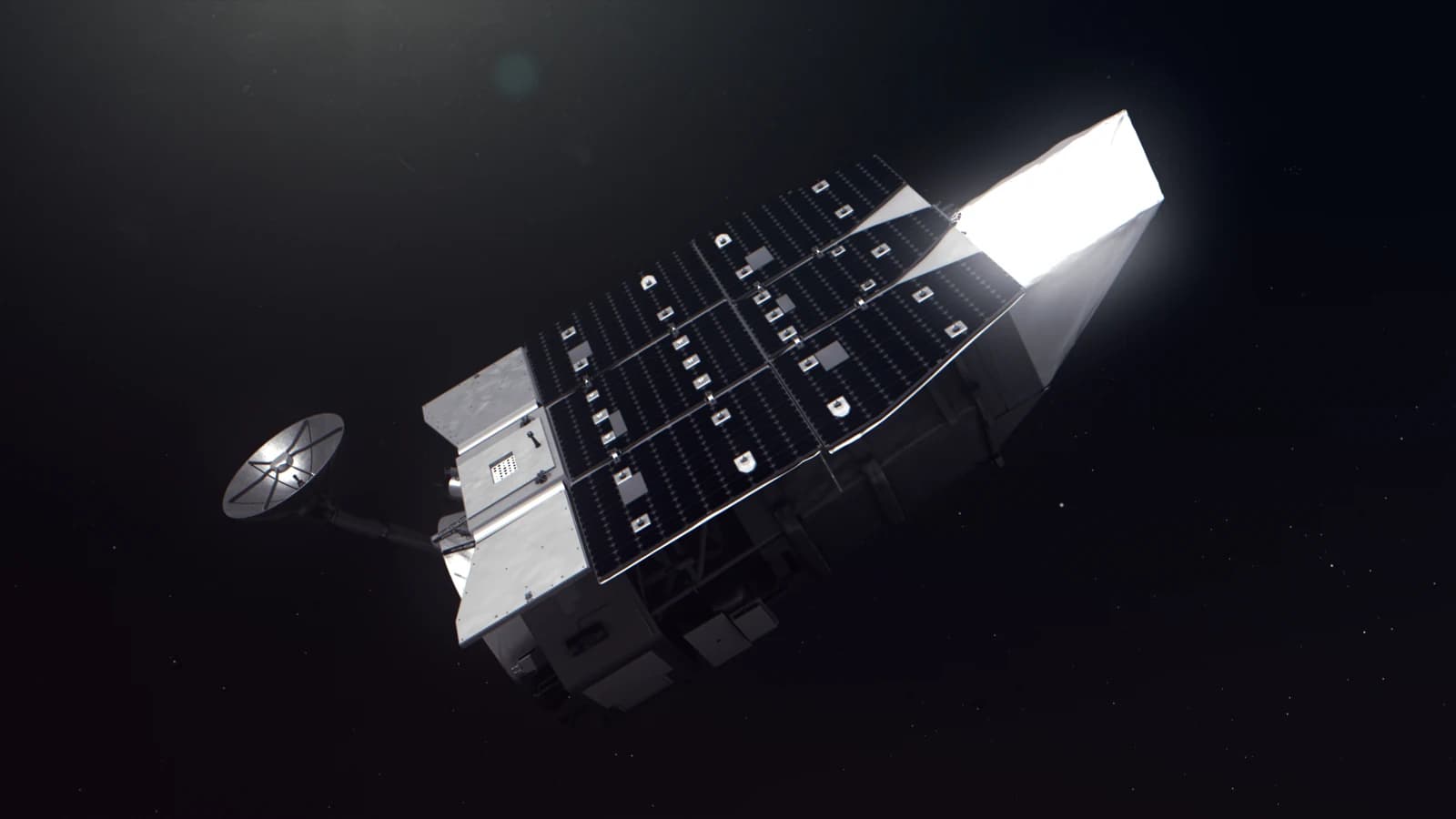
What happened in October 2026?
On October 22, the Roman team announced the transition to the final science stage of commissioning. By then, the observatory could point at targets, hold its direction steadily, take exposures and transmit data. Tests of crowded stellar fields and dusty regions showed that the guidance system could handle these challenging scenes too. This is an engineering validation needed for future measurements.
A working telescope and a science-ready survey are different states. Researchers are now refining image quality, the instruments’ response to light and consistency between successive observations. If one exposure is accidentally a little brighter or blurrier than another, it could mimic a variable star or distort a galaxy’s shape. The team must understand such effects before interpreting faint signals as properties of the cosmos.
When did Roman launch, and where is it going?
Roman launched on August 30, 2026, at 7:26 a.m. Eastern Daylight Time, or 2:26 p.m. in Moscow. A Falcon Heavy lifted off from pad 39A at Kennedy Space Center in Florida. The observatory separated from the upper stage roughly 31 minutes later. These events have already happened, rather than being another proposed date: reports still anticipating a fall-2026 or 2027 launch must be read in the context of when they were published.
Its operating region is near the second Sun–Earth Lagrange point, roughly 1.5 million kilometers from our planet. Roman will orbit the L2 region rather than hover motionless at the point itself. This location helps provide a stable thermal environment and a broad view. In a September update, NASA expected arrival in the final orbit about 100 days after launch, around early December. As of this article’s date, it is too soon to describe that arrival as completed.
What does a field a hundred times larger than Hubble’s mean?
Roman’s primary mirror is 2.4 meters across, like Hubble’s. Images can, however, be compared by different properties: field size, sensitivity, angular resolution and wavelength range. WFI captures roughly 0.28 square degrees of sky per exposure, an area larger than the apparent disk of the full Moon. That area is almost a hundred times larger than Hubble’s widest ACS frames and about two hundred times larger than its WFC3-IR infrared camera’s field.
This does not mean that every galaxy will be magnified a hundredfold or that all details will be a hundred times smaller. The main advantage is more sources in one high-quality frame and fewer separate pointings for a large map. Roman, Hubble and James Webb can complement one another: a wide survey finds rare objects and relationships between them, while detailed observations of selected targets address other questions. Each instrument retains its own wavelength ranges and limits.
Different wavelength ranges and roles explain why Hubble’s future still matters after Roman’s launch. In October 2026, NASA asked companies about a possible reboost and servicing of the older observatory. This explores options for preserving the instrument rather than announcing an approved repair expedition.
How the panoramic WFI camera works
The Wide Field Instrument is Roman’s primary science instrument: an approximately 300-megapixel camera assembled from 18 detectors, each with 4096 × 4096 pixels. Light collected by the optics falls on this mosaic and becomes electrical signals. The large pixel count combines a wide field with fine detail, but does not by itself guarantee accuracy: noise, temperature stability, detector sensitivity and knowledge of how the instrument renders a point source all matter.
An optical element wheel sits in front of the detectors. Its eight imaging filters span roughly 0.48 to 2.3 micrometers, from visible light into the near infrared. A prism and grism also provide slitless spectroscopy, spreading sources’ light by wavelength. A survey can therefore supply images and spectral information. This is not an unlimited set of colors recorded simultaneously: observing modes are selected for a particular program.
Why the camera still needs adjustment after launch
Ground tests cannot fully reproduce weightlessness, temperatures and structural changes after launch. On October 14, NASA described checks of all WFI detectors, electronics, the element wheel, alignment mechanism and thermal system. Internal LEDs provide controllable illumination at different levels. They allow detector response to be measured and sensitivity differences corrected before they become errors in a celestial object’s brightness.
Engineers separately refined focus and optical alignment. After corrections, WFI’s residual wavefront error was 63 nanometers RMS against a requirement of about 90 nanometers. This characterizes how far the optics depart from an ideal passing light wave; RMS denotes a root-mean-square measure. This check helps assess how reliably the camera can distinguish faint changes in shape and brightness.
A science survey needs more than one sharp demonstration image: the reproducibility of thousands of later exposures must be understood. Tests examine whether measured brightness changes when a star falls on another part of the mosaic and how temperature affects image quality. Some effects are reduced by adjusting hardware; others are characterized through calibration and accounted for during processing. This work turns a beautiful panorama into measurements suitable for independent analysis.
How the telescope holds an image steady, and what first light means
A still photograph hides the guidance system’s continuous work. Small regions of each of the 18 detectors rapidly measure guide-star positions, while the control system compensates for the observatory’s drift. These tests succeeded in September. This is especially important for long exposures: even a small movement smears light and, in a starlight-suppression experiment, can let the bright background leak back into a faint planet’s location.
According to the September 30 update, the coronagraph first received cosmic light on September 22, followed by another test on the 27th. The targets were stellar fields in the Large Magellanic Cloud. The team checked light transmission, focus and pointing. First light means that the optical system has begun obtaining real sky data; it does not yet demonstrate starlight suppression at the required contrast or constitute a planet discovery. Those tasks require subsequent, more complex tests.
Why Roman will image the same fields repeatedly
WFI’s program centers on three core surveys: a wide area away from the Galactic plane, repeated observations of extragalactic fields, and the Milky Way’s crowded stellar bulge. Their goals differ, so their areas, filters, depths and revisit rates differ too. Being a survey telescope does not mean imaging the entire sky equally deeply every day: observing time is distributed among selected programs.
Repetition turns a map into a history of change. It can reveal a supernova, build a star’s light curve or capture a brief microlensing event. The bulge survey strategy includes high-cadence seasons with observations roughly twelve minutes apart, as well as less frequent monitoring. This is a plan for a future sample. The shorter the target event, the more important not only single-image sensitivity but also the chance of catching it between successive exposures becomes.
What panoramas can reveal about dark matter and energy
Roman will not photograph dark energy as though it were glowing gas. Cosmology uses the shapes of many galaxies, their spectra, spatial distributions and changing supernova brightness. Weak gravitational lensing produces small, correlated distortions in images. To distinguish them from the optics’ own pattern, researchers must understand a point source’s image across the camera, which explains the direct importance of today’s calibration work.
The spectroscopic survey will help study galaxy clustering and baryon acoustic oscillations, while supernovae provide another route to reconstructing expansion history. Dark matter concerns gravitational structure; dark energy describes cosmic acceleration. The names are not interchangeable. Roman’s future results can be compared with DESI and Euclid. Entering commissioning does not, however, establish changing dark energy or resolve disagreements between cosmological models.
How Roman will find planets that do not appear in a photograph
For most of its future planet discoveries, Roman will measure starlight rather than obtain a separate image of a world. A transiting planet slightly dims its host star. In microlensing, a nearer body’s gravity temporarily amplifies a background star’s light. WFI must monitor enormous numbers of sources frequently enough to record these changes and distinguish them from noise and ordinary stellar variability.
Microlensing is useful for cold, wide orbits and rogue planets. The light being amplified belongs to the distant star, not to the unseen planet’s own infrared emission. Transits produce a different sample. NASA’s forecast of around a hundred thousand transit detections must not be assigned to microlensing alone or presented as exoplanets already found. Candidate counts and masses will require analysis of event quality, search completeness and additional constraints.
Why the coronagraph is not a promise of a new Earth
The second instrument, the Roman Coronagraph Instrument, works differently. It is designed to suppress a star’s bright glare so that the much fainter light of a planet or circumstellar disk can be recorded directly. An opaque obstruction alone is insufficient: diffraction and small optical errors leave a background. Masks are therefore combined with deformable mirrors whose shapes are adjusted by actuators, compensating for wavefront errors.
This is a technology demonstration targeting large gas planets, including Jupiter analogs in reflected starlight. It is intended to prepare methods for more ambitious future observatories capable of studying Earth-like worlds. That longer-term goal must not be transferred to Roman as a promise of an image of an inhabited continent or oxygen on another Earth. The required contrast, stability and reproducibility of direct observations must first be demonstrated.
How large images will reach researchers
A large survey needs a data link as well as a camera. In September, NASA tested ground stations in Japan, Australia and the U.S. state of New Mexico. They are expected to receive roughly 1.4 terabytes of science data per day at link rates up to 500 megabits per second. Tests used real housekeeping information and preliminary images. The planned science-data flow and an archive already received are different quantities.
Roman observations will have no proprietary period during which only one group has access. Public data can be used by different researchers, including for questions beyond a survey’s main purpose. Openness does not remove the need for processing: calibration, uncertainty descriptions, catalogs and candidate verification remain essential. Automatically detecting a bright point does not yet determine whether it is a supernova, a moving object or an image artifact.
The SPHEREx survey already shows how access to infrared measurements works. The IRSA archive publishes calibrated images and provides tools to extract a spectrum at given coordinates or assemble a mosaic of a selected field.
When to expect science images, and what counts as a result
As of October 31, 2026, test observations of the sky already exist, while NASA expects the first science images by early 2027. There is no contradiction: engineering first light serves a different purpose from a major release of prepared science data. The exact date depends on further commissioning. There is no basis for promising a specific January day or a complete catalog immediately after the first panorama.
The primary program lasts five years. In September, NASA estimated that fuel could support at least 22 years of potential operations, taking account of savings and the expected costs of subsequent maneuvers. This is a propellant-based possibility, not an approved funding duration or a guarantee that every component will remain healthy. The strongest news will be validated measurement accuracy, released data and independent scientific results, rather than another large forecast number.
Sources
- NASA — Roman’s final science commissioning, October 22, 2026
- NASA — the completed launch on August 30, 2026
- NASA — WFI specifications, March 2026 version
- NASA — the wide-field camera and field-of-view comparisons
- NASA — WFI checkout and focus adjustment, October 14, 2026
- NASA — guidance and the coronagraph’s first light, September 30, 2026
- NASA/JPL — the purpose and limits of Roman’s coronagraph
- NASA — Roman’s three core surveys and their strategy
- NASA — microlensing, transits and direct imaging of planets
- NASA — ground-station tests and Roman’s data flow
- NASA — the science program, orbit and open access
- NASA — fuel savings and the planned arrival at L2, September 14, 2026
- NASA — how Roman’s commissioning works
- NASA SVS — the official 2023 visualization of Roman
- NASA — potential commercial servicing, October 30, 2026
- NASA/GSFC on SAM.gov — request 80GSFC27RFIHSTS, October 29, 2026
- NASA/IPAC IRSA, available SPHEREx releases and tools
Questions and answers
Has Roman launched, or is it still preparing for liftoff?
It launched on a Falcon Heavy on August 30, 2026. As of October 31, the observatory is undergoing science commissioning on its way to its operating region near L2. Older late-2026 or 2027 launch dates refer to previous plans.
Why do first images already exist if science images are expected in 2027?
First light and test frames check the optics, electronics and guidance. They do not mean that all measurement modes are ready or that full surveys have started. The first science images are expected by early 2027 following further testing and calibration.
Will Roman replace James Webb and Hubble?
The telescopes have different strengths and programs. Roman combines a wide field with high image quality for large surveys. Other observatories can investigate targets in detail at their own wavelengths. A larger frame does not mean superiority in every parameter.
Can Roman photograph an Earth-like planet and find life?
The coronagraph is intended to test direct imaging of large gas worlds and disks. These technologies will help future searches for Earth-like planets, but Roman does not promise to detect life on an Earth twin. Most of its planet discoveries are expected through changes in starlight.
Will the telescope operate for 22 years?
NASA reported that potential propellant lifetime thanks to an accurate launch, trajectory correction and additional reserves. It is not a guaranteed mission duration. The primary program lasts five years; extensions also depend on hardware condition and support decisions.