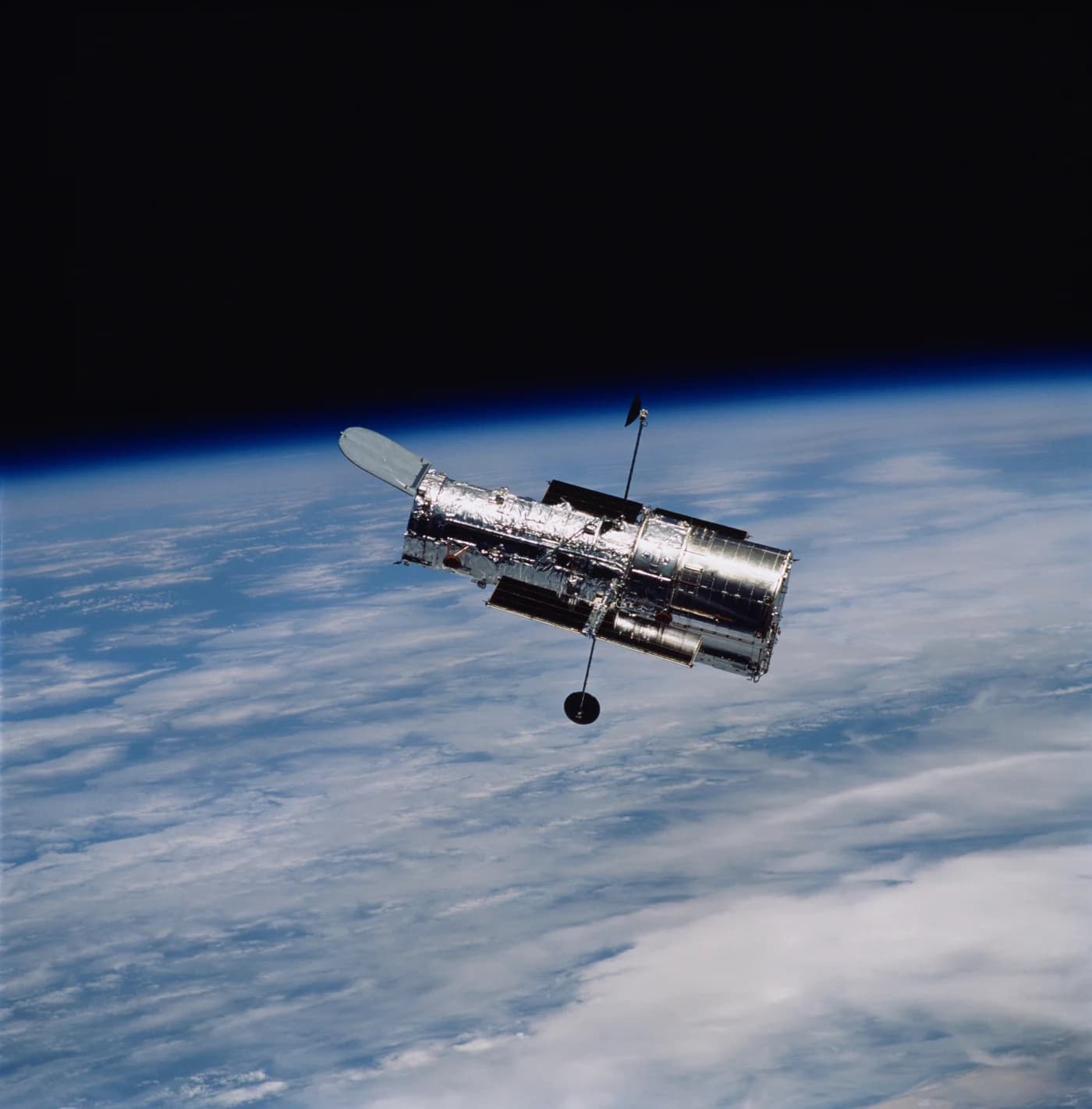
Hubble continues to do science, but its orbit is gradually decaying. On October 30, 2026, NASA announced that it was exploring commercial options to raise the telescope’s orbit, service it or bring its flight to a safe end. This is not yet an approved rescue expedition. Understanding the observatory’s future means separating instrument health, orbital lifetime and decisions about a new mission: those three questions have no single shared end date.
- NASA issued a request for information on October 29. As of November 1, there is no announced contractor, selected spacecraft or approved servicing mission.
- Three options are being considered: raising the orbit to at least 600 kilometers, servicing, and bringing the mission to a safe end. Respondents may address one or more options.
- The projected reentry window without intervention is 2033–2034. This is a probabilistic orbital forecast, not an appointed day for switching off the telescope.
- Raising the orbit does not replace repairs, and one-gyro operation does not mean science has stopped. Each approach to extending the lifetime addresses a different problem.
What NASA announced in October 2026
On October 29, Goddard Space Flight Center published a Request for Information, or RFI, and NASA explained its goals the following day. The agency is gathering information on what commercial companies could do for the working telescope. Responses are due by November 30, 2026. Hubble’s scientific value is given as a reason to explore extending its life, rather than grounds for immediately sending a crew.
The document explicitly states that it is not a request for proposals or a government commitment to commission a flight. NASA wants to understand feasibility, risks, schedules and possible costs. The accurate status is therefore an exploration of options. Claims that repairs have already been scheduled or a rescuer chosen go beyond what has been published as of November 1.
Raise, service or deorbit: three different tasks
The RFI’s first option is a vehicle that can rendezvous with Hubble, capture it and raise its orbit to at least 600 kilometers. The second is servicing to improve performance and resilience to aging. The third is bringing the flight to a safe end, including controlled atmospheric reentry. Companies may describe capabilities for one or more options, rather than necessarily combine everything into a single flight.
These actions are not synonyms for repair. A reboost extends orbital lifetime, but does not itself replace aging electronics. Replacing a component may improve an instrument, but does not stop subsequent orbital decay. Bringing the mission safely to an end does not require pretending the telescope will become young again. Separating the tasks makes each operation’s benefits assessable.
Why the orbit decays even though the telescope is in space
Hubble travels in low Earth orbit, where the extremely thin atmosphere still causes drag. NASA’s overview gives an approximate altitude of 483 kilometers. Unlike mirror diameter, this is not a permanent property: the orbit changes over time. A figure of 540 or 550 kilometers from an older article cannot automatically be presented as today’s altitude.
Drag removes orbital energy, gradually bringing the spacecraft lower. Hubble has no propulsion system to maintain its altitude. Solar arrays supply electricity to its systems, but electrical power does not create an orbital engine that is absent. A reboost requires an external vehicle and a controlled change in the motion of the combined spacecraft.
What 2032 and 2033–2034 actually mean
In its October 30 announcement, NASA identifies 2033–2034 as the likely reentry window without intervention. The RFI provides more detail from a July 2026 analysis: a 10% probability of reentry by September 2032 and 50% by December 2033. These are cumulative probabilities by those dates, not two scheduled dates for a fall.
This leads to the planning horizon of carrying out a possible mission no later than 2032: intervention must be prepared in advance. It does not mean a flight has been approved for that year. Nor does the forecast establish an exact day, reentry location or promised scientific lifetime. The new estimate concerns the orbit under specified conditions, and intervention could change that outcome.
Why scientific and orbital lifetimes differ
A telescope can remain in orbit after useful observations have ended: science requires working instruments, power, communications, pointing and ground support. The opposite engineering challenge is also possible: preserving a working observatory as its orbit becomes too low. The answer to how much longer Hubble will operate therefore depends on which resource is being discussed.
NASA continues to describe Hubble as an active scientific observatory. The RFI notes high demand for observing time and unique capabilities, but gives no guarantee of faultless operation until a particular year. A probabilistic reentry timescale cannot become a warranty for every component. A successful reboost would not stop the other systems from aging either.
One gyro does not mean science has stopped
In June 2024, NASA resumed observations after switching from three gyros in use to one. Gyros measure the telescope’s rotation; together with other sensors, they help determine its orientation. Actuators, including reaction wheels, turn and stabilize the observatory. Neither a rotation measurement nor a reaction wheel provides a way to raise the orbit.
One-gyro mode uses stellar and other sensors to maintain precise pointing at a selected target. The trade-offs are more complex and slower target acquisition, less flexible scheduling and limitations on some fast-moving targets. This changes productivity rather than automatically making every image less sharp. It shows how engineering workarounds can extend science operations without replacing a component in orbit.
When Hubble was last serviced
Astronauts visited the telescope for servicing five times. The last completed expedition was STS-125 in May 2009, known as Servicing Mission 4. The difference between its number and the total count reflects the separate 3A and 3B missions. In 2009, astronauts installed WFC3 and the COS spectrograph, repaired other instruments and replaced systems including batteries and gyros.
A device intended to facilitate eventual deorbiting was also attached to the telescope’s base. Having a prepared interface does not mean a ready-made tug exists. Crewed servicing required specialized tools, procedures and extensive preparation. The new request asks what means commercial companies could use to perform such tasks now.
Why the earlier SpaceX proposal does not mean a flight has been selected
In 2022, NASA and SpaceX did study a proposed Hubble reboost involving the Polaris Program and Dragon. The original announcement described a feasibility study under an unfunded agreement, not an approved NASA mission. The study was nonexclusive: other companies could propose their own approaches.
The October 2026 RFI does not turn that earlier idea into a winning bid. The document allows for a crew if a particular proposal requires one, but names no selected astronauts, spacecraft or rocket. Robotic and crewed approaches require different solutions. Describing either as already scheduled would skip the assessment of capabilities and the agency’s subsequent decisions.
Why retain an older telescope alongside newer ones
Hubble retains valuable ultraviolet and visible-light observations, along with near-infrared capabilities. In the RFI, NASA reports observing requests exceeding available time by more than seven to one. This measures scientific-community demand, not a promise that repairs would multiply discoveries sevenfold. Individual research tasks depend on wavelength coverage, instruments and accumulated observing records.
The arrival of the Roman telescope and James Webb’s work do not make all these capabilities interchangeable. Joint Cepheid measurements, for example, help check distance calibrations relevant to the Hubble tension. Extending the spacecraft’s lifetime is not itself a solution to that cosmological discrepancy. The new document concerns the instrument’s availability for many kinds of research.
Why approaching and pushing is not enough
Even an option without internal repairs requires a safe rendezvous with a large, sensitive observatory. The RFI asks for descriptions of capture, acceptable target rotation rates, control of the combined spacecraft and risk mitigation. Reboost or servicing must not harm Hubble. That is a design requirement, not proof that risks have already been eliminated.
A potential provider must substantiate technological readiness, schedule and cost, while NASA must assess the responses and possible next steps. The next meaningful news will concern that assessment rather than an inevitable rescue-flight date. For now, the reliable answer is that the observatory is working, its orbit needs attention, and intervention options remain under investigation.
Any servicing scenario also faces an orbital constraint: space debris requires attention to conjunction risks and the spacecraft’s eventual disposal. Raising a telescope does not automatically make its continued existence safe indefinitely. A mission plan must address scientific value and a controlled end to operations.
Sources
- NASA — potential commercial servicing, October 30, 2026
- NASA/GSFC on SAM.gov — request 80GSFC27RFIHSTS, October 29, 2026
- NASA — Hubble’s orbit, design and scientific capabilities
- NASA — science resumes with one gyro, June 2024
- NASA — how one-gyro mode works and its limitations
- NASA — the fifth and last completed servicing mission, 2009
- NASA — the 2022 study of a possible reboost with SpaceX
- NASA — joint Hubble and Webb Cepheid check, March 2024
- ESA: space debris questions
Questions and answers
Has Hubble stopped working?
No. In its October 30, 2026 announcement, NASA describes ongoing science and explores ways to extend it. Age and technical limitations do not mean the observatory has already been switched off.
Will Hubble definitely fall in 2033?
That is not an established date. NASA identifies 2033–2034 as the likely reentry window without intervention; the RFI gives probabilities by different dates. A reboost or controlled end of mission would change the scenario.
Has SpaceX been selected for repairs?
No such announcement has been made as of November 1, 2026. The 2022 Dragon feasibility study and the new information request are not a servicing contract. No provider, spacecraft or crew has been named.
Would a reboost make the telescope as good as new?
A reboost would address orbital decay, but would not replace aging instruments and electronics. Servicing is a separate RFI option. Continued scientific operations depend on several systems and decisions.
Does one gyro mean poor images?
Not necessarily. Other sensors help maintain precise pointing in this mode. The main limits concern target acquisition, scheduling and some fast-moving objects, rather than every frame necessarily becoming blurred.