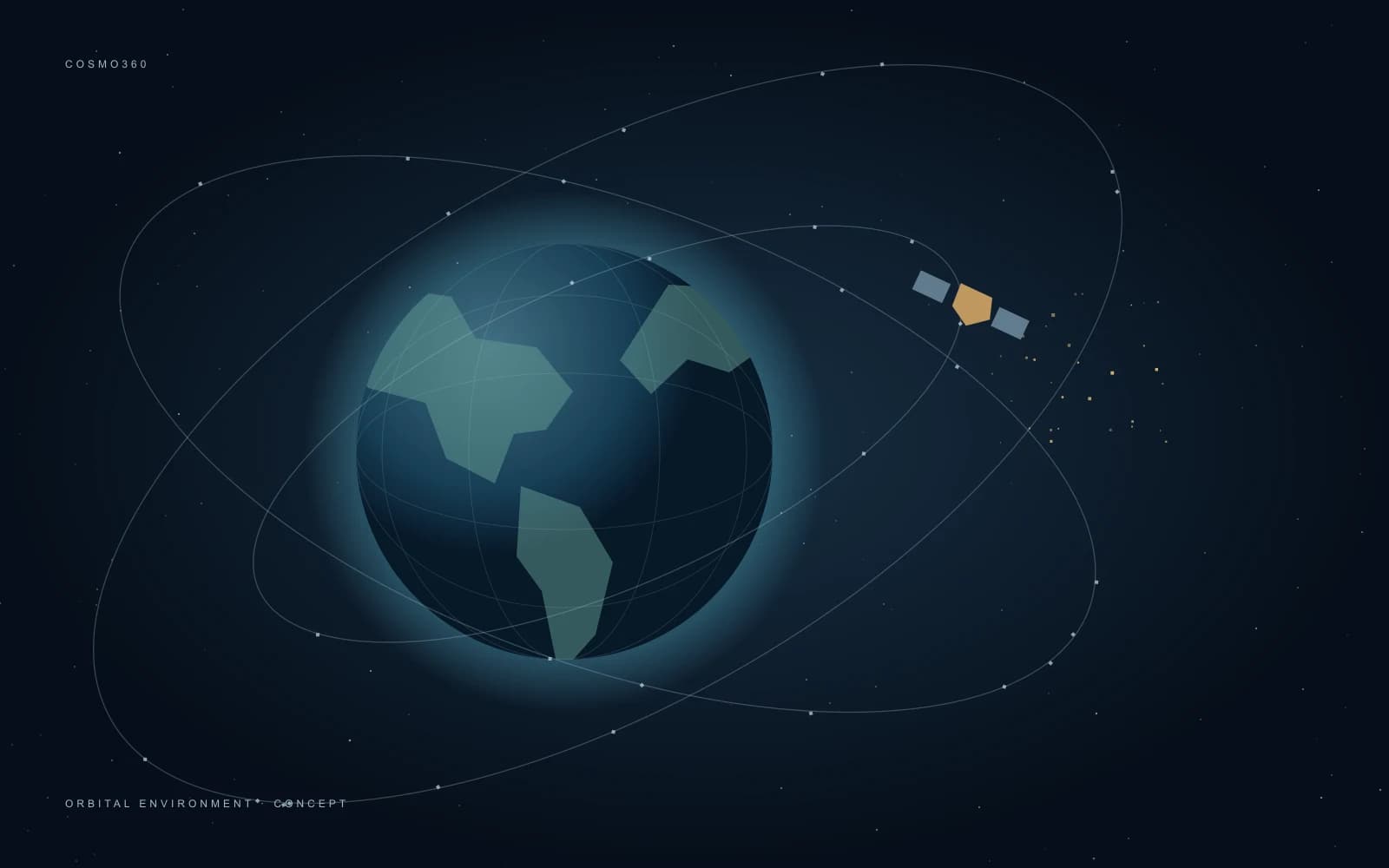
Illustrations often show Earth surrounded by a dense cloud of fragments. The dots are not drawn to scale, but the problem is real: collisions can create fragments faster than the atmosphere removes old ones. ESA’s 2026 report identifies that chain as the main long-term threat. Here is what it means for satellites, crewed flights and future orbital cleanup.
- Space debris consists of non-functional artificial objects and fragments; an operational satellite is not yet debris.
- Kessler syndrome is a collision cascade, rather than an instantaneous explosion of every satellite around Earth.
- Preventing fragments, coordinating spacecraft traffic and removing dangerous old objects are all needed.
What counts as space debris?
A spent rocket stage, a failed satellite and a fragment from a destroyed spacecraft are different examples of the same problem. They no longer perform a useful function but continue orbiting. Naturally occurring meteoroids do not belong to this definition. Protecting against asteroids and cleaning Earth orbit therefore require different approaches, even though headlines sometimes describe both as threats from space.
Size matters, but does not create a simple dividing line between safe and dangerous. Large objects are easier to detect and track; small ones are harder to see, and impact energy rises rapidly with collision speed. Objects on intersecting orbits can meet at many kilometres per second. A fragment that would look harmless on the ground can consequently damage working equipment.
What is new in ESA’s 2026 report?
The 2026 report uses data collected through the end of 2025. Its figures should therefore not be presented as an exact count for the current minute. ESA identifies growing satellite constellations, continuing debris accumulation and insufficiently rapid departures from crowded regions after missions end. Some operating constellations also change altitude substantially, complicating traffic coordination.
For 2025, the report records more than 300 launches and over 4,000 new payloads. On average, more than three intact satellites or rocket bodies re-entered each day, while about ten new payloads were launched daily. These figures concern different categories: simply subtracting all departing debris from all new objects would not produce a complete orbital balance.
How Kessler syndrome works
Imagine a large uncontrolled object colliding with another body. Instead of two targets, many fragments now follow different trajectories. Some cross other satellites’ orbits and can cause further breakups. If fragment production persistently outpaces natural removal, the environment keeps deteriorating even without additional launches. This is the central idea behind the cascade.
There is no single countdown that will suddenly declare all space closed. Risk depends on altitude, orbital inclination, object density and persistence. Some regions can become more hazardous than others. An impenetrable wall around the planet is therefore an inaccurate image: the problem is increasing damage probability and the loss of safe access to particular orbital regions.
Why debris does not fall immediately, and why altitude matters
An orbiting object continuously falls under Earth’s gravity, but its sideways motion lets it keep missing the surface. Faint drag from the upper atmosphere gradually removes energy and lowers the orbit. Atmospheric density depends strongly on altitude and solar activity, so there is no universal deadline by which every fragment will burn up.
The same physics explains orbital decay of the Hubble Space Telescope and routine altitude corrections for crewed stations. Moving a large object higher is not automatically a solution: it may persist longer and occupy another hazardous region. Each spacecraft needs an end-of-life plan accounting for its mass, fuel, control capabilities and the risk to people during re-entry.
Can spacecraft simply dodge every fragment?
Tracking systems help assess conjunctions and plan manoeuvres. Predictions contain uncertainty: an object’s position has a measurement error, and disturbances change its trajectory. Two calculated paths passing near one another do not necessarily imply a collision. Operators must assess probabilities and consequences rather than react to every dramatic image of crossing lines.
Not every hazardous particle can be tracked individually. Statistical models and structural protection address small fragments, while spacecraft can sometimes manoeuvre away from larger known threats. A defunct stage generally cannot respond to a command, and coordinating two active satellites requires sharing data. Growing constellations make this a continuing operational task.
Why one giant net cannot collect everything
Cleanup first requires approaching a particular target and almost matching its motion. Space around Earth is not a single shared road: reaching objects in different orbits requires different amounts of propellant. A giant net left across orbital traffic would itself become a hazard and a source of fragments. Practical projects begin with selected targets and controlled capture operations.
ESA describes ClearSpace-1 as a planned demonstration to remove the inactive Proba-1 satellite, weighing about 95 kg. The target was not equipped for convenient capture and may tumble, requiring the servicing spacecraft to determine its motion precisely. Checking the current target matters: early ClearSpace-1 reports named a different object. At this check, the mission is in preparation, not evidence of an operational mass-cleanup system.
What can be done before launch?
It is easier to plan fuel reserves, reliable disposal and capture features in advance than to chase an unpredictably tumbling body. After a mission, stored energy that might cause an explosion must be addressed: leftover propellants and charged batteries require safe handling. New satellites are also being designed with standard mechanical interfaces and navigation aids to assist future removal vehicles.
Faster departure from low orbits is another part of the solution. ESA requirements specify disposal within five years after mission end where applicable. This belongs to a particular set of rules; it is not a promise that all old fragments will disappear after five years. Prevention limits new debris sources, while dangerous existing objects may need separate removal missions.
Will routes to the Moon and Mars close?
Kessler syndrome does not imply that the next launch must end in disaster. Yet every lunar mission begins near Earth, and communications, navigation and monitoring depend on satellite infrastructure. Starship and other transport plans therefore cannot be separated from orbital environmental quality. Greater payload capacity does not automatically provide protection against a high-speed fragment.
The practical goal is to preserve reliable space operations for decades. That calls for better observations, coordinated manoeuvres, dependable disposal and proven methods for removing large hazardous targets. ESA’s report does not set a date for “space closing”, but shows why delay is costly: preventing one breakup avoids having to deal with an entire new cloud of objects.
Sources
- ESA: space debris frequently asked questions
- ESA: Space Environment Report 2026
- ESA: active debris removal, ClearSpace-1 and CAT
Image
Questions and answers
Has Kessler syndrome already started?
ESA identifies self-sustaining fragment growth in long-term models. This is not one instantaneous event affecting every orbit; risks need to be assessed for particular regions and scenarios.
Can space debris be seen from the ground?
Some large objects can be observed as moving points. Most small particles are invisible to the unaided eye. Dots on orbital diagrams are usually enlarged and do not show true scale.
Why not stop launches and wait for cleanup?
Waiting does not remove every source: collisions between existing objects can keep generating fragments, and natural decay times vary widely. ESA therefore treats active removal as part of the solution.