On September 28, 2026, Starship entered Earth orbit for the first time and delivered 26 Starlink V3 satellites. SpaceX reported this outcome from its 14th test flight. The next major tasks include developing the complete reuse cycle, transferring propellant between spacecraft and testing the Starship HLS lunar variant. A Mars flight will require an even more complex sequence of operations.
- On Flight 14, Starship deployed satellites, deorbited and splashed down in the Pacific.
- The system consists of the Super Heavy booster and the Starship upper stage and spacecraft.
- Lunar expeditions are planned to use dedicated tanker vehicles and an orbital propellant depot.
- NASA’s target year for a lunar landing is 2028; readiness will determine the first lander provider.
What is Starship: a rocket, a spacecraft or both?
The name Starship has two meanings. It refers to SpaceX’s entire two-stage transportation system and to its upper stage, the spacecraft itself. At launch, the Super Heavy booster sits underneath. It performs the first part of the acceleration, then separates while the spacecraft continues using its own engines.
This distinction matters when reading reports about a return. Landing the booster demonstrates one capability; returning the spacecraft from orbit demonstrates another. The upper stage enters the atmosphere after travelling much faster and follows its own braking sequence. A report that “Starship returned” is more useful when it identifies which part, where it came from and how it returned.
What happened during Flight 14?
The launch took place on September 28, 2026, from Starbase in Texas. According to SpaceX’s report, one engine on the booster and one on the spacecraft shut down prematurely during ascent. The upper stage compensated for lost thrust by running its remaining engines longer, then entered orbit with a separate burn. All 26 Starlink V3 satellites were deployed, and contact was established with each one.
Because of the engine problem, the team shortened the spacecraft’s time in orbit. Starship performed a deorbit burn, re-entered the atmosphere and splashed down in a prepared area of the northern Pacific Ocean. Orbital payload delivery was achieved during this test, while engine issues still required attention. Both outcomes matter when assessing the programme’s next step.
Why reaching space and reaching orbit are different
A vehicle can climb very high and soon fall back. To remain in orbit, it needs sufficient speed along Earth’s surface: it keeps falling, but the planet’s curvature leaves the surface below its trajectory. Altitude alone cannot provide that condition. A striking view of Earth through a window therefore does not prove that a flight is orbital.
Flight 14 illustrates the difference through its sequence of manoeuvres. The spacecraft first followed a suborbital path designed to return without spending a prolonged period circling Earth. After the team checked its systems, an additional engine burn placed it in orbit. Another burn was then needed to leave orbit. These are separate flight-control stages, even if a livestream viewer sees only a few brief engine firings.
Orbital flight also requires accounting for space debris: high payload capacity does not replace conjunction assessment and a safe end-of-mission plan. Defunct objects and new constellations share near-Earth regions, so increasing launch activity needs coordination and reliable removal of spacecraft from their operational orbits.
Why return both stages?
The idea behind Starship is to use expensive flight hardware repeatedly. In a conventional expendable launch, an exhausted stage takes its engines, tanks, electronics and structure with it. Returning the stage preserves the possibility of preparing them for another launch. Between landing and the next flight, however, there is servicing: inspection, diagnostics, replacement of worn components and refuelling.
Practical reusability is therefore assessed across the entire cycle. The vehicle must return in suitable condition, regain flight readiness within a reasonable time and launch again with a payload. An impressive individual manoeuvre is an important step, but transportation costs also depend on flight frequency, equipment lifetime and ground operations. Proposed savings become measurable as experience with that cycle accumulates.
Why does such a large rocket need orbital refuelling?
The spacecraft spends a substantial portion of its propellant reaching Earth orbit. Further acceleration, braking near the destination, landing and take-off require fuel and oxidiser again. Simply loading more before launch cannot solve the problem: those extra supplies also have mass that must be lifted. Orbital refuelling divides the payload and propellant among multiple launches.
In SpaceX’s lunar concept, several Starship tankers deliver propellant to an orbital depot, which then supplies the lunar spacecraft. One expedition consequently depends on a whole transportation chain: launches, rendezvous, docking, liquid transfer and storage until the propellant is needed. The exact number of tanker flights depends on vehicle performance and the mission plan; there is no universal count for every expedition.
What propellant operations have been tested?
The NASA TechPort project record describes a demonstration that moved more than three tonnes of liquid oxygen between tanks inside a single Starship. This experiment helps investigate liquid behaviour in flight. It is not equivalent to transferring supplies between two independent spacecraft through a docking connection, an operation involving additional vehicles and equipment.
In weightlessness, liquid does not collect at the bottom of a tank as it does on Earth. Engineers must manage its position, pressure and temperature while accounting for vapour and incoming heat. Limiting propellant losses is important for prolonged storage. These challenges explain why an orbital filling station needs its own test programme, even if a diagram makes it look like a simple hose between two vehicles.
How Starship is intended to support a lunar return
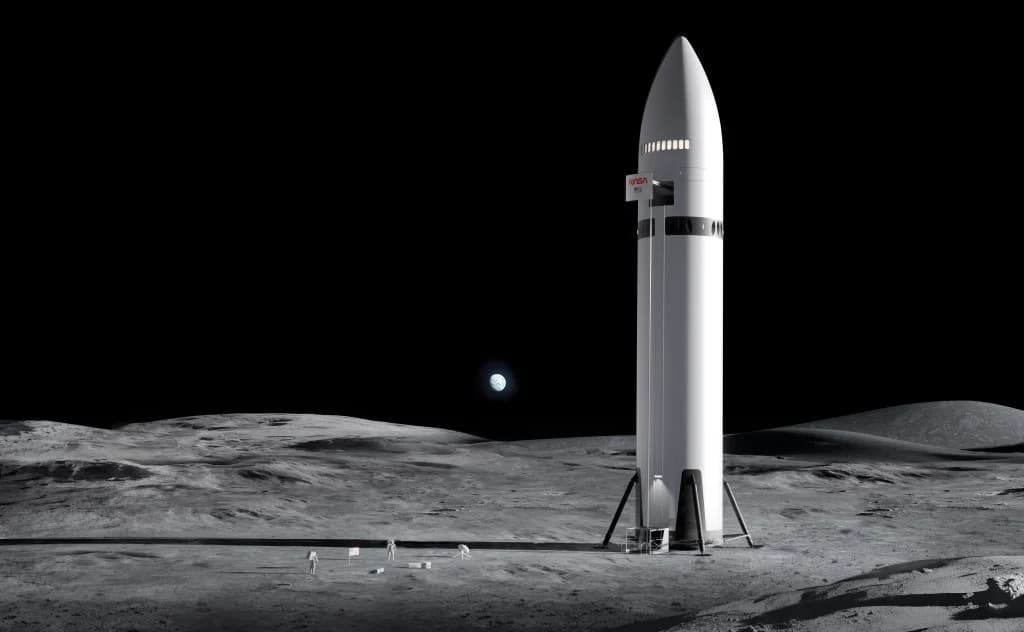
The lunar variant is called Starship HLS, or Human Landing System. Under NASA’s architecture updated on October 23, 2026, the refuelled vehicle meets Orion near Earth, then sends both docked spacecraft towards the Moon. The crew arrives aboard Orion; two astronauts descend to the surface in the lunar lander. Orion is used to return the astronauts to Earth.
Demonstration stages must precede a landing, including joint tests with Orion during Artemis III. NASA is also developing a lunar landing system with Blue Origin. Starship’s success in Earth orbit therefore does not by itself determine which vehicle will make the first new landing. The readiness of the landing variant is established through its own test programme.
When will Starship fly to Mars?
On its Starship page, SpaceX gives no earlier than 2028 as the start of cargo flights to the Martian surface. This is a development and service-planning target, not a confirmed launch date for a crewed expedition. An interplanetary mission requires coordinated launch, cruise, communications and landing operations. Mars has a thin atmosphere: it affects descent without making it a repeat of the procedure used on Earth.
Sending an uncrewed spacecraft, delivering useful cargo, mounting a crewed expedition and establishing a permanent settlement are different milestones. Each adds requirements. People need reliable life support, protection, energy and a return plan. Success around Earth tests only part of that system. A date in a statement of ambition should therefore be considered alongside the tests already completed and the problems still awaiting solutions.
Which results should you watch for in future launches?
The first question is what objective was announced for the specific test. It might concern engines, satellite deployment, heat shielding, recovery or propellant operations. Knowing the objective in advance makes the outcome easier to interpret: what data were collected, which operations were completed and what needs further development. The launch itself says little about completion of the whole programme.
The second question is whether the vehicle moved closer to repeatable operations. Sequences of results are useful here: how much payload was delivered, how the return went, what condition the hardware was in and whether it flew again. Lunar testing and refuelling deserve separate attention. Together, these capabilities show the progression from an experimental vehicle to a system that a complex expedition can depend on.
Where to watch Starship launches and check postponements
SpaceX’s official flight page combines a mission description with a livestream link. Before watching, check the flight number, calendar date and time zone. The advertised time often refers to a launch window: departure may shift within it or move to another day after checks of the hardware and launch-site conditions.
After the flight, use the published outcome rather than relying solely on a preflight minute-by-minute schedule. During a test, the sequence and duration of operations can change. That happened on Flight 14, when the team shortened the orbital phase. A planned event time and an actual result answer different questions, even when they appear on the same page.
Sources
- SpaceX — Starship Flight 14, results from September 28, 2026
- SpaceX — Starship design and cargo mission plans
- NASA — revised lunar lander plans, October 23, 2026
- NASA TechPort — cryogenic propellant transfer demonstration inside Starship
- NASA — Artemis III joint spacecraft tests
- NASA — European Service Module, Orion propulsion and life support
- NASA — Mars Facts, atmosphere and surface conditions
- NASA — five hazards of human deep-space expeditions
- ESA: Space Environment Report 2026
Image
Questions and answers
Has Starship reached orbit?
Yes. SpaceX reported its first orbital flight on September 28, 2026, with the deployment of 26 Starlink V3 satellites.
How does Starship differ from Super Heavy?
Super Heavy is the lower stage that accelerates the system early in flight. Starship is the upper stage and spacecraft; the same name is also used for the complete system.
Was Starship Flight 14 successful?
It achieved an important objective by deploying satellites into orbit. Engines also shut down, and the time in orbit was shortened. Its outcome includes both completed tasks and identified problems.
Does transfer inside a spacecraft prove orbital refuelling is ready?
No. Moving liquid between a vehicle’s own tanks and transferring it between two spacecraft are different operations. The complete transportation architecture requires both processes to be tested.
Will Starship necessarily be first to return people to the Moon?
NASA ties selection of the first lunar lander to system readiness. SpaceX participates alongside Blue Origin; an orbital launch does not settle that choice.
When will Starship fly to Mars?
SpaceX gives no earlier than 2028 for cargo missions to the Martian surface. This is a planning target, not a date for the first human departure to Mars.