2 November 2026 marks 26 years of continuous human presence aboard the ISS. The station nevertheless has a finite service life: on 28 October, the head of Roscosmos named 2031–2032 as a possible disposal timeframe. This is not an appointed crash date. Ending research, returning the crew and deorbiting the enormous complex in a controlled way are separate stages requiring preparation.
- 2031–2032 is a stated possible timeframe; an exact date for the final manoeuvre has not been announced.
- NASA is preparing a dedicated deorbit vehicle whose development it contracted to SpaceX.
- Much of the structure will break up in the atmosphere, but some fragments may reach a remote ocean region.
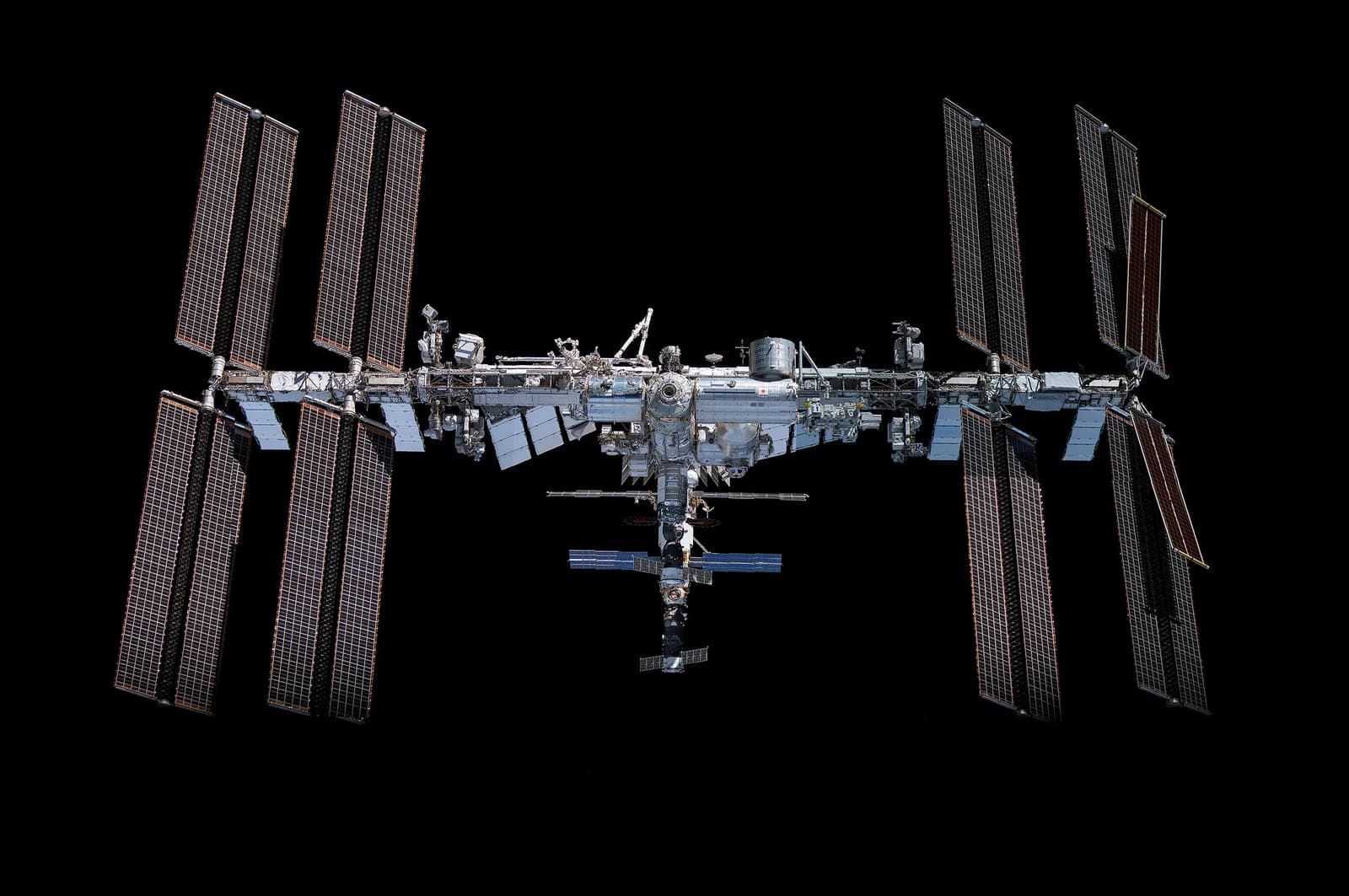
Why different years appear in ISS disposal plans
According to TASS on 28 October 2026, Dmitry Bakanov said disposal could take place in 2031 or 2032 following a shift in the end of operations to 2030. The report also mentioned discussions with partners about extending operations. Negotiations and possible dates should not be turned into a confirmed timetable: different participants may be discussing different stages of the programme’s conclusion.
NASA’s plan calls for station operations through 2030 and a transition to commercial destinations in low Earth orbit. Preparing the trajectory can take time after the final year of routine research. Headlines about “operating through 2030” and “disposal in 2031–2032” are therefore not inherently contradictory. Any schedule update should be checked against the date and status of the original statement.
Why replacing failed components cannot continue indefinitely
A computer or pump can be replaced, but the station is more than a collection of removable devices. Its life is also limited by load-bearing structures, pressurised modules, trusses and radiators. These experience thermal cycles and loads from dockings and manoeuvres. New electronics do not renew an old structural frame; an extension requires engineering assessments as well as political decisions.
Age alone does not mean the crew faces an imminent unavoidable accident. Systems are monitored, faults repaired and operating limits reviewed. Planning the end is intended to preserve control through the final stage. Deciding the fate of a huge complex becomes much harder after it loses essential attitude-control, communications or propulsion capabilities.
Why the station cannot simply be switched off
At roughly 400 km, the atmosphere is extremely thin but still affects motion. Without reboosts, the station gradually loses altitude. The rate depends partly on solar activity and the state of the upper atmosphere. “Leaving it in orbit” would not create a stationary museum; it would leave a massive object subject to processes that cannot be precisely targeted without control.
Raising the complex much higher is difficult too: it requires thrust and propellant, while control and access by transport vehicles remain concerns. Some higher regions also have greater hazards from space debris and slower natural clearance. NASA compared these options with controlled re-entry and favoured the latter. A longer-lasting orbit does not necessarily mean a longer period of safe station operations.
What role does the SpaceX vehicle play?
In June 2024, NASA selected SpaceX to develop and deliver the U.S. Deorbit Vehicle. The announced contract has a maximum potential value of $843 million, with launch services to be procured separately. NASA will own and operate the vehicle after development. Describing the operation as “Musk sinking the station” therefore oversimplifies the responsibilities of companies and space agencies.
This is a distinct task, separate from Starship tests or routine crew transport. The crucial capabilities are controlling the large complex and providing adequate margin for a safe final manoeuvre. NASA also emphasises the international partners’ shared responsibility: the ISS was designed as an interdependent system. A dedicated vehicle does not remove the need to coordinate the Russian and U.S. segments during preparation.
How the station will be directed towards the ocean
Deorbiting is not a vertical fall triggered by a switch. Natural drag and controlled orbital lowering are followed by adjustments to the ground track and debris footprint. Everyone must return to Earth before the final stage. The last braking burn directs the complex into a selected entry corridor rather than allowing atmospheric entry at a random location.
The target is a remote, uninhabited ocean region. The popular phrase “sinking it at Point Nemo” does not mean the entire station will hit one geographical point intact. The structure will break up, producing an extended possible debris footprint. The engineering task is to control that region and reduce risks to people, shipping and aviation.
Why the station will not simply disappear
NASA expects solar arrays and radiators to separate first, followed by separation of modules and truss sections, and then fragmentation of those large elements. Much of the hardware should burn or vaporise during intense heating. Dense or heat-resistant components can nevertheless survive. A controlled impact region is therefore necessary even though the station will not reach the water intact.
Returning the entire complex as a museum is not a simple disassembly job. Large modules were not designed for easy removal and landing, and assembly required many flights and spacewalks. Smaller historical items can be preserved, but returning the whole structure would require a separate transport and assembly programme.
What comes after the ISS?
NASA intends to purchase services on commercial orbital stations and retain access to microgravity research. Successor projects have different designs and schedules. An announced plan, a tested module and a station ready for long-term habitation represent different levels of readiness. Attractive renderings alone do not guarantee an uninterrupted transition.
The Artemis lunar programme serves a different purpose and does not replace every capability of low Earth orbit. Working near Earth allows hardware testing and long-duration human research with comparatively accessible resupply. Ending the ISS era therefore means changing the platform and operating model rather than ending human spaceflight.
What today’s anniversary represents
The first resident crew reached the ISS on 2 November 2000: William Shepherd, Yuri Gidzenko and Sergei Krikalev began an unbroken succession of expeditions. By 2 November 2026, 26 years have passed. This differs from the start of assembly in 1998, explaining why ISS history is measured both by structural age and by the duration of continuous habitation.
The most useful milestones are an agreed operating horizon, readiness of the deorbit vehicle and successor-station test results. An exact final-burn date will belong to an approved operational plan. For now, the possible 2031–2032 timeframe should be distinguished from a promise that the entire programme will end then under an unchanged sequence.
Sources
- TASS: statement on the possible 2031–2032 timeframe, 28 October 2026
- NASA: ISS transition plan and engineering FAQs
- NASA: selection of SpaceX for the U.S. Deorbit Vehicle
- NASA: arrival of the first resident crew
Image
Questions and answers
What is the exact ISS disposal date?
An exact date has not been announced. The 28 October 2026 statement gave a possible 2031–2032 timeframe; final timing depends on partner decisions and operational readiness.
Will people remain aboard during re-entry?
No. NASA’s plan calls for the entire crew to return before the final controlled deorbit stage. This is not a crewed descent in a landing capsule.
Why not send the ISS to the Moon?
The ISS was designed for low Earth orbit. A journey to the Moon would require different propulsion, protection and operating arrangements; preservation by that route is not the selected plan.