A geomagnetic storm is a reconfiguration of near-Earth plasma, fields and electric currents after enhanced energy input from the solar wind. An auroral display is only one of its manifestations. On October 29, 2026, a new analysis of paired TRACERS observations was published, helping distinguish whether the Sun–Earth connection varies from place to place or over time. Here is the physics of that connection and three different ways a storm affects technology.
- Major storms develop when solar-wind energy is transferred efficiently into the magnetosphere. The flow’s speed and density matter, as does the direction of the magnetic field it carries.
- The TRACERS study uses 207 paired polar-cusp encounters from November 2025 through February 2026. This is an observational sample, not 207 separate geomagnetic storms.
- Spatial variability dominated temporal variability under the conditions studied. Temporal changes were also found within spatial structures, however, and the conclusions remain preliminary.
- GNSS errors, increased satellite drag and currents in long power lines have different physical mechanisms. A single overall activity rating does not imply the same damage to every system.
What is actually disturbed during a geomagnetic storm?
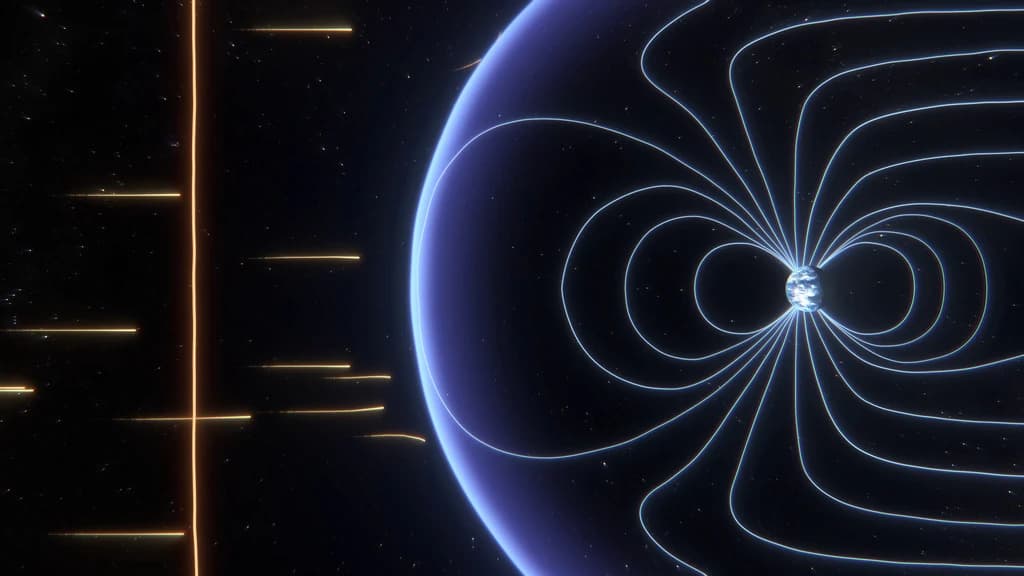
The magnetosphere is the region around Earth dominated by its magnetic field. It contains tenuous plasma: charged particles that move, produce currents and interact with fields. A storm changes the state of this connected system. A ground-based magnetometer registers the result as a field deviation, but the event is not confined to a magnetic needle at the surface; it involves a vast region around our planet.
The solar wind acts continuously, whereas a major storm requires particularly efficient energy exchange. Large events are often associated with coronal mass ejections. Fast streams from coronal holes and regions where they interact with slower wind can also cause disturbances. A storm therefore cannot simply be defined as a flare reaching Earth: the plasma’s properties and the magnetosphere’s response must be considered.
Why the magnetic shield is not a solid wall
The solar wind compresses the magnetosphere on the dayside and stretches it into a long nightside tail. Its boundary with the surrounding plasma is called the magnetopause. Its location depends on the flow’s pressure and the magnetic field’s state. This is a moving physical boundary, not a solid shell with a fixed radius. The magnetosphere’s protective role coexists with continual transfer of energy, matter and momentum across it.
Magnetic reconnection is one of the main transfer mechanisms. As field configurations change, previously separate plasma regions acquire a new magnetic connection. Field energy can become particle motion and heat. Diagrams depict this as field lines breaking and reconnecting. The lines represent field geometry; the physical process is investigated through particle, electric-field and magnetic-field measurements.
At planets with magnetospheres, the bow shock can be studied separately from the magnetopause. At Jupiter, the Juno spacecraft found that plasma signals at shock crossings differ with magnetic field orientation. Two passes showed how the transition encountered by the solar wind on its approach to the planet can vary.
Why field direction matters alongside speed
The solar wind carries the interplanetary magnetic field. A sustained southward orientation on Earth’s dayside often facilitates energy transfer into the magnetosphere. Two flows with similar speeds can therefore produce different responses. Density and speed determine dynamic pressure, while the fields’ relative orientation affects magnetic coupling. Duration and changing conditions also matter for the development of a major event.
The system’s response includes currents at the magnetopause, in the tail, around Earth and in the ionosphere, the ionized part of the upper atmosphere. Their fields combine with Earth’s main field. Strengthening of the ring current, for example, helps explain the characteristic reduction of the horizontal field component during a storm. Bright northern lights reveal energy transfer into the atmosphere, but do not measure all magnetospheric energy or currents.
What the polar cusps can reveal
Near the magnetic poles are regions with funnel-shaped field geometry, called polar cusps. Open magnetic connections allow particles of solar origin to reach the upper atmosphere. Their energy distributions carry information about processes that occurred much farther away at the magnetopause. A cusp is therefore a useful place to record reconnection’s consequences without repeatedly traveling directly to the distant reconnection region.
Step-like structures occur in the ions’ energy distributions. A single spacecraft passes through them and records signal changes without immediately knowing their cause. It may have crossed neighboring, persistent regions with different properties, or the system itself may have changed during the passage. This mixing of space and time complicates interpretation of an individual measurement set and is central to TRACERS.
Why TRACERS needs two satellites
The mission’s two spacecraft launched on July 23, 2025, and fly in low Earth orbit. They pass through the region of interest one after the other. Repeated measurements allow the positions and properties of similar structures to be compared over a short interval. Two instruments alone are not enough: known trajectories, spacecraft attitudes, solar-wind conditions and plasma motion matter too.
The new study primarily uses the Analyzer for Cusp Ions, ACI, on both satellites. Additional electron measurements help locate the region’s boundary, while electric-field measurements check structural motion where accuracy permits. The spacecraft do not photograph an invisible hole in the shield; they measure particle signatures and compare them with models of magnetic geometry and external conditions.
What the 207 paired observations showed
On October 29, 2026, the Journal of Geophysical Research: Space Physics published a study by Stephen Fuselier and colleagues. It examines 207 paired cusp encounters from November 2025 through February 2026. The authors classified 129 as predominantly consistent with spatial variability of reconnection, 48 with temporal variability, and 30 as ambiguous. These are not counts of separate storms.
Spatial differences dominated in the groups of interplanetary field directions and dynamic-pressure ranges examined. Yet almost all cases classified as spatial also contained temporal changes within larger structures. It would therefore be wrong to conclude that reconnection never changes over time. The result concerns one type of variability dominating in the chosen diagnostic and needs further verification.
Why the first results cannot be extended to every storm
Observations proved more difficult than originally planned. After launch, one satellite developed a serious battery charge-storage problem, restricting its measurements to the sunlit portion of the orbit. The study uses paired southern-cusp encounters, and the conditions under which that cusp is encountered are unevenly distributed. This is not a random, uniform sample of every magnetospheric state.
NASA’s October 29 report describes routine southern-cusp observations and a prime-mission extension into spring 2027, approved in September. Further data should refine the conclusions. The study does not yet provide a universal formula for storm strength, onset time or loading of a particular transformer. An entire chain of processes lies between reconnection physics and effects on technology.
How a storm increases satellite drag
Very tenuous gas remains even in low Earth orbit. Atmospheric drag gradually removes a satellite’s orbital energy. During geomagnetic disturbances, the upper atmosphere receives additional energy, heats up and changes its density distribution. More gas may then be present at a spacecraft’s altitude, increasing drag. This is a mechanical consequence of a changed atmosphere.
The effect depends on altitude, spacecraft shape and mass, attitude, and the ability to adjust its orbit. Changed trajectories must be recalculated for active satellites and debris alike to assess close approaches. This mechanism cannot automatically be assigned to every distant probe: low Earth orbit differs greatly from interplanetary space. Surface charging and radiation damage also exist, but are different mechanisms of impact.
Where currents in power grids come from
On the ground, rapid magnetic-field changes and the associated geoelectric field matter. Geomagnetically induced currents, or GICs, develop in extended conducting systems. Their paths depend not only on power lines but also on ground conductivity and the network’s overall configuration. They are not a stream of solar particles arriving directly in a copper wire.
A slowly varying current component can push a power transformer outside its design regime: its core saturates, increasing heating, waveform distortion and reactive-power demand. Protection trips and voltage-stability problems may follow. Risk differs between networks and operating loads. A major disturbance does not imply identical failure of every electrical device at every outlet.
Why radio disruption does not always mean a geomagnetic storm
A solar flare increases electromagnetic radiation. X-ray and ultraviolet photons can rapidly alter ionization on Earth’s dayside and cause absorption of high-frequency radio signals. This differs from a geomagnetic storm driven by energy input from the solar wind. Radio disruption during a flare does not establish that the magnetosphere is already undergoing a major storm.
Space-weather reports therefore need to identify the phenomenon and measured quantity. Has the X-ray flux changed, has a solar-wind disturbance arrived, have ground magnetic variations intensified, or has radio propagation deteriorated? These events may be related, but their physical pathways and timing differ. A single dramatic headline about a solar strike conceals those distinctions.
What TRACERS adds to our understanding of future storms
A physical result and an operational forecast address different tasks. Assessing impacts requires tracing the path from solar-wind conditions through the magnetopause and current systems to the ionosphere, atmosphere and ground infrastructure. TRACERS refines one important link: how magnetic coupling varies on small scales and what cusp particles can reveal about it. Other spacecraft and ground observatories add to that picture.
The October analysis is valuable because it asks a testable question about space and time. It can be compared with a new sample, reanalyzed and refined by revisiting ambiguous classifications. That is a more reliable route toward space-weather models than treating every conspicuous flare as a warning of the same catastrophe. As of November 1, 2026, the published outcome is a preliminary scientific result, not a promise to forecast every subsequent storm precisely.
Observations near Earth are complemented by measurements near the source: Parker Solar Probe studies the corona before the wind crosses interplanetary space. Combining these data helps separate the original flow’s properties from changes accumulated along the way. They are different observing points within one system, rather than interchangeable forecasts for a particular city.
Sources
- NASA — the first TRACERS results, October 29, 2026
- JGR: Space Physics — analysis of 207 polar-cusp encounters
- NOAA — the causes and physics of geomagnetic storms
- NOAA — the structure of Earth’s magnetosphere
- NASA — the magnetosphere, reconnection and the MMS mission
- NOAA — space weather and satellite navigation
- NOAA — atmospheric heating and satellite drag
- NOAA — induced currents and electric power grids
- NOAA — solar flares and radio blackouts
- NASA — why TRACERS measures the polar cusps
- NASA SVS — the official TRACERS animation and credits
- NASA: Parker Solar Probe, September 2026
- Nature Communications: Joseph et al., observations at Jupiter’s bow shock
Questions and answers
What is a geomagnetic storm in simple terms?
It is a major disturbance of Earth’s magnetosphere when solar-wind energy is transferred efficiently into it. Plasma, fields and currents change, with effects measured in space and on the ground. Auroras are one possible manifestation.
Does every solar flare cause a geomagnetic storm?
No. A flare describes an outburst of radiation, while a geomagnetic storm depends on the solar wind interacting with the magnetosphere. The arriving flow’s direction, properties and duration matter, including its magnetic-field orientation.
Can TRACERS now predict storms precisely?
No. The October 29, 2026, study investigates spatial and temporal variability of reconnection using 207 paired cusp encounters. It is a preliminary physical diagnostic, not a ready forecast of storm strength and timing at a particular location.
Why can navigation be wrong during a storm even if the satellite works?
The signal passes through a changed ionosphere. Errors in accounting for electrons and irregularities in the medium affect radio propagation and can disrupt signal tracking. This need not indicate a fault in the spacecraft or receiver.
Must a major storm switch off all electronics?
No. Effects depend on the system: long power grids are sensitive to induced currents, low-orbit satellites to changed atmospheric drag, and navigation to the ionosphere. Overall disturbance intensity does not dictate the same outcome for every device.