Mercury capture is weeks away: BepiColombo has already parted with its transfer module but has not yet become a satellite of the planet. Here is the schedule as of 30 October 2026, the reason for the long deceleration and the measurements that require two orbiters at one world.
- Under ESA’s current schedule, the joined MPO and Mio spacecraft should enter Mercury orbit on 21 November 2026. This is a future operation, not an arrival already confirmed.
- The MTM transfer module successfully separated on 3 September. The science orbiters are scheduled to part on 9–10 December, with the main science program beginning in April 2027.
- Eight years are needed to reshape the orbit around the Sun and approach Mercury with a suitable relative velocity. Nine gravity assists and electric propulsion saved propellant; a power problem added a delay.
- Polar ice, a partly liquid core and a magnetic field were studied before BepiColombo. The new mission should refine their properties and connections, rather than establish each of them for the first time.
What has happened by 30 October 2026
BepiColombo is a joint ESA–JAXA mission launched on 20 October 2018. Its “arrival” spans several stages. The first is complete: on 3 September 2026, the Mercury Transfer Module, or MTM, separated from the stack. It supplied electric propulsion and power during the interplanetary journey. The European Mercury Planetary Orbiter, MPO, now supports the science spacecraft that remain joined together. Japan’s Mio still sits above it inside a protective sunshield.
On 24 September, MPO tested its axial thrusters for the first time in the new configuration: an 8-minute, 42-second firing changed the stack’s velocity by 11.4 m/s. This was a trajectory correction, not orbit insertion. As of this article’s date, the next major milestone is Mercury capture on 21 November. After its September separation, MTM remained in orbit around the Sun; it no longer travels attached to the research spacecraft. Old illustrations of the complete stack show an earlier configuration.
Why November arrival does not mean immediate science operations
On 21 November 2026, MPO and Mio are scheduled to enter a shared polar orbit around Mercury. In this configuration, they will not yet operate as two independent satellites. Mio is scheduled for release into its final elongated orbit on 9–10 December. MPO must then discard the no-longer-needed MOSIF sunshield and use a series of maneuvers to reach its own lower orbit. Current ESA updates place completion of this transition in March 2027.
The main science program should begin in April 2027, after spacecraft and instrument commissioning. Deployments, calibrations and observation setup come first. Here, “captured by the planet,” “in its operational orbit” and “making regular measurements” are months apart. A November success will therefore not immediately deliver completed new composition maps of the whole planet. Exact operational dates may change: ESA’s latest updates are more useful for tracking the schedule than an animation produced before the mission was delayed.
Why the innermost planet is so hard to reach
Distance on a picture of the Solar System does not determine an expedition’s duration. After launch, a spacecraft retains much of Earth’s orbital motion around the Sun. Moving inward from Earth’s orbit requires a reduction in orbital energy. As it falls farther toward the Sun, its speed rises again, while remaining near small Mercury requires a suitable velocity relative to the planet itself. Passing close by and staying in a working orbit for months are different navigation problems.
BepiColombo gradually reshaped its solar orbit with nine gravity assists: one at Earth, two at Venus and six at Mercury. During a flyby, a planet changes the spacecraft’s direction and velocity relative to the Sun. The chosen geometry can remove orbital energy that engines would otherwise have to remove. Months or years between encounters allow the spacecraft and planet to return to the required positions. The long route saves propellant and makes it possible to deliver a substantial science payload.
What ion propulsion and the 2024 problem changed
The MTM transfer module used solar electric propulsion: solar-array energy helped turn xenon into plasma and accelerate the expelled particles. The thrust is small, but it can act for days or weeks while using propellant efficiently. It complemented the planetary flybys. The science orbiter MPO has a separate chemical propulsion system for the next corrections and orbital changes; shutting down the electric system did not leave the mission without maneuvering capability.
Part of the journey’s duration does come from a technical delay. In April 2024, a problem reduced the power available to the electric thrusters. ESA identified unexpected currents between MTM’s solar array and its power-distribution unit. Instead of the previous December 2025 arrival, specialists designed a lower-thrust trajectory arriving in November 2026. Electric propulsion was switched off on 15 June 2026 after completing its task. The eight-year journey therefore combines a deliberately efficient route with an additional delay caused by the fault.
Why Mercury needs two research orbiters at once
MPO should follow a polar orbit about 480–1,500 km above the surface, with a period of roughly 2.3 hours. Its eleven experiments address the surface, composition, topography, interior and surrounding environment. Mio, carrying five experiments, will have a much more elongated polar orbit: approximately 590–11,640 km and 9.3 hours per revolution. This will take it through different magnetospheric regions to measure fields, plasma, energetic particles, sodium and dust.
Different orbits do more than increase coverage. A single passing spacecraft cannot always tell whether its environment changed with time or whether it simply crossed a spatial boundary. Simultaneous observations from two locations help distinguish these causes. A magnetic-field measurement near the surface can be compared with conditions in the outer magnetosphere, and particle changes with the exosphere’s response. This is a key additional capability of BepiColombo compared with the single MESSENGER spacecraft, which orbited Mercury in 2011–2015.
How the spacecraft handle heat and why some instruments had to wait
Near Mercury, solar arrays cannot simply face the Sun continuously for maximum power: overheating would damage them. Array orientation, insulation and a radiator are therefore part of the science strategy. After release, Mio will stabilize itself by spinning at about 15 revolutions per minute, spreading heating around its sides. It could not spin while attached during cruise, so the MOSIF sunshield protected it. Separation changes not only the spacecraft arrangement but also the way they manage heat.
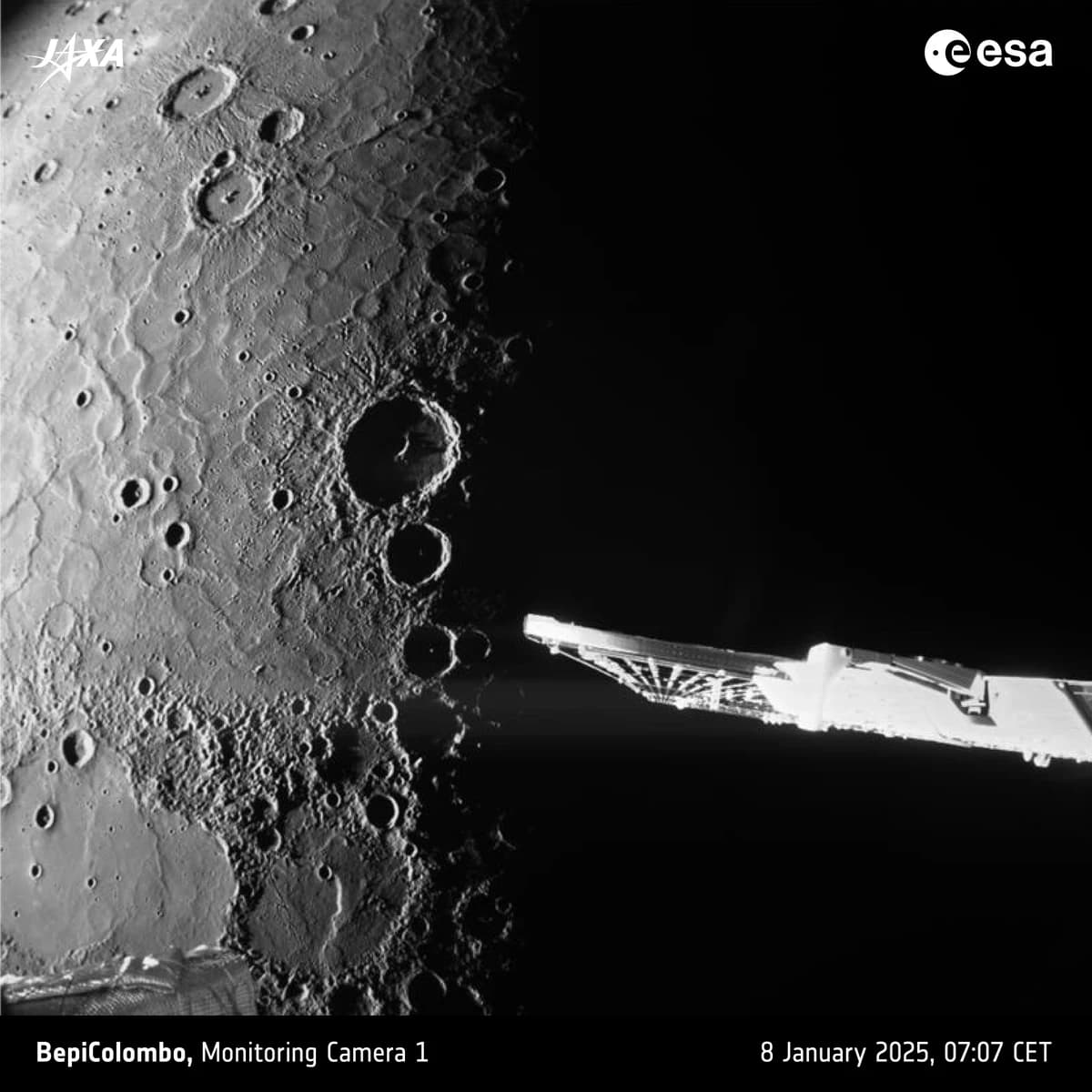
In the stacked cruise configuration, structures blocked some instruments’ fields of view. For example, the main surface-imaging system could not yet operate as it should on the independent MPO. Magnetometers and some particle detectors, however, already collected data during flybys. Public images of Mercury often came from small engineering cameras on MTM. A striking image therefore does not mean that the whole future orbital laboratory has completed its measurements or that the image came from its main mapping instrument.
What BepiColombo will test about water and ice
Water ice on Mercury is not a promised first discovery for BepiColombo. In 2012, the MESSENGER team presented mutually consistent evidence: neutron measurements of hydrogen, reflectance properties and polar temperature conditions. These supported the conclusion that ice makes up much of the north polar deposits. In the coldest places it can be exposed at the surface; in slightly warmer locations it can survive beneath dark protective material. This concerns specific cold traps, not an ordinary sunlit plain.
The next task is to better determine the distribution and quantity of volatiles, including in the south polar region, which the previous orbital geometry covered less well. The Russian Mercury Gamma-ray and Neutron Spectrometer, MGNS, on MPO will measure elemental composition at and just below the surface. The neutron signal is sensitive to hydrogen, but hydrogen alone is not an image of a water molecule. Identifying the material’s form requires combining composition, topography, permanent shadow and other measurements.
Comparison with the Moon’s polar deposits helps frame questions about water delivery and preservation, but does not make the two worlds’ histories identical. Volatile-rich impactors are among the proposed sources of Mercury’s water; the relative contributions of different processes still need refinement. Even confirmed ice does not imply an ocean, a habitable surface or an accessible supply of drinking water. For this mission, it is primarily a record of material transport and preservation close to the Sun.
How to study a core without drilling into the planet
Mercury has a very large metallic core relative to the planet’s size, and evidence indicates that it is partly liquid. A cutaway drawing, however, does not show directly measured boundaries of every interior layer. BepiColombo will refine models by combining independent constraints. The Mercury Orbiter Radio science Experiment, MORE, uses precise spacecraft tracking to investigate the gravity field. The BELA laser altimeter measures topography, while other observations help connect the planet’s shape and rotation with its internal structure.
The composition of the outer shell also matters. Element ratios, including potassium and thorium, constrain scenarios of formation and material loss. The simple idea that “all volatiles burned away near the Sun” fits poorly with the abundance of some volatile elements found by MESSENGER. New spectrometric maps will help compare the consequences of early heating, impacts and later geological processing. No single surface iron map will directly measure the iron core’s mass or select one unique formation history.
The magnetic field: a small planet and the fast solar wind
Mercury’s intrinsic global magnetic field has long been known. As on Earth, it is associated with a dynamo in electrically conducting material inside the planet, but Mercury’s field is much weaker. It is also offset relative to the planet’s equator. Understanding its source requires precise measurements that separate the interior contribution from currents in the surrounding plasma. Magnetometers on both spacecraft will observe different altitudes at the same time: the low-flying MPO and far-ranging Mio will complement each other.
A magnetosphere is not a sealed shield. The solar wind brings particles and an interplanetary magnetic field, reshapes boundaries and can direct charged particles toward the surface. Their impacts eject atoms from rocks, replenishing the tenuous exosphere. Mio’s instrument suites will measure plasma and waves, while MPO’s instruments examine the near-surface environment and its response. On Earth, solar-wind interaction is familiar through auroras; near Mercury, the task is to measure a different magnetic system rather than find an exact copy of the terrestrial light display.
Connecting a rock map with a cloud of atoms
Mercury’s exosphere is so tenuous that it should not be pictured as an ordinary atmosphere with weather and surface pressure. Its material is linked to solar irradiation, particle impacts and micrometeoroids. PHEBUS will investigate the composition and changes of this envelope in ultraviolet light, while MSASI on Mio images sodium distributions. Combining these data with particle fluxes helps reveal which processes supply atoms and how rapidly they leave the planet’s surroundings.
At the surface, instruments perform complementary tasks: SIMBIO-SYS provides images and spectra, MERTIS studies mineralogy and thermal properties, and MIXS maps elemental composition through X-rays. Geological meaning emerges when these measurements are read together. A bright area might be fresh impact ejecta, volcanic material or a hollow associated with volatile loss. Shape, spectrum and composition allow these alternatives to be tested. Comparisons with the MESSENGER archive will require accounting for lighting and resolution before differences can be called real surface change.
What news to expect and how to read the first results
The next expected milestones are confirmation of orbital capture, Mio’s release, equipment deployments, MPO’s transition to its working orbit and the start of regular science. These events matter in their own right and do not require an immediate sensational discovery. The nominal program lasts about one Earth year; a possible extension depends on spacecraft condition and agency decisions. Repeated passes and observations under different conditions should turn individual signals into coherent maps and time series.
To assess a dramatic claim about “water,” a “liquid core” or a “living Mercury,” first identify the measured quantity. Is it a neutron flux, a chemical spectrum, an orbital change, a magnetic field or an observed geological change? Then examine uncertainties and comparisons with earlier data. BepiColombo’s value lies in connecting the interior, surface and surrounding environment within one program. As of 30 October 2026, that full orbital investigation still lies ahead, although the long cruise has already produced images and scientific measurements.
Sources
- ESA — latest updates on BepiColombo’s arrival
- ESA — successful MTM separation, 3 September 2026
- ESA — new trajectory and reason for the arrival delay, September 2024
- ESA — MPO orbit and scientific instruments
- ESA — Mio orbit and scientific instruments
- NASA/JPL — MESSENGER evidence for water ice, November 2012
- NASA — Mercury’s interior, surface and magnetosphere
- ESA — questions about Mercury’s origin, composition and magnetic field
- ESA — images from the sixth flyby, January 2025
- IKI RAS — mission objectives and Russian contributions to instruments
- ESA — original north polar image and license
- ESA — staged arrival timeline, July 2026 update
- ESA — BepiColombo factsheet and mission milestones
Questions and answers
Has BepiColombo already arrived at Mercury?
As of 30 October 2026, no. The transfer module separated on 3 September, but Mercury’s gravitational capture of the MPO–Mio stack is scheduled for 21 November. Starting the arrival phase and completing orbit insertion are different events.
Why has the journey to Mercury taken eight years?
Transferring from Earth’s solar orbit and then staying near Mercury requires a large change in orbital energy. The mission saved propellant with nine gravity assists and prolonged electric propulsion. A 2024 power problem additionally moved arrival from December 2025 to November 2026.
Will BepiColombo land on the surface?
No. MPO and Mio are designed to work in different polar orbits. This mission has no lander or Mercury sample return; the interior is studied remotely and through the spacecraft’s motion.
Will BepiColombo be the first to find water on Mercury?
MESSENGER already obtained strong evidence for water ice in polar cold traps. The new mission aims to refine the deposits’ composition, distribution and quantity, study the south better and test models of their origin. No future result can yet be treated as a completed discovery.
When will the main scientific data start appearing?
The main science phase is scheduled for April 2027, after reaching working orbits and completing checks. Some measurements have already been made during cruise and flybys. Full maps and conclusions will require accumulation, calibration and analysis; there is no single date for all future discoveries.