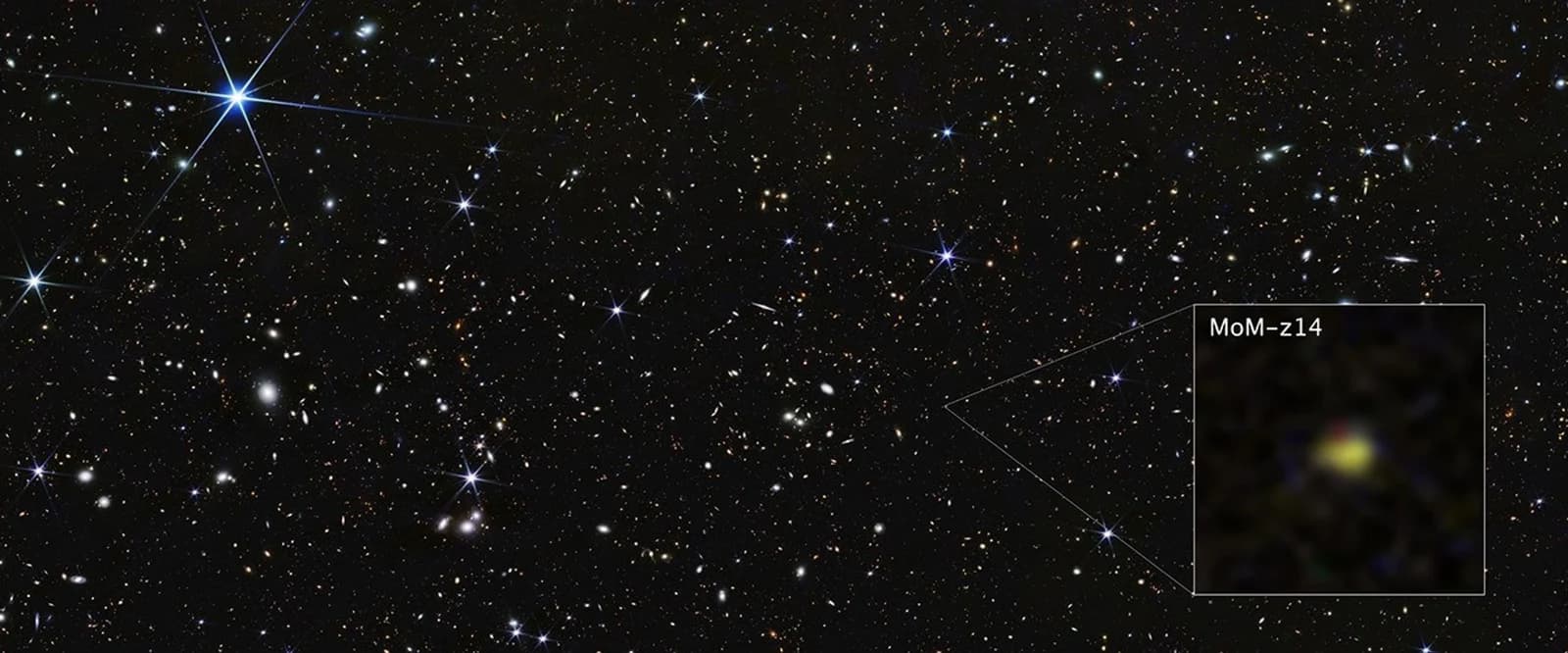
James Webb observes galaxies from an era when the universe was only a few hundred million years old. Among spectroscopically confirmed records checked as of 29 October 2026, the earliest is MoM-z14: its light shows the cosmos about 280 million years after the Big Bang. The galaxy is surprisingly bright and compact. That challenges descriptions of how the first stellar systems formed, but does not reveal an object that existed before the universe itself.
- MoM-z14 has a confirmed redshift of z = 14.44 ± 0.02. This is a record for the epoch observed, not a measured age for all its stars.
- About 280 million years after the Big Bang and about 13.5 billion years of light travel are different quantities. The present-day distance requires a separate cosmological calculation.
- A photometric candidate is not yet a confirmed record holder. A spectrum helps establish which features genuinely belong to a distant galaxy.
- The excess of bright early galaxies tests models of star formation, dust, and sources of radiation. By itself, it does not overturn the universe’s hot early phase.
Which galaxy currently holds the distance record?
In the NASA and ESA/Webb materials checked, MoM-z14 in the COSMOS field remains the record holder. NIRSpec confirmed a redshift of 14.44 with an uncertainty of about 0.02. In the adopted cosmological model, that corresponds to roughly 280 million years after the Big Bang. Calling it the “oldest galaxy” here means that we see an especially early cosmic epoch, not that we know the galaxy’s exact birth date.
Discovery and announcement dates need to be distinguished. The first version of the scientific paper appeared in May 2025; an updated version followed on 28 January 2026, alongside a major NASA release. The journal publication belongs to 2026. This is therefore a current check of the record, not a new October discovery. Objects with even higher estimated redshifts do not acquire the same status from a headline alone: the method and reliability must be checked.
Redshift, cosmic age, and light-travel time
Cosmological redshift describes how much a wavelength stretched while light traveled. The factor is 1 + z: for MoM-z14, the observed wavelength is about 15.44 times the emitted wavelength. Ultraviolet radiation from early stars therefore arrives in the infrared, where Webb operates. Redshift itself is measured in neither years nor light-years.
Combining z with an expansion model gives the epoch observed. About 280 million years is the universe’s age when this light was emitted. About 13.5 billion years is how long the light traveled. Neither figure means the galaxy or its stars had already existed for 13.5 billion years in the image. We received ancient light, not a picture of the source’s present state.
The present-day distance is another quantity: space expanded while the light traveled. Light-travel time in billions of years therefore cannot simply be relabeled as today’s distance in billions of light-years. That distance requires a stated cosmological model and distance definition. When comparing records, it is better to begin with spectroscopic redshifts and translate them into times consistently.
How a faint patch becomes a confirmed galaxy
Researchers first compare images taken through different filters. A very distant source becomes sharply fainter over part of the wavelength range because of hydrogen absorption; the position of that change helps estimate its redshift. This selects photometric candidates. A nearer dusty galaxy, a strong emission line, or an overlapping neighbor can sometimes produce similar brightness measurements. A single red dot does not settle the question.
A spectrum separates the light in much greater detail. For MoM-z14, the team used a sharp Lyman break and faint emission lines in NIRSpec/PRISM data. The published version reports five ultraviolet lines at around three-sigma significance each, so consistency across the whole pattern matters. NIRCam shows the source’s position and shape, while spectroscopy tests its assignment to a distant epoch. The two datasets complement one another.
What happened to the previous JADES-GS-z14-0 record?
In May 2024, the JADES team reported JADES-GS-z14-0, seen less than 300 million years after the Big Bang. Its initial NIRSpec estimate was z = 14.32 with substantial uncertainty. In an analysis of ALMA data published in 2025, an ionized-oxygen line shifted from the far-infrared into millimeter wavelengths allowed the systemic redshift to be refined to 14.1796 ± 0.0007. The old value of 14.32 in an archived news release should not automatically be treated as the latest measurement.
This refinement does not mean the galaxy was imaginary. An independent instrument added a more precise spectral marker and information about its gas. Oxygen is particularly interesting because its main production is tied to stellar evolution: the early gas had already received products of previous stars’ lives. That is chemical evidence of rapid processing, not a sign of an oxygen atmosphere or life in the distant galaxy.
Why a bright galaxy is not necessarily too old
Luminosity is not a direct weighing device. A small fraction of hot, massive stars can produce abundant ultraviolet light, while dust absorbs some radiation. Stellar-mass estimates depend on population age, star-formation history, the distribution of stellar masses, and composition. The same measured light therefore need not imply the same mass or formation time.
Black holes can add another contribution through the light of gas falling toward them. In a CEERS-sample study presented in 2024, accounting for such sources reduced some initial mass estimates. That is not a universal explanation for every Webb object. MoM-z14’s elongated shape and other properties instead suggest that an active nucleus does not dominate its ultraviolet light. Each source needs individual analysis.
What is surprising about MoM-z14?
The object is extremely compact: its effective radius, enclosing half the light in the adopted description, is estimated at about 74 parsecs. This is not the galaxy’s outer boundary. Yet the source is very luminous for the epoch observed and appears elongated. Its size, spectrum, and color together test which stellar population could generate that light in a dense environment.
Spectral modeling indicates a rapid recent rise in star formation: the average rate over the last five million years is about ten times the average over fifty million years. This reconstructs a history from data rather than a continuous recording. Light dominated by young stars, combined with weak dust attenuation, can boost the observed brightness without requiring every star to be exceptionally old. Other objects will show how typical this behavior is.
Why nitrogen in such an early galaxy matters
Researchers found signs of unusually high nitrogen enrichment relative to carbon in MoM-z14’s spectrum. That constrains chemical evolution: which stars could have produced and expelled the material in time? One proposed explanation involves supermassive stars in very dense early clusters. An elemental-abundance ratio is not, however, a direct detection of an individual star of that kind.
The Milky Way offers a useful comparison: a small part of its ancient stellar population shows a similar nitrogen feature. Those stars preserve traces of early chemistry, while Webb observes distant systems directly in the past. Comparing them helps connect different stages of galaxy evolution. It does not mean MoM-z14 is a young image of our own Galaxy or that one unique stellar-formation pathway has already been established.
Does MoM-z14 prove unusually early reionization?
After neutral atoms formed, hydrogen strongly affected the transmission of particular parts of the spectrum. Energetic radiation from early sources later ionized the gas, separating electrons from nuclei. This process is called reionization. It happened at different times in different places, so individual galaxies help reconstruct its spatial pattern and progression, rather than just one universal date.
MoM-z14 lacks the strong absorption damping wing expected from abundant neutral gas along the relevant part of the light’s path. The authors describe this as tentative evidence that its immediate surroundings were partly ionized. That wording matters: it does not establish that the entire cosmos was already ionized by 280 million years. Inferring the global history requires other sightlines, gas models, and a larger sample.
Has James Webb disproved the Big Bang?
No: the results discussed here do not demonstrate galaxies older than the universe. The hot early-universe model rests on several observations: cosmic expansion, the microwave background, and light-element abundances. Calculating how rapidly gas assembles into stars and galaxies is a subsequent, more complex layer of description. An incomplete or inaccurate calculation does not automatically overturn all those observational foundations.
The standard picture involves both dark matter, which forms gravitational structures, and ordinary-gas processes: cooling, star formation, outflows, and dust. Numerical predictions depend on how these processes are described. Webb demands more stringent tests. If a discrepancy survives those tests, it needs explaining, but a particular new-physics claim must follow from comparing models with data, not from calling something “impossible.”
What should clarify the early-galaxy puzzle?
Complete samples are needed, not just one record holder. The MoM team compared the density of very bright sources at z around 14–15 with pre-Webb predictions and found an excess exceeding a factor of one hundred, with substantial statistical uncertainty. That concerns a particular luminosity, epoch, and survey; it does not mean the entire universe contains a hundred times more galaxies of every kind. Rare objects are particularly sensitive to search volume and selection rules.
Deep spectra, independent gas lines, and observations of different fields will refine redshifts, active-nucleus contributions, composition, and star-formation rates. Faint objects also require explicit treatment of missing signals and selection errors. A future record may push the observed epoch earlier still. Its scientific value will depend on how well it is confirmed and what it changes about galaxy formation, not just a smaller number of millions of years.
The SPHEREx spectral survey is useful for studying statistics of nearer galaxy populations. It spans the entire sky. Redshift estimates for large numbers of galaxies will help measure how unevenly they are distributed in space.
Sources
- NASA — MoM-z14 and redshift 14.44, 28 January 2026
- Naidu et al. — MoM-z14, published study and 2026 version
- NASA — original JADES-GS-z14-0 record, May 2024
- Carniani et al. — ALMA refinement of JADES-GS-z14-0, 2025
- ESO — oxygen in JADES-GS-z14-0, 20 March 2025
- NASA — black-hole light and early-galaxy mass estimates, 2024
- NASA — JADES and bursts of star formation, 2023
- NASA — the Big Bang and independent observational foundations
- NASA — current overview of the early universe and Webb records
- NASA — cosmic history, first stars, and reionization
- NASA JPL on the completion of the first SPHEREx map
Questions and answers
Which galaxy is the most distant as of October 2026?
In the sources checked, MoM-z14 holds the spectroscopically confirmed record at z = 14.44 ± 0.02. It is seen about 280 million years after the Big Bang. New photometric candidates need separate evaluation.
Is MoM-z14 only 280 million years old?
That is the universe’s age at the epoch observed, not the galaxy’s exact age. Its light traveled for about 13.5 billion years; we do not observe the source’s present appearance.
Have galaxies older than the universe been found?
The MoM-z14 and JADES results do not establish that. Unexpected brightness and a modeled stellar population are not direct evidence of an age exceeding the universe’s. Such claims require spectral checks and analysis of the assumptions.
Does oxygen in JADES-GS-z14-0 imply possible life?
The observation concerns ionized-oxygen emission from galactic gas. It helps investigate redshift and chemical processing by stars. No planetary atmosphere, ocean, or organisms were reported.
Has Webb photographed the Big Bang itself?
It observes light from stars and galaxies hundreds of millions of years after the hot early phase. The cosmic microwave background belongs to a much earlier epoch and is studied with other instruments. A record-breaking galaxy is not an image of the universe’s beginning.