What the Milky Way is
The Milky Way is the galaxy containing the Solar System: an immense system of stars, gas, dust, and dark matter. It is a barred spiral galaxy. Its stellar disk is on the order of 100,000 light-years across.
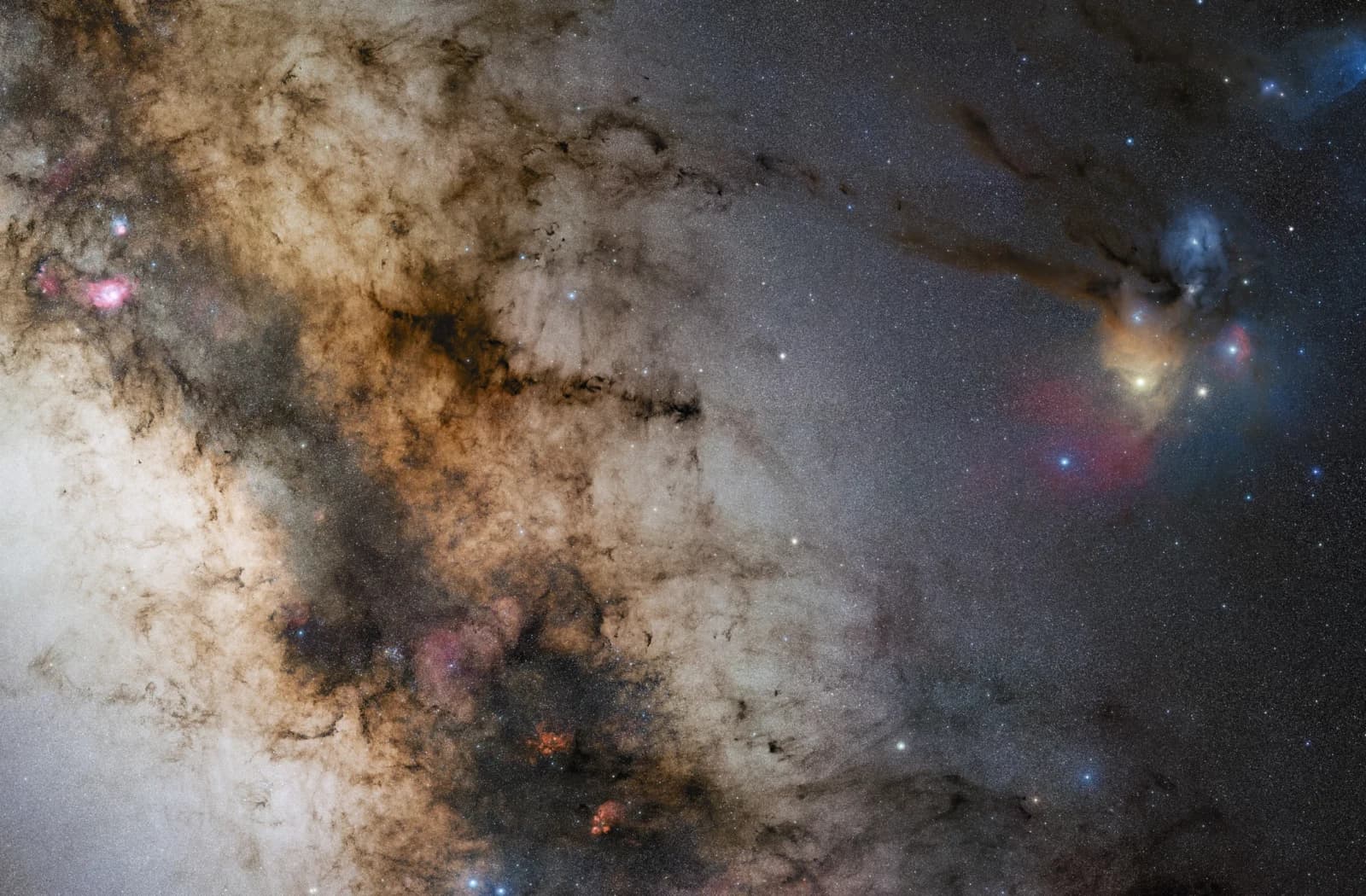
We distinguish the galaxy itself from its visible band across the sky. The pale band appears when we look along the stellar disk from within it. Light from countless distant stars overlaps, while dark regions are often associated with light-absorbing dust.
When comparing our Galaxy with distant objects, the travel time of light matters. Early galaxies in Webb images appear as they were in the young universe. MoM-z14 is observed at an epoch roughly 280 million years after the big bang; this does not mean that its entire stellar population is that old. Comparing different epochs helps researchers investigate how galaxies changed and how modern structures may have grown from simpler systems.
Why the Milky Way looks like a band
We look through the stellar disk from inside it. Looking along the galactic plane brings many distant stars into our field of view, and their combined light forms an extended band. Dark gaps in photographs are often caused by dust blocking light from behind. A lack of brightness does not necessarily mean a lack of matter.
The Milky Way belongs to the Local Group together with Andromeda and other galaxies. The Sun is one star within a large galactic system, and that system is itself part of a larger cosmic neighborhood.
The disk, central bar, and halo
The galaxy's structure includes a stellar disk, a central region with a bar, and a more extended halo. At the center lies the supermassive object Sagittarius A*, with a mass of about four million Suns. The visible spiral arms are part of the disk's structure.
Different components contain different stellar populations and help reconstruct the history of formation. The motion of matter is also used to study the mass distribution, including dark matter, which we do not see as a glowing landscape. Gaia data on stellar positions and motions allow this picture to be tested more precisely than a single beautiful overview image can.
How to map the galaxy without leaving it
A map of the Milky Way emerges by combining objects' distances, positions, and motions. Dust complicates our view, and parts of the galaxy are hidden or incompletely visible. New catalogs therefore change details of the accepted picture: the positions of arms, their prominence, and the structure of particular regions. Revising the drawing is a normal outcome of more accurate data.
Visualizations based on Gaia help combine these measurements into an understandable external view. The label “artist's impression” remains essential, however: nobody has taken such a photograph from a neighboring galaxy. An observational map and a drawn overall portrait serve different purposes. When choosing an image, check exactly what was photographed by a telescope and what scale was reconstructed from a scientific model.
How does a galaxy differ from a constellation?
The Milky Way is a physical system of stars, gas, and dust containing the Sun. A constellation is a region on the celestial sphere as seen from Earth. One patch of sky can contain nearby stars in our galaxy and objects far beyond it.
Andromeda is therefore the name of both a constellation and a separate galaxy, M31. They share a direction on the map, but are not the same system.
How to picture distances within the Milky Way
A light-year is a distance, not an age: it is the length of the path light travels in one year. A galaxy described as roughly a hundred thousand light-years across is therefore being measured in extent. Meanwhile, light from a distant star reveals its past. A sky map combines objects whose signals took different times to reach us; it is not a simultaneous portrait of the entire Galaxy at one shared instant.
The Sun lies in the disk, about 26,000 light-years from the centre. On an external diagram this address looks like a single marker, but an observer on Earth sees each direction through different layers of stars and dust. Some regions are easier to examine than others. A catalogue of observed objects therefore cannot automatically be treated as a complete inventory of everything in a chosen part of the disk.
Even a remarkably detailed survey covers only part of the stellar population. ESA notes that Gaia examined almost two billion stars: an enormous set of measurements, but about one percent of the Milky Way’s total. Such a sample allows researchers to investigate Galactic structure and motion, while still accounting for missing objects. A vast number of points on a map demonstrates the scale of the work, not that the investigation is complete.
The Galaxy’s visible band crosses several constellations because constellations divide directions on Earth’s sky. They do not split the stellar disk into separate physical pieces. An observing map selects a stretch of the band available at a particular place and season; a distance map explains its structure. The two views complement one another: one helps locate a target, while the other places it in three-dimensional space.
The scale of an individual galaxy must be distinguished from the expansion of the Universe. Dark energy belongs to the cosmological description of that expansion, whereas the Milky Way’s structure is studied through the motions of stars and gas and the distribution of mass. A map of our Galaxy and a measurement of the expansion history therefore address different questions: the properties of dark energy cannot be inferred simply from the Sun’s position in a spiral arm.
Sources
- NASA: Galaxies
- ESA: Guide to Our Galaxy
- ESA: Gaia’s New View of the Milky Way
- NASA — dark energy and the expansion history of the Universe
- NASA — galaxy MoM-z14 in the early universe
Image
Questions and answers
Is there a real photograph of the entire Milky Way from outside?
No. We are inside the galaxy; external views of its overall shape are created using observations and models.
Is the Milky Way a galaxy or a constellation?
The Milky Way is a physical system of stars, gas, dust, and dark matter. A constellation is a region of the celestial sphere. The Milky Way's band passes through several constellations.