Where we are in the galaxy: the short answer
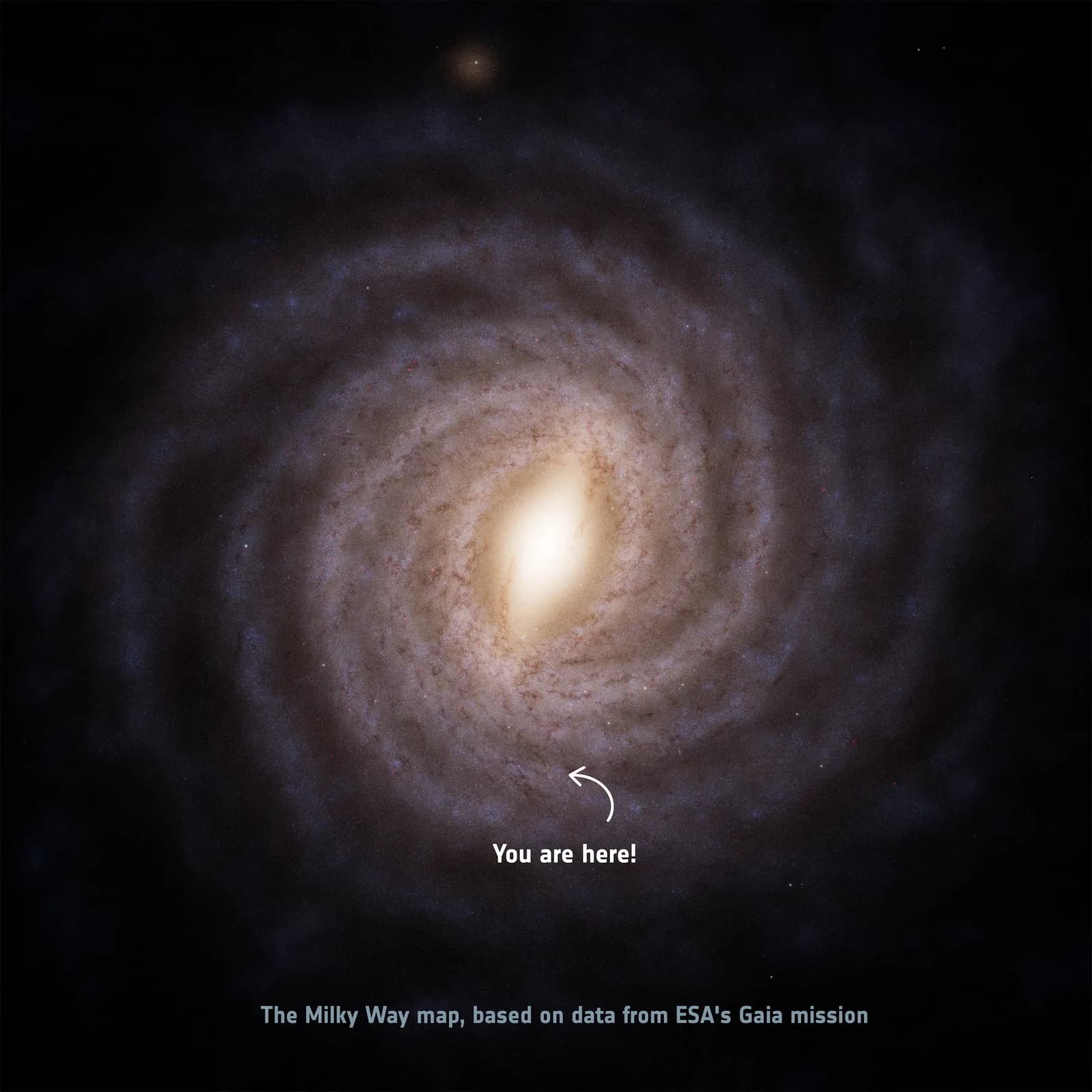
Earth is in the Solar System, and the Solar System is in the Milky Way. The Sun lies in the Orion Arm, also called the Local Arm or Orion Spur. It sits between the Sagittarius and Perseus arms. This is neither the galactic center nor its farthest edge.
We are approximately 26,000 light-years from the galactic center. A light-year is a unit of distance: the distance light travels in one year. The number therefore describes the spatial scale of our address, rather than the age of Earth or the Sun.
Two maps make this easier to picture. In the first, Earth is the third planet from the Sun. In the second, the entire Solar System becomes a single point in the stellar disk. Changing the scale does not change our location, but reveals how small our familiar family of planets is compared with the galaxy.
The Milky Way: the next level of our address
The Milky Way is a spiral galaxy: an immense system of stars, gas, dust, and dark matter. Its stellar disk spans more than 100,000 light-years. The pale band in a dark sky appears because we are looking along that disk from within it.
The illustration above the article shows a reconstructed view of the Milky Way from above; an arrow marks the Solar System's location. It was created using data from the Gaia telescope. It is not a photograph of the galaxy from outside: this overall view is reconstructed from observations made within the stellar disk.
Our galaxy is not alone. Together with Andromeda and dozens of smaller galaxies, it belongs to the Local Group. This adds another level to our cosmic address: Earth — Solar System — Milky Way — Local Group.
How the Sun moves together with the planets
The Solar System orbits the center of the Milky Way at about 230 kilometers per second. One complete orbit takes roughly 230 million years. This interval is sometimes called a galactic year: it is incomparably longer than an Earth year.
It is important to distinguish two motions here. Earth orbits the Sun, while the entire Solar System simultaneously moves within the galaxy. The Sun's orbit around the galactic center does not by itself tell us where the Milky Way is moving relative to other galaxies.
The familiar picture of a stationary Sun is therefore useful for studying planetary orbits, but it shows only one scale. It does not mean our star is fixed in space while planets move around it.
The Local Group and Laniakea: what lies beyond
The galaxies of the Local Group are bound by gravity. On a still larger scale, our group lies near the outer regions of the Laniakea supercluster. Its name became widely known after a 2014 study in which astronomers identified this region from the flows of galaxies.
A supercluster should not be imagined as a scaled-up Solar System. Its components are generally not bound to one another as tightly by gravity as planets are to a star. Laniakea helps describe large-scale structure and the motion of matter, but it is not a solid shell around our cosmic home.
Farther out, we see the cosmic web: galaxies and clusters form extended filaments and walls, with less populated regions called voids between them. Our address becomes part of this web, rather than a series of nested, stationary boxes.
Where our galaxy is heading and how fast it moves
The Milky Way has no single universal direction of motion. Its speed depends on the frame of reference: we can compare its motion with a neighboring galaxy, the center of the Local Group, or the cosmic microwave background — ancient light filling the Universe.
A 2017 study estimated the Local Group's motion relative to the cosmic microwave background at approximately 630 kilometers per second. This value applies to the group of galaxies, rather than Earth's orbit or the Sun's movement around the galactic center.
The uneven distribution of matter affects this large-scale flow. Important regions include the Great Attractor and the concentration of clusters in Shapley. The Great Attractor is not a single giant black hole or a point into which our galaxy must inevitably fall.
Regions with a lower density of matter are important too. The study of the “dipole repeller” describes their role alongside the influence of dense structures. This is not a new force pushing galaxies away, but part of the picture of gravitational flows. Saying that “the galaxy is heading toward the Great Attractor” conveys only a fragment of that picture.
Will the Milky Way collide with Andromeda?
The approach of Andromeda is a separate question about the future of our Local Group. The popular claim that a collision will inevitably happen in four to five billion years can no longer be presented as an established scenario.
In June 2025, NASA reported on a study using Hubble and Gaia observations. Its simulations give roughly equal chances of the two galaxies colliding or not colliding within the next ten billion years. The result depends on measurement uncertainties and the influence of other members of the Local Group.
This is a probabilistic forecast, rather than a scheduled catastrophe. The more precisely astronomers measure the motions and masses of galaxies, the better they can test possible futures. Our cosmic address is known much more confidently than its fate billions of years from now.
Sources
- NASA: Solar System Facts: the Solar System's location and motion
- ESA: Gaia: studying the Milky Way from within
- NASA: About the Planets: eight planets and dwarf worlds
- NASA: Galaxies: the Milky Way and the Local Group
- NASA: Large Scale Structures: superclusters and the cosmic web
- Tully et al.: The Laniakea supercluster of galaxies, Nature, 2014
- Hoffman et al.: The dipole repeller, Nature Astronomy, 2017
- NASA: Hubble Casts Doubt on Certainty of Galactic Collision, 2025
Questions and answers
Where are we in the Milky Way galaxy?
The Solar System lies in the Orion Arm, between the Sagittarius and Perseus arms, approximately 26,000 light-years from the galactic center.
Why can't we give just one speed for our galaxy?
Speed requires a frame of reference. Motion relative to Andromeda and the Local Group's motion relative to the cosmic microwave background are different measurements.
Is the Great Attractor a black hole?
No. It is a region of increased matter concentration associated with galaxies and their clusters. It contributes to large-scale gravitational flows.
Will the Milky Way definitely collide with Andromeda?
Its inevitability has not been established. The study reported by NASA in 2025 estimates an approximately 50% probability of a collision within the next ten billion years.