The universe is expanding, and the explanation for its accelerated expansion is called dark energy. DESI is testing whether it remained constant throughout cosmic history. After the widely discussed 2025 results came an important twist: a separate measurement presented in summer 2026 moved closer to the standard model. Combined analyses of different observations still leave hints of evolution, however. Here is what scientists measured, and why the data do not imply an imminent end to the universe.
- Dark energy and dark matter are different unknown components: the former is associated with cosmic acceleration, the latter helps explain gravity and the growth of structure.
- DESI’s hints of evolving dark energy depend on the dataset and model. No new physical entity has yet been detected.
- In summer 2026, an analysis of light absorbed by intergalactic hydrogen produced a result closer to ΛCDM. Combined datasets leave the question open.
- DESI completed its original five-year map in 2026; the first dark-energy results using that entire survey are expected in 2027.
What is dark energy in plain language
It is the name for an unknown component of the cosmological model that explains the universe’s accelerated expansion. Current estimates assign it roughly 68–70% of the total mass-energy content. This percentage refers to the entire cosmic budget, not to the invisible matter inside a particular galaxy. The name does not mean scientists have found its particles, a sample, or its radiation.
Dark matter addresses a different problem: its gravitational effects help explain the motion of matter and the formation of galaxies. In the standard description, dark energy is distributed much more uniformly and affects the evolution of the cosmic scale. The shared word “dark” expresses our limited understanding of both components, but does not make them one substance. Detecting either would not automatically reveal the other.
What expands, and what acceleration means
On large scales, distances increase between regions that follow the overall expansion of space. The farther away such a galaxy is, the larger the expansion-related redshift of its light. This is not an explosion from a central point somewhere among today’s galaxies: an observer in another distant region would also see the overall pattern of recession.
Expansion and acceleration are two different claims. The first concerns the growth of the cosmic scale; the second concerns how that growth has changed over time. Bound systems do not have to stretch along with the universe. Gravity holds the Milky Way together, and Earth remains in orbit around the Sun. A cosmological result cannot be turned into a prediction that planets will noticeably drift apart next year because of dark energy.
Comparing cosmological measurements also brings up the Hubble tension: different approaches yield estimates of the present expansion rate that do not fully agree. This comparison uses the Hubble constant H₀, while the history of acceleration is studied through changes in expansion over time. The questions are connected through a cosmological model, but refining each quantity requires its own observations and assessment of uncertainties.
How supernovae revealed cosmic acceleration
In 1998, two independent teams presented observations of distant Type Ia supernovae. These explosions allow distance estimates by comparing their measured brightness with their expected luminosity. At certain redshifts, the supernovae were fainter than predicted by a description with decelerating expansion. Within the cosmological analysis, this indicated larger-than-expected distances and an acceleration of expansion at late times.
Saul Perlmutter, Brian Schmidt, and Adam Riess received the 2011 Nobel Prize in Physics for discovering accelerated expansion. Subsequent tests use more than supernovae: they compare them with the distribution of galaxies, the cosmic microwave background, and other observations. Today’s debate therefore concerns the consistency of several ways to reconstruct cosmic history, rather than a single unusually faint explosion.
Why the standard model assumes a constant
In ΛCDM, Λ stands for the cosmological constant and CDM for cold dark matter. The constant describes a component with unchanging energy density: as space expands, it does not become diluted like ordinary matter. It is the density that stays constant; this does not mean that the total amount of this energy within an expanding region is unchanged. A possible connection with vacuum energy does not yet explain its observed value.
To compare models, cosmologists use a parameter called w, which relates pressure to energy density. For a cosmological constant, w = −1. In more flexible descriptions, it can change with cosmic epoch. Negative pressure here is a property of a gravitational source in general relativity, not an ordinary wind between galaxies. Even if observations favor a varying w, its physical cause will still need to be established: fitting parameters does not itself detect a new field.
What DESI measures instead of dark energy itself
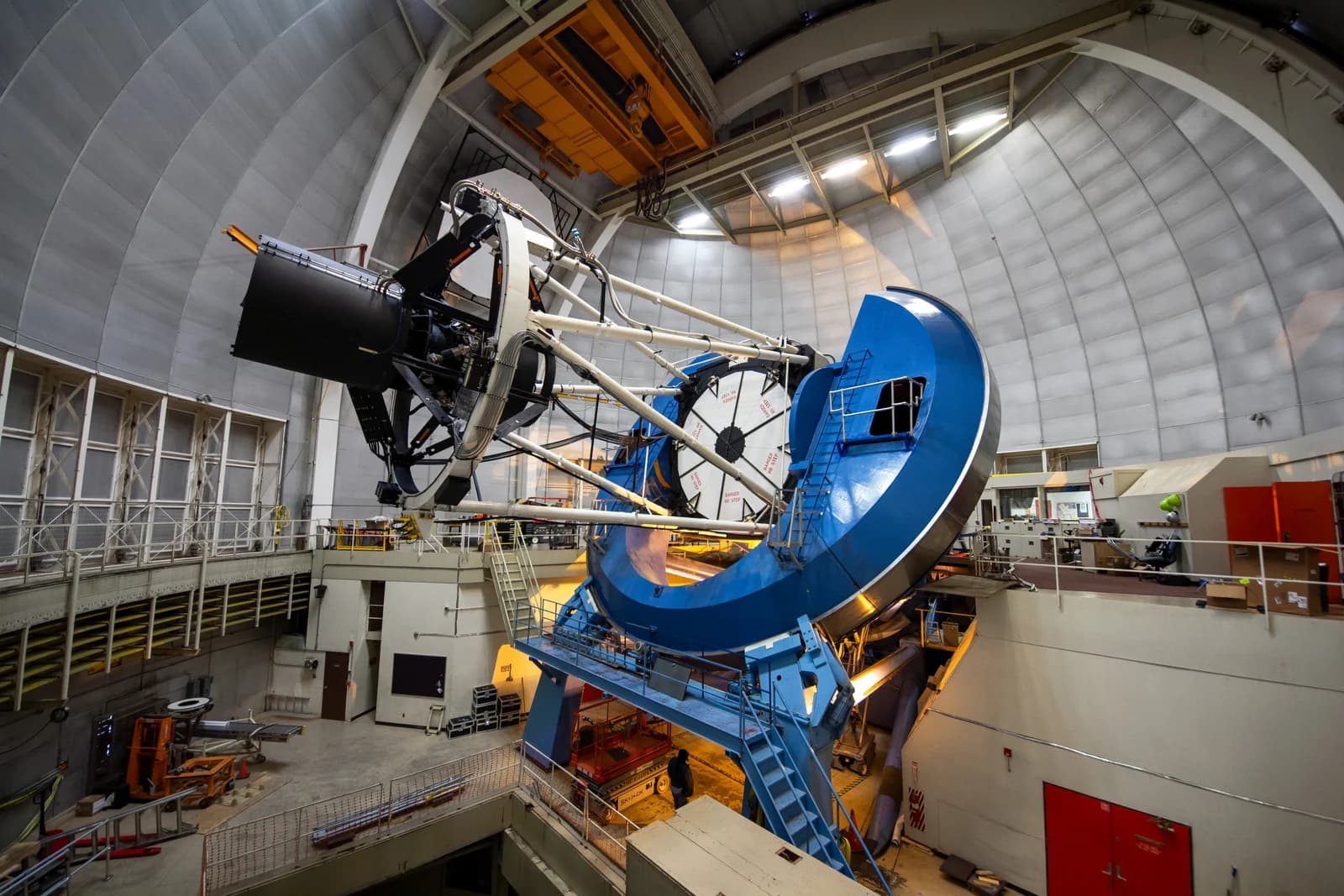
DESI is a spectroscopic instrument on the Nicholas U. Mayall 4-meter Telescope at Kitt Peak National Observatory in Arizona. Five thousand controlled optical fibers simultaneously collect light from different objects. Spectra reveal how far familiar emission or absorption lines have shifted. Redshifts, together with sky directions, allow researchers to build a three-dimensional map of a vast volume of the universe.
The map contains galaxies and quasars observed at different epochs: light from more distant objects has traveled longer to reach us. A redshift is not, however, a ready-made distance independent of cosmological assumptions. Scientists compare the map’s statistical properties with model predictions and test which expansion history fits the measurements. A DESI image of points is therefore a map of visible sources and structure, not a photograph of dark energy.
How the BAO cosmic ruler works
Acoustic waves traveled through the mixture of matter and radiation in the early hot universe. Their imprint remains in the distribution of matter: galaxy pairs occur slightly more often at a particular characteristic separation. This statistical scale, called baryon acoustic oscillations, or BAO, is about 150 megaparsecs in present-day comoving coordinates.
Comparing the apparent size of this “ruler” along and across the line of sight at different redshifts tests cosmic geometry and expansion. The signal is a slight excess in probability among millions of pairs, not a set of neat shells that can be drawn around every galaxy. Extracting it is precisely why a large sample is needed. Errors in object selection and spectral measurements must also be accounted for.
What prompted the big headlines in 2025
On 19 March 2025, the team presented cosmological results from DESI’s first three years: the BAO analysis used more than 14 million galaxies and quasars. On its own, that dataset agreed well with flat ΛCDM. The intriguing result appeared when it was combined with the cosmic microwave background and then supernovae: a more flexible model with evolving w fitted the combined data better than a constant.
For combinations of BAO, the cosmic microwave background, and different supernova samples, the preference for evolving energy ranged from 2.8 to 4.2 sigma. That range matters: the answer depends on which observations are included. It is a statistical preference within the models being compared, not a direct measurement of a new particle or a ready-made probability that the hypothesis is true. The phrase “dark energy is weakening” compresses a more complex description of its dependence on cosmic epoch.
A new turn: what changed in summer 2026
On 30 July 2026, DESI presented a new analysis of the Lyman-alpha forest: the many absorption features in the spectra of distant quasars. Light from these bright galactic nuclei, powered by matter around supermassive black holes, passes through intergalactic hydrogen. The gas leaves spectral traces that reveal its distribution roughly 11 billion years ago. This provides another way to investigate cosmic structure.
The researchers used not only the characteristic BAO scale but also the shape of the statistical signal, including the Alcock–Paczyński geometric test. Converting observations into incorrect distances along and across the line of sight introduces an artificial distortion into the reconstructed pattern. The new analysis extracted additional information from these differences. The separate measurement became more precise and moved toward standard ΛCDM.
This did not settle the question of evolving energy. In the paper’s 4 August 2026 version, the combination of DESI BAO, the new Lyman-alpha analysis, and the cosmic microwave background favors an evolving-w model at 2.7 sigma; adding supernovae gives 3.2 sigma. Directly comparing these figures with the maximum 4.2 sigma from a different data combination is inappropriate. The new result shows how much the dataset and signal-extraction method matter.
Why this is not yet a discovery of new physics
Real evolution of dark energy must be distinguished from a statistical fluctuation and residual systematic errors. Supernovae, galaxy spectra, and the cosmic microwave background are measured with different instruments and analyzed using different methods. Even a small mismatch in calibration or in the description of objects can affect a joint fit. Larger datasets therefore need tests using simulated data and independent measurements.
A flexible description of w also assumes a particular mathematical form for its evolution. It is useful for testing constancy, but does not automatically cover every possible theory. A preference for that model establishes neither a particular new field nor a failure of general relativity. A robust conclusion must survive improved data, comparisons between methods, and tests of hidden assumptions. ΛCDM remains a working model being tested with increasing precision.
The map is complete: when to expect the next test
On 15 April 2026, DESI announced that it had completed its original five-year sky survey ahead of schedule. By then, the instrument had observed more than 47 million galaxies and quasars, as well as 20 million Milky Way stars. These large numbers cannot replace the sample size in the 2025 results: completing observations and publishing a validated cosmological analysis are different stages.
The team expects the first dark-energy results from the complete five-year survey in 2027; observations in the extended project continue through 2028. Independent approaches matter too. Euclid studies galaxy distributions and gravitational lensing, while Roman’s program combines BAO, supernovae, and lensing. Comparing methods will help establish whether the same scenario describes both the expansion of space and the growth of cosmic structure.
The panoramic Roman telescope will test cosmological models through galaxy shapes and supernova light curves. This requires consistent camera measurements across fields and exposures: entering science commissioning does not yet provide a new estimate of dark energy’s properties.
Will the universe’s fate change
If the cosmological constant is correct and that description can be extended into the distant future, accelerated expansion will continue. Increasingly distant galaxies will become unobservable, and the cosmos will grow colder and more dilute. This is a scenario of long-term evolution, not a sudden explosion. If dark energy evolves, the range of possible future histories is wider, but a hint of such evolution is insufficient to select one.
Weaker acceleration is not the same as contraction: distances can keep increasing even if the character of that growth changes. A Big Crunch or Big Rip requires additional properties of the future model. DESI reconstructs history from light arriving from the past; it does not observe the future directly. The data checked as of 28 October 2026 provide an interesting test of dark energy’s constancy, but establish neither a reversal of expansion nor a scientific date for the end of the universe.
Sources
- NASA — what we know about dark energy
- Berkeley Lab — DESI results, 19 March 2025
- DESI DR2 II — BAO constraints, version of 9 October 2025
- DESI — new Lyman-alpha analysis, 30 July 2026
- DESI DR2 IV — Lyman-alpha and cosmology, version of 4 August 2026
- DESI — original survey completed, 15 April 2026
- NASA Roman — methods for studying dark energy
- NASA LAMBDA — the Hubble constant and its measurement methods
- NASA — Roman’s three core surveys and their strategy
- NASA — Roman’s final science commissioning, October 22, 2026
Questions and answers
Is dark energy the same as dark matter?
No. Dark matter helps explain the gravitational effects of invisible matter and the growth of galaxies. Dark energy is associated with the universe’s accelerated expansion. Their names reflect their unknown nature, not that they are identical.
Has DESI proved that dark energy is weakening?
No. Some combined datasets favor a model with evolving w, but the result depends on data and assumptions. The new 2026 Lyman-alpha analysis, considered separately, agrees more closely with ΛCDM, so the question remains open.
Has the universe already started contracting?
The DESI results discussed here do not establish that. Possible changes in dark energy, weaker acceleration, halted expansion, and contraction are different claims. Moving from one to another requires additional conclusions and a model.
Can dark energy be photographed?
DESI has no image of dark energy itself. It measures galaxy and quasar spectra; scientists use the distribution of objects and absorption by gas to test cosmic geometry and the history of expansion.
Have DESI’s five-year results already been published?
Collection of the original five-year map was completed in April 2026. The team expects the first dark-energy results based on that entire survey in 2027. A completed map does not yet mean a completed cosmological analysis.