What an exoplanet is, in simple terms
An exoplanet is a planet located outside the Solar System. It usually orbits another star. There are also free-floating planets that are not bound to a star. Another name for an exoplanet is an extrasolar planet.
Picture the night sky: many of those bright points are distant stars. Some have planetary systems of their own. Their worlds may be rocky, gaseous, scorching, or icy. The word “exoplanet” alone says nothing about the presence of oceans, air, or living beings.
How a planet differs from an exoplanet
The main distinction is which planetary system it belongs to. Earth, Mars, and Jupiter orbit the Sun and are Solar System planets. A world orbiting another star is called an exoplanet. Every exoplanet is therefore a planet, but not every planet is an exoplanet.
The distinction is not based on composition or size. A gas giant around another star may resemble Jupiter, and a small rocky exoplanet may resemble Earth. Similar sizes do not, however, imply the same temperature, atmosphere, or surface conditions.
How exoplanets form: from dust to a whole world
Many planets begin forming in a disk of gas and dust around a young star, called a protoplanetary disk. It contains the material for future worlds: tiny solid particles, gas, and, in cold regions, ice.
First, particles collide and stick together. Larger bodies called planetesimals gradually emerge, forming the building blocks of planets. They attract matter, collide with one another, and can grow into planetary embryos. Some collisions destroy bodies, however: growth is not equally successful everywhere.
The outcome depends on the amount of material, temperature, and time. A sufficiently massive core can retain a large amount of gas and become the foundation of a giant planet. Under other conditions, a rocky world develops. Formation takes millions of years; for terrestrial planets, the process may continue for tens of millions of years.
This is a general outline, rather than a completely solved problem. Astronomers investigate why similar disks produce such different planetary systems and how their final orbital architecture takes shape.
Gravitational interactions can eject a young world from its original system. These rogue planets no longer orbit their host star, so the usual search for transits across that star’s disc does not work for them. Finding them requires other approaches, such as observing microlensing of a background star or the intrinsic infrared emission of a young object. Their formation history remains a separate question.
What kinds of exoplanets are there?
Rocky exoplanets are compared with Earth and Mars: rock and metals dominate their composition. Gas giants are closer to Jupiter and Saturn. They include “hot Jupiters,” enormous worlds on very tight orbits that receive a great deal of energy from their stars.
There are also Neptune-like planets and super-Earths. The term “super-Earth” primarily describes mass: such a world is more massive than Earth, but lighter than our system's ice giants. It promises neither a solid surface nor an Earth-like climate. Some of these objects may have a thick gaseous envelope.
These categories help us compare discoveries. Conclusions about an individual planet require measurements of its mass, radius, and other properties, rather than just an impressive name.
Who discovered the first exoplanets?
Exoplanets were not invented: scientists discovered them through observable signals. An important milestone came in 1992, when Aleksander Wolszczan and Dale Frail published a study of planets around the pulsar PSR B1257+12. A pulsar is a rapidly rotating stellar remnant that emits regular radio pulses. Small changes in the pulses' arrival times revealed the planets' influence.
In 1995, Michel Mayor and Didier Queloz announced the discovery of 51 Pegasi b, the first firmly established exoplanet around a Sun-like star. It is a gas giant that completes an orbit in approximately four Earth days.
The two dates mark different milestones: 1992 refers to the first confirmed extrasolar planets around a pulsar, and 1995 to the discovery around a Sun-like star. The search then expanded from individual objects to the study of entire planetary systems.
How we find planets that are almost invisible
The transit method looks for small, periodic dips in a star's brightness. If a planet crosses in front of the star from our perspective, it blocks some light. The repeating signal reveals the orbital period, while the depth of the brightness dip helps estimate the planet's radius when the star's properties are known.
The radial-velocity method uses the star's own motion. The planet also pulls on its star, causing slight changes in the star's velocity toward or away from the observer. This appears as shifts in the lines of its spectrum. These measurements provide information about the planet's orbit and mass.
Other methods include direct imaging and gravitational microlensing: a change in a distant star's light caused by the gravity of an object in front of it. Each method is sensitive to particular types of systems. Repeat observations help distinguish a planet from interference and other causes of a changing signal.
What the habitable zone means
The habitable zone is the range of distances from a star where, under suitable atmospheric conditions, liquid water could persist on a planet's surface. Water matters to life as we know it, so this range helps identify interesting targets for study.
The zone lies at different distances around different stars. Around a faint red dwarf, it is closer to the star; around a brighter star, it is farther away. When people discuss an exoplanet's habitable zone in our galaxy, they generally mean the conditions around its particular star.
Being in this range guarantees neither an ocean nor life. A planet may lack the necessary atmosphere or water, and stellar activity may create unfavorable conditions. An assessment requires knowledge of the world's properties, rather than its orbit alone.
A headline saying “a planet has been found in the habitable zone” should therefore be read as news of a promising observational target. It is not yet the discovery of an inhabited planet or proof of conditions in which humans could live.
Is there life on exoplanets, and how do we search for it?
There is no confirmed evidence of life on exoplanets yet. For most worlds, even atmospheric details remain unknown, let alone organisms. Scientists investigate whether conditions could be suitable and look for signs that might point to biological processes.
One tool is spectroscopy. During a transit, some of a star's light may pass through a planet's atmosphere. Molecules absorb particular wavelengths, leaving features in the spectrum. Researchers use these to try to determine the composition of the gaseous envelope.
Interpreting the signal is difficult: features from different substances can overlap. A proposed biosignature must be tested and compared with nonbiological explanations. Even detecting an interesting molecule does not by itself mean life has been found. Discussion of how local organisms might adapt remains hypothetical until the organisms themselves are discovered.
K2-18 b is an instructive modern example. Its spectrum has prompted discussion of methane and possible traces of other compounds, but a 2026 reanalysis shows how weak features depend on processing and the model. A report of a potential biosignature therefore cannot be equated with detecting organisms.
Closer to home, the debate about life on Venus offers another example of these checks. When assessing a possible atmospheric marker, the altitude of the layer, the observing wavelength and alternative molecules capable of producing a similar signal all matter. This helps explain why two atmospheric studies may answer different questions even when headlines portray them as directly confirming or refuting each other.
Discussions of intelligent life raise the Fermi paradox, which concerns a separate set of questions. A potentially habitable planet, biological processes and detectable technology are different things. Technosignatures are possible observable traces of a civilisation’s activity, such as artificial radio signals or laser pulses. Searching for them requires appropriate instruments, verification criteria and an assessment of which kinds of signal are accessible to observation.
How long an exoplanet exists: what its “lifespan” means
Exoplanets have no single lifespan. It helps to distinguish the age of a celestial body, its future fate, and the period during which conditions might be suitable for life. These are different characteristics, and the word “exoplanet” determines none of them.
Stellar evolution plays a major role. When a Sun-like star becomes a red giant, nearby planets may be destroyed or engulfed. A star's death does not necessarily destroy every world in its system, however.
One example is the gas giant WD 1856 b, which orbits a white dwarf, the remnant of a star. James Webb Space Telescope observations help reconstruct this system's history. Such objects show why we cannot assign all planets a single lifespan or assume it equals their stars' lifetimes.
Proxima b and TRAPPIST-1: real examples
Proxima Centauri b is the nearest known exoplanet: its system is approximately four light-years away. A light-year is the distance light travels in one year. Estimates suggest the planet may be rocky, and it lies in a red dwarf's habitable zone. The presence of a suitable atmosphere and liquid water has not been established, however.
The TRAPPIST-1 system lies about 40 light-years away. It has seven known rocky planets similar in size to Earth. Three of them — e, f, and g — are considered to lie in the habitable zone. Ground-based and space telescopes study these worlds, but their size similarity to Earth does not confirm similar conditions.
The TRAPPIST-1 system lets researchers compare different ways of testing for atmospheres within one family of planets. Thermal phase curves of the inner planets b and c strongly constrain thick envelopes, while the presence of a heavy atmosphere on e remains an open question. A result for the world closest to the star therefore cannot be extended to every neighboring planet: their irradiation and observational constraints differ.
Can we see a real photograph of an exoplanet?
Yes, direct images have been obtained for some exoplanets. Usually, however, they show a faint light source beside a dazzlingly bright star. Such observations are often possible for young, large planets in wide orbits, but we do not have detailed photographs of their mountains, continents, and oceans.
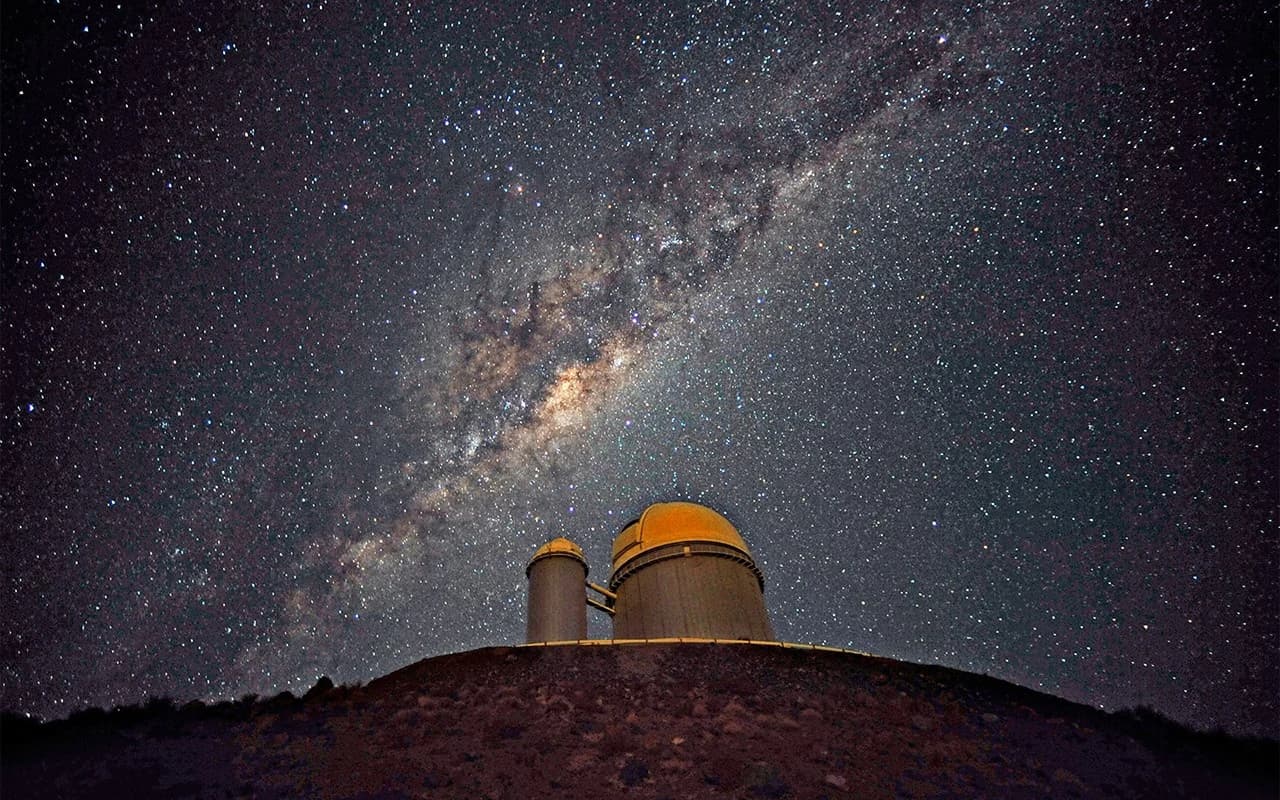
A beautiful landscape of an alien world in a publication is usually an illustration or model. It helps imagine possible conditions, but does not replace measurements. The photograph above this article shows the Milky Way over La Silla Observatory; no individual exoplanet's surface is visible in it.
Sources
- NASA: what an exoplanet is
- NASA: glossary of exoplanet terms
- NASA: how planets form
- NASA: types of exoplanets
- NASA: the history of the first discoveries
- NASA: methods for finding and studying exoplanets
- NASA: the habitable zone
- ESA: searching for life and studying atmospheres
- NASA: the planet WD 1856 b after its star's death
- NASA: the seven planets of the TRAPPIST-1 system
- NASA: nearby exoplanets and observing possibilities
- Wolszczan and Frail: study of planets around a pulsar, Nature, 1992
- Astronomy & Astrophysics — reassessing K2-18 b’s atmosphere, 2026
- Frontiers — review of the Venus phosphine debate
- Nature Astronomy — independent reassessment of the phosphine signal
- NASA — planets outside stellar systems
- NASA — searching for technosignatures of intelligent life
- Nature Astronomy — phase curves of b and c, 3 April 2026
- Glidden et al. — constraints on a secondary atmosphere for e, 2025
Image
Questions and answers
What does the word “exoplanet” mean?
It is an extrasolar planet: a world outside the Solar System, usually orbiting another star.
Is Earth an exoplanet?
No. Earth is in the Solar System and orbits the Sun. The term “exoplanet” is used for planets outside it.
How does an exoplanet form from scratch?
In many systems, everything begins with gas and dust around a young star. Particles join into larger bodies, from which planets gradually form.
Is a super-Earth necessarily suitable for life?
No. The name is primarily related to mass. A super-Earth may have a completely different atmosphere, temperature, and structure from Earth.
Is the habitable zone a place where life has already been found?
No. Under suitable conditions, liquid water can exist there on the surface. The presence of water, an atmosphere, and life must each be checked separately.
Do exoplanets have habitats?
They have physical conditions that may be favorable or unfavorable to life as we know it. No inhabited exoplanet has yet been confirmed.
What is an exoplanet's lifespan?
There is no common value: its fate depends on the particular system and the star's evolution. A planet's lifespan also differs from the period of possible habitability.
Who discovered the first exoplanet?
The first confirmed planets around a pulsar are associated with Wolszczan and Frail's 1992 study. Mayor and Queloz discovered the first firmly established planet around a Sun-like star in 1995.