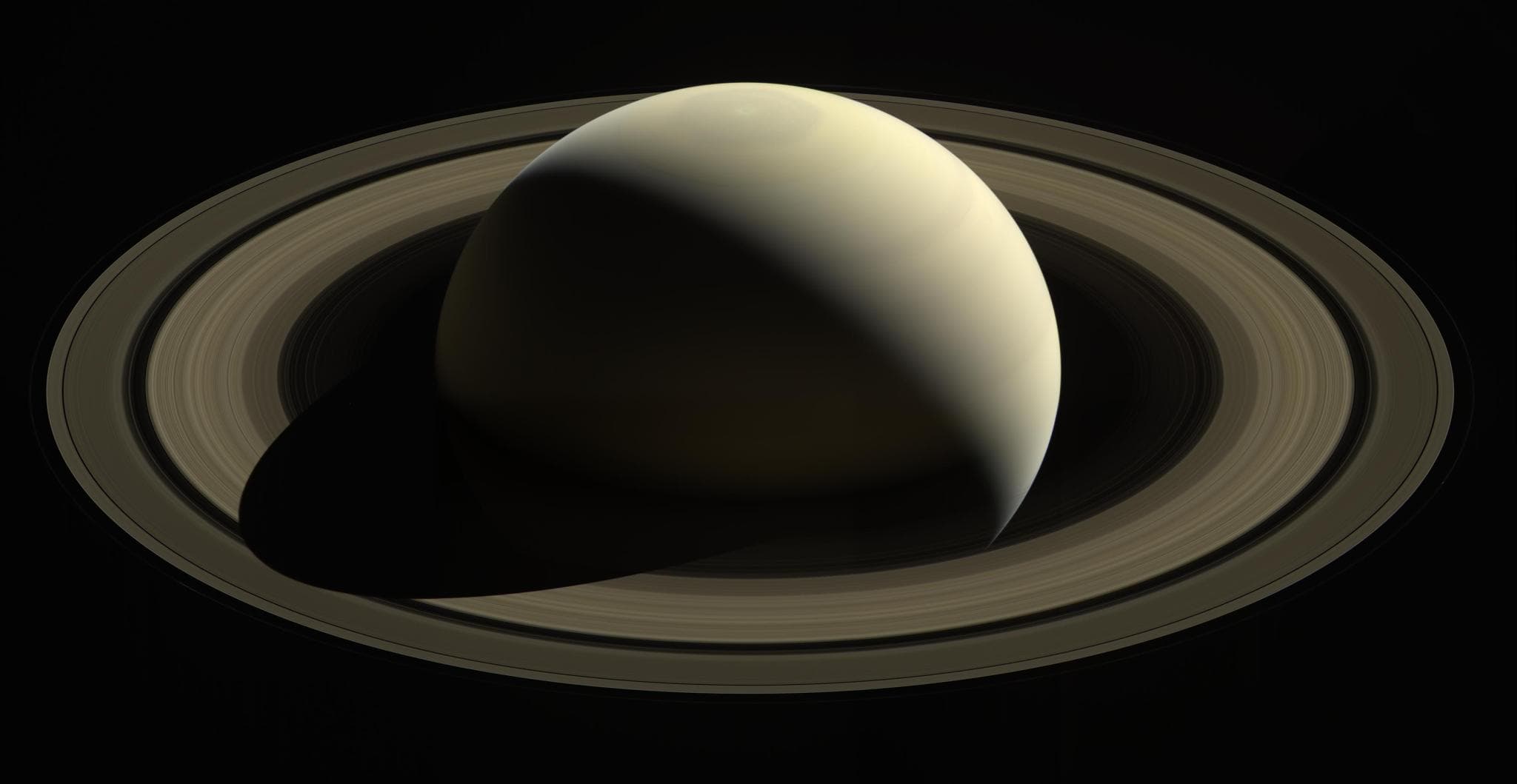
Icy rings and an atmosphere in motion
Rings make Saturn recognizable, but they are not one solid disk. Vast numbers of particles follow individual orbits. The planet itself is a gas giant with gradually changing conditions deep inside; the bright bands in photographs belong to its cloudy atmosphere.
Saturn: key facts
- Type
- Gas giant
- Mean radius
- 58,232 km
- Mean distance from the Sun
- ≈ 9.58 AU · 1.43 billion km
- Orbital period
- ≈ 29.45 Earth years
- Rotation
- ≈ 10 h 42 min
- Temperature
- ≈ −140 °C · 1-bar level
- Mass
- 5,68 × 10²⁶ kg
- Mean density
- 687 kg/m³
Values are rounded. The distance describes the orbit, not the current distance from Earth. For giant planets, temperature refers to a reference atmospheric level: they have no solid ground. Mean radius differs from equatorial radius.
Atmosphere and appearance
Hydrogen and helium, cloud bands and fast jet streams. There is no solid surface.
Cassini Division
The dark gap between the bright A and B rings.
Polar hexagon
A wave-like jet stream around the north pole.
Enceladus and Titan
Enceladus has icy plumes; Titan is surrounded by a dense atmosphere.
What is inside?
Proposed structure. Composition changes gradually, and sharp boundaries between layers may not exist. Colors and region sizes are illustrative.
Cloud cover
Cloud layers and atmospheric haze.
Liquid hydrogen
As pressure increases, hydrogen becomes a dense liquid.
Metallic hydrogen
An electrically conducting inner region.
Core region
Heavy elements: rock, metals and other compounds. Its boundaries are not precisely known.
The cutaway is based on physical models and indirect measurements. It is not a photograph of the interior; in 3D, you can select each layer separately.
Natural satellites
Large moons include Titan, with a dense atmosphere, and Enceladus, with an icy surface and plumes of material. Studying them helps us understand processes far from the Sun's warmth.
History of discovery and exploration
Known since ancient times
Saturn was observed without a telescope, but its famous rings cannot be distinguished that way. Their nature became clear only as telescopes improved.
- 1610
An unusual shape
Galileo saw strange projections on either side of Saturn. His telescope was not yet powerful enough to identify the rings.
- 1655–1659
Titan and the rings
Christiaan Huygens discovered Titan in 1655 and described the ring system in 1659, explaining Saturn's shape.
- 1675
Cassini's gap
Giovanni Domenico Cassini discovered a prominent gap between the main rings.
- 1979–1981
The first close visits
Pioneer 11 made the first Saturn flyby in 1979. Voyager followed, revealing the fine structure of the rings and many details of the moons.
- 2004–2005
Cassini and Huygens
Cassini entered Saturn's orbit in 2004. On January 14, 2005, Huygens landed on Titan.
- September 15, 2017
The final plunge
After 13 years exploring the system, Cassini ended its mission in Saturn's atmosphere.
Cassini observed Saturn and its moons from 2004 to 2017. Huygens descended onto Titan.
Why the same Saturn can look very different
Several geometrical conditions shape the rings’ appearance: the observer’s location, the direction of sunlight, and which parts of the system the planet obscures. One image may emphasise the rings’ shadow, while another reveals faint structures through scattered light. Comparing stripe brightness without this context is risky. The material’s composition has not necessarily changed; sometimes only the lighting arrangement is different.
Before comparing photographs, establish the date, the direction of the Sun and the camera’s position relative to the ring plane. Distinguish an Earth-based view from a Cassini image taken elsewhere in the system. A simple model using a lamp and a tilted circle helps explain why shadows and the visible ellipse can change independently. This geometry is more dependable than assuming that part of a ring suddenly disappeared.
Using the rings to investigate the interior
Fine structures in the rings carry information about forces acting on their particles. Besides the influence of moons, some waves are related to oscillations of Saturn itself and small changes in its gravity field. Studying them is known as ring seismology. An instrument need not reach the planet’s centre, because a process in the interior leaves a measurable signature in the surrounding ring system.
A wavy pattern does not let you read a finished core radius from a ruler. Researchers compare observations with models of density, rotation and the stability of internal layers. What matters is a set of consistent clues rather than one striking stripe in a photograph. Saturn diagrams can therefore be refined after Cassini has ended: archived measurements continue to be tested with new calculations and physical models.
Why radar was used to study Titan’s surface
Titan’s atmospheric haze obstructs an ordinary view of its surface. Cassini’s radar transmitted radio signals and measured the returning echoes to investigate hidden terrain and surface properties. This is an active technique: the spacecraft does not merely collect reflected sunlight. A radar mosaic showing seas and dunes is therefore not equivalent to the colour photograph someone would take through a spacecraft window.
Brightness in a radar image depends partly on how a surface scatters the signal. A dark region is not necessarily black in visible colour, and a bright patch need not be covered in pale material. Establish the observing mode before interpreting a shoreline or dune pattern. The caption is part of the scientific information: without it, a genuine image can easily give a misleading impression of the landscape.
Saturn’s moon Titan is interesting for more than its hidden terrain: its organic chemistry is the target of the Dragonfly mission. The spacecraft is intended to fly between surface sites and analyse local samples. This continues the exploration begun by Cassini and Huygens, adding the ability to compare material from different geological settings directly on site. Preparing such a mission does not mean that life has already been found on the moon.
What to look for when observing Saturn from Earth
Begin by identifying Saturn confidently on a chart for the current sky. Through a steady telescope, try to distinguish the disc and its surrounding rings. Do not compare the small eyepiece view with a processed close-up without accounting for scale. Even if fine gaps remain invisible, correctly recognising the geometry of the disc and rings is a genuine observation you have made for yourself.
On repeat visits, note the conditions as well as the details: Saturn’s altitude, atmospheric steadiness and how easily you can focus. A low Saturn may look poor through equipment that is working perfectly. Comparing several evenings helps distinguish limitations imposed by Earth’s atmosphere from those of the optics. This is more useful than continuing to enlarge an image after additional detail has stopped appearing.
Questions and answers
What are Saturn's rings made of?
Mainly water-ice particles mixed with other materials. They are numerous individual particles of different sizes, not a continuous plate.
Why are the rings sometimes almost invisible?
When we view their plane nearly edge-on, the broad oval becomes a thin line. Their appearance depends on orbital geometry and tilt, not a sudden disappearance of the rings.
Does Saturn have a solid surface?
There is no surface for an ordinary landing. Atmospheric temperatures and gravitational acceleration quoted for the planet refer to a chosen level, not the ground.
Continue exploring
The model offers a cutaway, rotation, images and a flight through a reconstructed environment. You can read the information on this page without loading 3D.
Open in the journeyAll planets and the Sun